Mammals didn't just show up on the scene ready to give birth to live young. For a long time, our direct ancestors were basically lizards with a twist. They had the bones of mammals but the reproductive habits of a turtle. Recent research into the fossil record and the genomes of modern monotremes like the platypus proves that egg-laying isn't a "primitive" mistake. It was a highly successful survival strategy for millions of years.
If you look at a cow or a human, it's easy to think we've always been this way. But the reality is much weirder. Our ancestors, the cynodonts, lived through the greatest mass extinctions in Earth's history. They did it by laying leathery eggs in burrows. We only made the switch to live birth because of a freak evolutionary accident involving an ancient virus.
The Fossil Evidence Hiding in Plain Sight
Scientists used to assume that because we don't see many egg-laying mammals now, the transition to live birth must have happened early. They were wrong. New analysis of fossils from the Jurassic and Triassic periods shows that the skeletal structure for laying eggs persisted much longer than anyone thought.
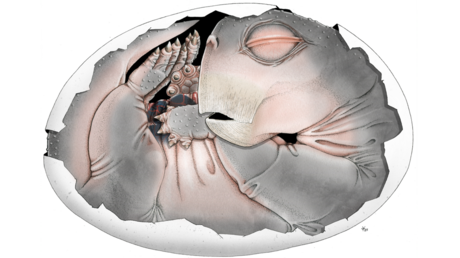
We're talking about creatures like Kayentatherium. This was a dog-sized cynodont that lived about 185 million years ago. Researchers found a fossil of a mother with 38 babies. That's a huge number. Modern mammals don't have litters that big. The only way you get 38 offspring at once is by laying a clutch of eggs. These babies had tiny heads and undeveloped skeletons, which is exactly what you see in animals that hatch from eggs rather than growing in a complex womb.
The shift didn't happen overnight. Evolution is messy. It's a series of "good enough" solutions that stick around until something better comes along. For the ancestors of mammals, the egg was a perfect vessel. It protected the embryo from drying out and allowed the mother to go find food instead of being weighed down by a heavy pregnancy.
Why the Platypus is a Living Time Machine
If you want to understand our history, you have to look at the monotremes. The platypus and the echidna are the only egg-laying mammals left. People used to call them "evolutionary oddities" or "less evolved." That's total nonsense. They're specialized survivors.
When scientists sequenced the platypus genome, they found something fascinating. They still have the genes for vitellogenin, a protein used to make egg yolk. Most of us lost those genes millions of years ago. By comparing the platypus DNA to humans and birds, researchers can pinpoint exactly when we started losing our "egg" genes and started gaining "milk" genes.
It turns out milk came before live birth. Our ancestors were likely "sweating" a nutrient-rich fluid to feed their hatched young long before they had nipples or a placenta. This transition period was long. We were egg-layers who nursed. Think about how strange that looks. A furry, warm-blooded creature sitting on a nest, then feeding the hatchlings with skin secretions.
The Viral Glitch That Changed Everything
You can't talk about the end of the egg-laying era without talking about the placenta. This is the organ that allows a mother to nourish a fetus directly. It's an invasive, aggressive piece of biological machinery. Honestly, it's a bit of a miracle it doesn't kill the mother.
We didn't "invent" the placenta through slow, incremental changes. We stole it. Millions of years ago, an endogenous retrovirus infected an early mammal. Usually, viruses are bad. But this one left behind a protein called syncytin. This protein allows cells to fuse together to form a barrier. In a virus, it helps the virus fuse with a host cell. In mammals, it became the foundation of the placenta.
Without that viral infection, we'd probably still be laying eggs. This is a huge point that most people miss. We often think of evolution as a ladder of progress. It's not. It's a series of accidents. We are only here because a virus happened to glitch our DNA in a way that made live birth possible.
Egg Laying vs Live Birth The Tradeoff
There's no such thing as a free lunch in biology. Giving up the egg was a massive risk. When you lay an egg, your investment is front-loaded. You make the egg, you hide it, and you hope for the best. If a predator finds the nest, you lose the whole batch, but the mother survives.
Live birth changed the stakes.
- Weight: Carrying a fetus makes the mother slow and vulnerable.
- Energy: The metabolic cost of a placenta is astronomical compared to an egg.
- Risk: If the mother dies, the offspring dies. Every time.
So why did we do it? Because it allows for bigger brains. An egg has a limited amount of space and nutrients. Once the yolk is gone, the baby has to hatch. A placenta provides a constant, high-energy fuel line. This allowed our ancestors to keep their young inside longer, developing more complex nervous systems before hitting the real world.
The Misconception of Primitive Traits
Stop using the word "primitive" to describe egg-laying. It's a loaded term that implies something is broken or outdated. If egg-laying was so bad, birds wouldn't be one of the most successful groups on the planet. Crocodilians have been laying eggs since before the dinosaurs and they're still here, virtually unchanged.
Our ancestors weren't "waiting" to become better. They were perfectly adapted to their environments. The cynodonts that survived the Permian extinction did so because their egg-laying habits were flexible. They could bury their eggs deep underground to survive heatwaves or volcanic winters.
How to Track This History Yourself
You don't need a PhD to see the remnants of this history. It's written in our own biology. If you're interested in the deep history of our lineage, start by looking at the anatomy of the inner ear. The bones we use to hear were originally part of the jaw in our egg-laying ancestors. As we moved away from the reptilian lifestyle, those bones migrated and shrank.
If you want to see the real deal, visit the Smithsonian or the American Museum of Natural History. Look for the "synapsid" section. Don't just look at the T-Rex. Look for the small, furry-looking skeletons with sprawling limbs. Those are your great-great-great-grandparents. Notice the pelvic structure. It's wide, designed to let eggs pass through.
Check out the latest papers in Nature or Science regarding monotreme genomics. The data is changing fast. We're finding that the transition to live birth happened multiple times in different ways across different lineages. It wasn't a single "event" but a messy, global experiment in survival.
Understand that your body is a patchwork of ancient decisions. You have the hair of a cynodont, the ear bones of a Triassic burrower, and the placenta of a viral accident. We are the survivors of a long line of egg-layers who got lucky.
Go look at a photo of a platypus puggle. It's a tiny, translucent creature that looks nothing like a modern mammal. That's the closest you'll ever get to seeing your own deep history in the flesh. Use that as a reminder that "normal" is just a matter of perspective in the timeline of the Earth.