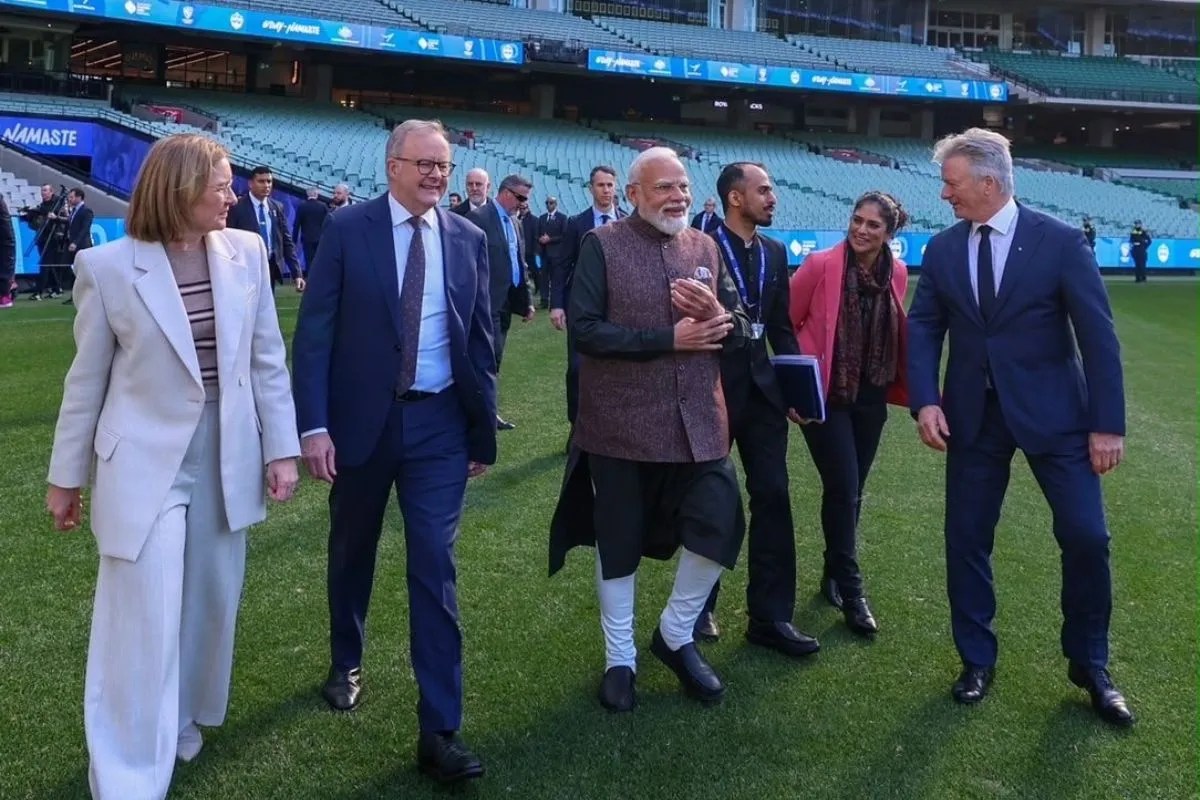
The globalization of franchise cricket has reached a structural inflection point where local market saturation forces domestic leagues to export live content to hyper-consuming foreign territories. The announcement by Indian Prime Minister Narendra Modi and Australian Prime Minister Anthony Albanese at the Melbourne Cricket Ground regarding the Big Bash League (BBL) 2026-27 season opener at Chennai’s MA Chidambaram Stadium is not merely a diplomatic gesture. It is a cold, calculated test of global sports asset migration.
By scheduling the Melbourne Renegades against the Perth Scorchers in Chennai on December 12, Cricket Australia (CA) and the Board of Control for Cricket in India (BCCI) are testing a specific hypothesis: can an overseas domestic cricket property generate sustainable economic yield when decoupled from its geographic roots? To understand the financial and logistical viability of this maneuver, the event must be deconstructed through three rigorous analytical pillars.
The Cross-Border Monetization Framework
The immediate commercial objective of playing a BBL regular-season game on Indian soil is the expansion of the league's media rights valuation and brand equity in the world’s most lucrative cricket market. While the Indian Premier League (IPL) commands absolute market dominance, its operational window is restricted to a specific quarter of the year. The BBL aims to capture a share of the latent demand during the northern hemisphere's winter months.
This strategic move operates on an asymmetrical revenue model:
- Broadcasting Optimization: The match is scheduled for 2:40 PM local time in Chennai, which translates to an 8:10 PM Australian Eastern Daylight Time (AEDT) prime-time slot. This synchronization eliminates the broadcast friction usually associated with overseas matches, ensuring maximal domestic ratings in Australia while capturing afternoon viewership in India.
- The "G’Day Namaste" Commercial Bridge: The fixture anchors a broader macroeconomic festival designed to promote Australian trade, tourism, and sports technology. The match acts as a high-visibility loss leader to facilitate business-to-business transactions across major Indian metros.
- Sponsorship Realignment: By physically entering India, the BBL provides its corporate partners direct experiential access to an audience of 38,000 stadium spectators and millions of digital streaming consumers, changing the asset value from regional to international.
The primary limitation of this monetization framework is the lack of direct consumer tribalism. The Melbourne Renegades are designated as the home team, yet local spectators have no systemic or historical loyalty to a Victorian franchise. CA is betting that high cricket literacy in Chennai—traditionally the stronghold of the Chennai Super Kings—will substitute for domestic tribalism.
Logistical Vulnerability and Operational Friction
Transitioning an active sports league across an ocean mid-season creates immediate operational bottlenecks. Unlike international bilateral tours that feature extended acclimatization phases, franchise leagues operate on compressed schedules requiring high player turnover and minimal travel latency.
An analysis of the travel mechanics reveals severe operational strains. There are zero non-stop commercial flights connecting major Australian capital cities directly to Chennai. The entire traveling contingent—players, coaching staff, broadcast technicians, and executives—must navigate hub-and-spoke transit models, typically routing through Southeast Asia or the Middle East. This structural reality introduces acute physiological risks regarding player fatigue and recovery cycles, particularly for a Perth Scorchers squad that must immediately return to Australia to resume their home-and-away campaign.
Climatic variables present a secondary, unhedgeable risk. The choice of December for a fixture in Chennai places the match directly within the late phase of the Northeast Monsoon, a period historically characterized by heavy rainfall and high washout probabilities. A weather-induced abandonment would not only eliminate match-day gate receipts but also severely diminish the return on investment for international broadcast partners who have purchased prime-time inventory.
The Macro-Diplomatic Trade-Off
Beneath the commercial mechanics lies a complex web of bilateral sports diplomacy defined by the India-Australia Sports Collaboration Roadmap. This framework links sports infrastructure development to geopolitical alignment. India is leveraging Australian operational expertise as it formalizes its bids for the 2030 Commonwealth Games and the 2036 Olympic Games, while Australia seeks deep market integration within the Indian technology and consumer sectors.
This creates a highly transactional relationship between the two sporting bodies:
- Infrastructure and Science Exchange: India gains access to Australian methodologies in sports science, high-performance coaching, and long-term athlete development models.
- Regulatory Clearances: The BCCI grants CA unprecedented access to its domestic market—a privilege rarely afforded to foreign sporting leagues—in exchange for reciprocal priority in future bilateral windows and multi-sport event hosting support.
- The Reciprocal IPL Hypothesis: This venture establishes the operational precedent for a future reciprocal arrangement where IPL franchises could stage exhibition or regular-season fixtures in major Australian venues like the MCG or SCG during the northern hemisphere's spring.
The fundamental risk of this diplomatic model is its vulnerability to shifting domestic political priorities. If the macroeconomic yields of the "G’Day Namaste" initiative fail to materialize, the justification for the significant capital expenditure required to host foreign domestic matches will collapse.
The ultimate success of the Chennai fixture will not be measured by stadium attendance or short-term social media metrics. It will be judged by whether the broadcast viewership delta in the Indian market can permanently elevate the BBL's baseline media rights value. If the audience acquisition cost proves too high due to logistical friction and weather disruptions, this historic opener will remain an isolated case study in sports diplomacy rather than the blueprint for a permanently globalized domestic league. The strategic play for Cricket Australia is to treat this match as a pure data-gathering exercise to isolate the exact acquisition cost of the Indian cricket consumer.