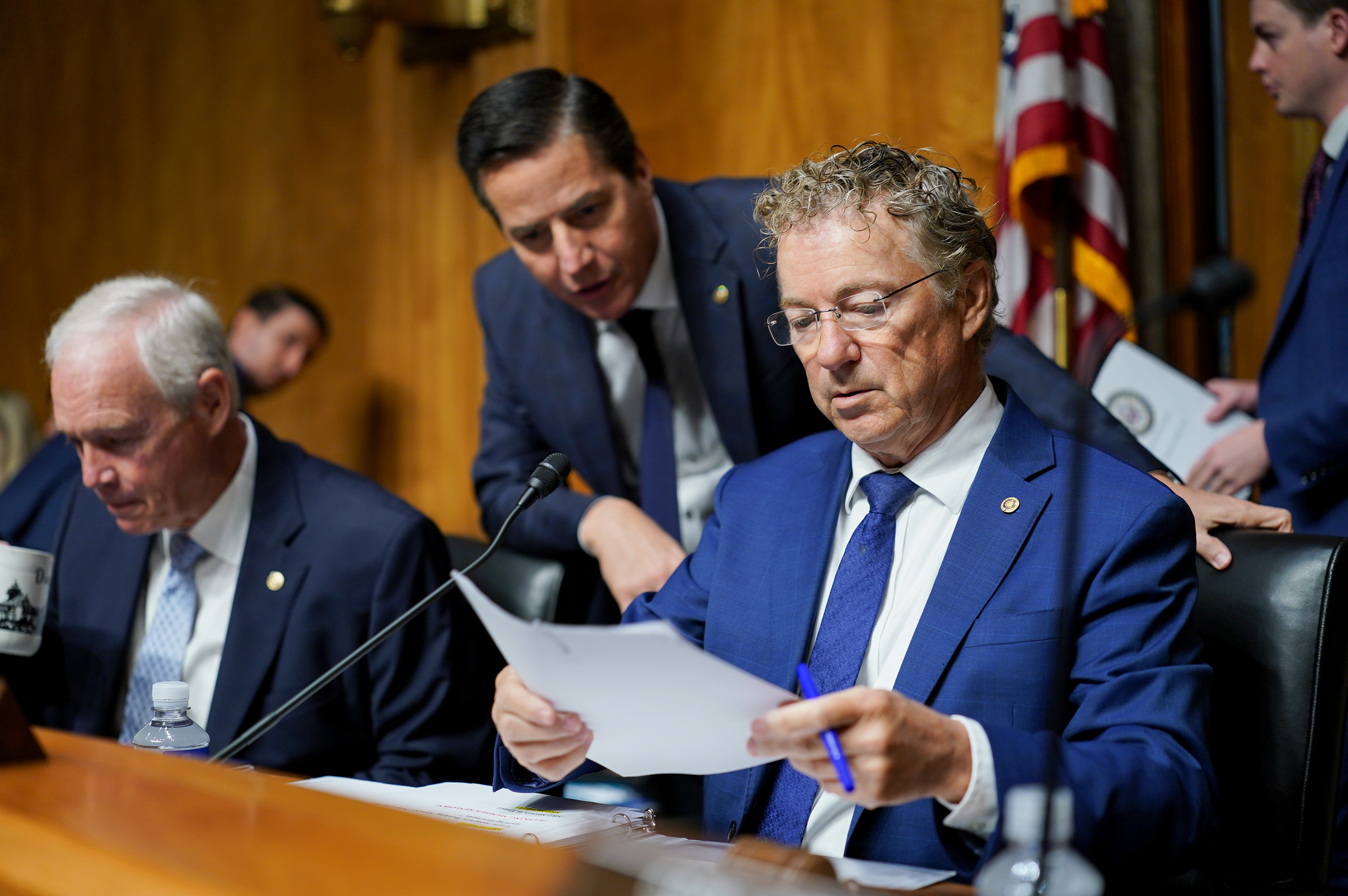
Legislative anomalies in high-consensus congressional votes reveal structural fissures within foreign policy frameworks. When the United States Senate advanced a sweeping Russia sanctions package by a margin of 86 to 12, the near-unanimous coalition exposed a single, analytical outlier on the right: Senator Rand Paul. Deconstructing this lone Republican opposition requires moving past partisan optics to analyze the underlying cost function of punitive trade measures, executive delegation, and the mechanics of secondary economic coercion.
The policy instrument in question, heavily associated with the legislative footprint of the late Senator Lindsey Graham, relies on a distinct coercion model. It targets third-party nations and trade partners that sustain the Kremlin's wartime economy by purchasing Russian energy assets, oil, petroleum derivatives, or strategic inputs like uranium. The enforcement mechanism centers on sweeping tariff authorities, including prospective secondary tariffs reaching up to 500 percent against non-compliant buyer states.
Evaluating the dissenting rationale necessitates examining the mechanics of tariff transmission. Tariffs function as a direct tax on domestic commercial actors and consumers. When Congress broadens executive latitude to impose sweeping secondary trade penalties, it shifts economic friction onto domestic supply chains. The institutional argument against the legislation rests on three core variables: inflationary feedback loops, the displacement of traditional trade alignment, and the expansion of unchecked executive authority over international commerce.
[Legislative Intent: Coerce Foreign Actors]
       │
       ▼
[Secondary Tariffs on Third Parties]
       │
       ▼
[Domestic Price Inflation & Supply Friction]
       │
       ▼
[Systemic Cost Borne by Domestic Consumers]
The friction points of this sanctions regime can be categorized through a structural lens.
The Delegation Hazard
The primary constitutional objection centers on the transfer of trade leverage to the executive branch. Modern legislative frameworks increasingly trade procedural oversight for rapid geopolitical signaling. By embedding broad, discretionary tariff powers into a punitive foreign policy package, the legislative branch hands over granular calibration tools. The structural risk involves the unpredictable deployment of these trade levers against traditional allies and emerging markets alike, creating regulatory uncertainty for global supply networks.
The Efficacy Deficit of Secondary Coercion
Economic isolation strategies assume that punitive thresholds alter target state behavior. However, large-scale commodity markets exhibit high elasticity and adaptation velocity. Secondary sanctions often accelerate the fragmentation of global financial architecture, encouraging targeted nations to route transactions through non-dollarized clearing houses or alternative bilateral arrangements. Rather than compressing wartime revenue through immediate deterrence, the policy creates structural incentives for long-term de-dollarization and alternative trade blocs.
The Domestic Incidence Cost
While congressional intent focuses on penalizing foreign aggression, the direct incidence of tariff penalties falls unevenly on domestic economic sectors. Imported industrial inputs, consumer goods, and energy derivatives absorb the initial shock. The economic cost function demonstrates that unilateral trade restrictions generate domestic deadweight loss long before altering the macroeconomic indicators of the target state.
The division among legislative dissenters—featuring a combination of right-leaning institutionalists wary of executive overreach and progressive lawmakers concerned about consumer impact—highlights an ideological convergence on trade skepticism. As legislative bodies navigate complex geopolitical conflicts, the friction between immediate signaling and long-term systemic stability remains the primary variable governing the success or failure of economic statecraft.