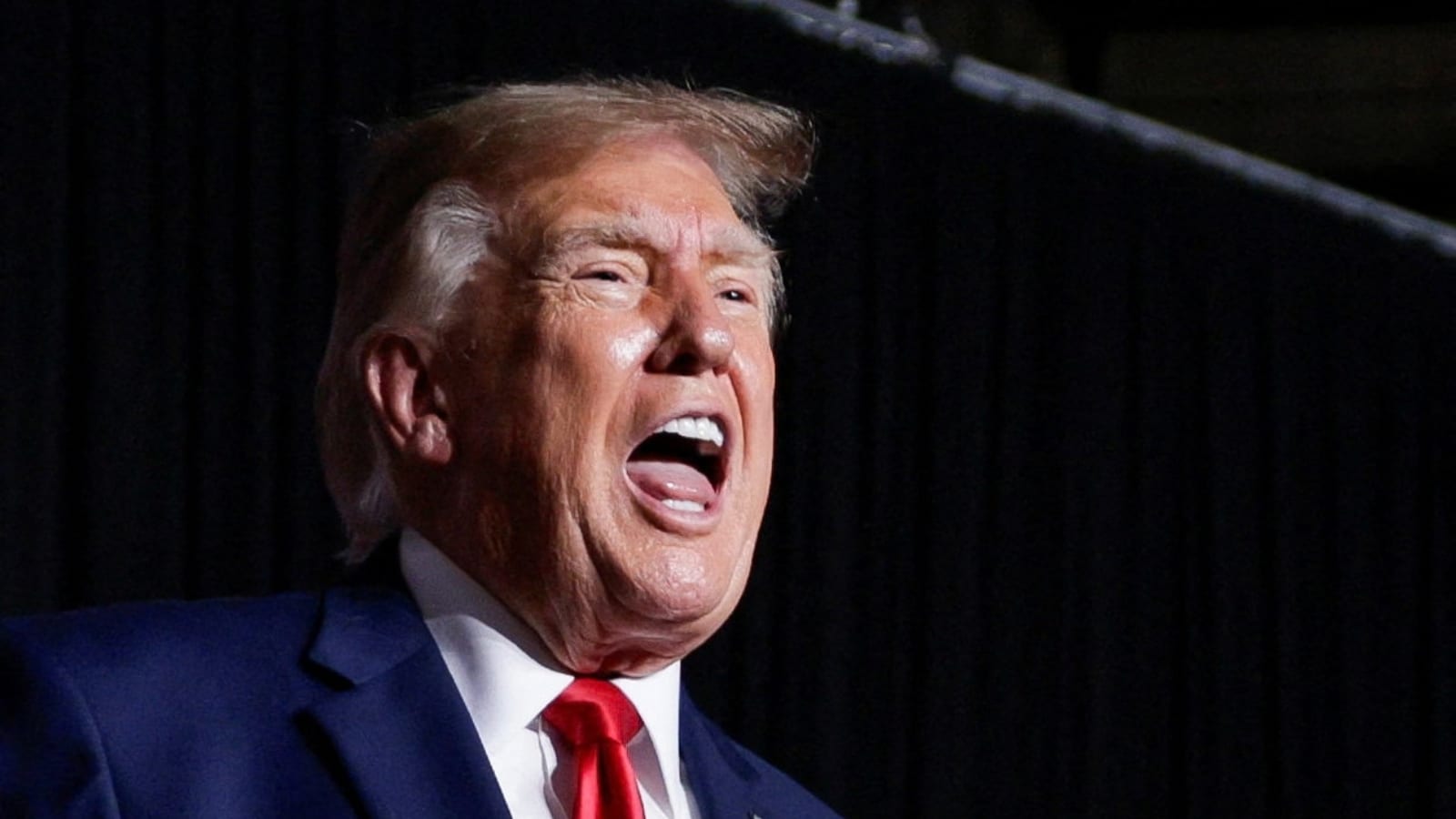
Ruling out a military strike against Iran prior to the United States midterm elections while labeling ongoing negotiations productive is not a shift toward pacifism; it is an explicit exercise in domestic political risk management and strategic time-buying. By publicly removing the kinetic option from the table for a defined window, the White House alters the immediate payoff matrix for both Washington and Tehran. This posture lowers near-term energy market volatility, insulates incumbent congressional candidates from the political liabilities of an open-ended Middle Eastern conflict, and shifts the burden of escalation onto the Iranian leadership during a critical negotiating phase.
To understand the mechanics of this declaration, observers must separate public diplomatic signaling from underlying strategic incentives. Standard geopolitical commentary often treats statements regarding military restraint as binary indicators of strength or weakness. In reality, coercive diplomacy relies on manipulating the adversary's perception of probability and timing. When an executive explicitly binds their own hands to a calendar—specifically the American electoral cycle—they trade short-term tactical ambiguity for immediate domestic stabilization and diplomatic bandwidth. Meanwhile, you can explore related developments here: Inside the French School Crisis Nobody is Talking About.
The Domestic Political Cost Function
Executive decision-making regarding foreign military intervention is heavily constrained by domestic electoral calendars. In the months leading up to a midterm election, the administration's primary utility function shifts from maximizing long-term geopolitical advantage to minimizing acute economic and political shocks that depress voter turnout or alienate swing demographics.
An offensive military campaign against Iranian nuclear infrastructure or regional proxies carries three immediate, quantifiable domestic risks for an incumbent party: To see the bigger picture, we recommend the detailed article by NPR.
- Energy Price Contagion: Even a limited strike risks retaliatory disruption in the Strait of Hormuz, through which roughly one-fifth of global petroleum liquids consumption passes. A sudden spike in crude oil prices translates within weeks into higher retail gasoline prices in the United States. In midterm elections, retail fuel costs act as a direct, daily tax on voters, disproportionately punishing the party holding the White House regardless of the strategic justification for the strike.
- Casualty Sensitivity and Mission Creep: Kinetic operations against an adversary with layered air defenses, ballistic missile arsenals, and regional proxy networks rarely remain contained to a single surgical exchange. The high probability of American military casualties or prolonged retaliatory cycles introduces an unpredictable variable into the final stretch of a congressional campaign, shifting media coverage away from domestic economic messaging.
- Coalition Fragmentation: A preemptive strike fractures the domestic political coalition. Non-interventionist factions within the administration's own base view new Middle Eastern entanglements as a betrayal of core campaign pledges, while traditional hawks may criticize any operation that stops short of regime change. Deferring the military option preserves internal party cohesion through November.
By explicitly ruling out an attack before the midterms, the administration effectively places a temporary ceiling on geopolitical risk premiums. Financial markets and domestic voters receive a clear signal that the executive branch will prioritize macroeconomic stability and conflict containment over immediate military enforcement until the electoral cycle concludes.
Mechanics of Strategic Time-Buying
Labeling talks with Tehran as productive serves a distinct functional purpose alongside the non-aggression pledge: it establishes a diplomatic holding pattern. In international negotiations involving nuclear thresholds and regional security, declarations of progress rarely signify an imminent comprehensive treaty. Instead, they indicate that both parties have found mutual utility in prolonging the negotiating process itself.
For Washington, the holding pattern achieves containment without expenditure. As long as Iranian negotiators remain engaged at the table, Tehran faces strong disincentives against taking irreversible steps toward weaponization, such as enriching uranium to weapons-grade levels or expelling international inspectors entirely. Crossing those red lines while publicly engaged in productive talks would shatter the diplomatic cover Tehran relies upon to prevent unified Western sanctions or multilateral military action. Thus, the process acts as a temporary brake on nuclear breakout timelines without requiring the United States to deploy additional carrier strike groups or expend munitions.
For Tehran, engaging in protracted dialogue with an administration that has publicly foresworn pre-election military strikes provides vital economic and operational breathing room. Iranian leadership operates under severe domestic economic strain, driven by structural inflation, currency devaluation, and persistent sanctions enforcement. The perception of productive diplomacy eases immediate pressure on the Iranian rial, dampens domestic panic, and creates space for Tehran to consolidate its regional posture or recalibrate its deterrence architecture without facing imminent bombardment.
The Credibility Paradox in Coercive Bargaining
In classical deterrence theory, as formulated by Thomas Schelling, the effectiveness of a threat depends on its credibility and the preservation of strategic ambiguity. By publicly announcing a moratorium on military strikes tied to the midterm elections, the White House intentionally sacrifices a degree of short-term coercive leverage. When an adversary knows the exact date before which a kinetic penalty will not be imposed, their urgency to make fundamental concessions diminishes.
This creates a specific operational vulnerability known as the deadline moral hazard. Knowing that Washington is politically self-deterred until November, Iranian negotiators can adopt a strategy of calibrated incrementalism:
- Offering reversible, low-cost concessions: Tehran can agree to minor transparency measures, prisoner exchanges, or temporary freezes on specific enrichment cascades to keep the talks labeled as productive.
- Withholding structural compromises: Core issues—such as the permanent dismantling of advanced centrifuges, restrictions on ballistic missile range, or the cessation of material support to regional militias—can be deferred indefinitely through technical working groups and procedural disputes.
- Exploiting the post-election transition: Tehran recognizes that once the midterm elections pass, the political calculus in Washington shifts again, potentially opening a window where the administration feels empowered to act—or conversely, where a newly divided Congress further restricts executive war powers.
To counteract this loss of immediate military leverage, Washington must rely on non-kinetic pressure mechanisms during the pre-election window. These include strict enforcement of existing secondary sanctions on illicit oil shipments, covert cyber operations, and diplomatic coordination with European and regional partners to maintain economic isolation. The underlying theory is that economic attrition can continue to degrade Tehran's negotiating position even while aircraft carriers remain in a defensive posture.
Asymmetrical Escalation Risks
While a bilateral understanding to avoid direct state-on-state military strikes stabilizes the primary front, it does not eliminate the risk of horizontal escalation through proxy networks. The Middle Eastern security architecture operates as a multi-tiered system where direct deterrence between Washington and Tehran frequently displaces conflict onto secondary theaters.
Iran's regional deterrence strategy relies heavily on decentralized non-state actors across Iraq, Syria, Lebanon, and Yemen. These groups possess varying degrees of operational autonomy and local political incentives. Even if Tehran's senior leadership prefers to maintain calm to preserve productive talks with Washington, an uncoordinated attack by a proxy faction that results in American fatalities would immediately collapse the administration's pre-election restraint.
In such a scenario, the domestic political cost function reverses instantly. Ahead of an election, failing to respond forcefully to fatal attacks on American personnel carries a higher political penalty than initiating a strike. Therefore, the durability of the pre-midterm moratorium rests entirely on Tehran's ability to exercise strict command and control over its regional affiliates, effectively enforcing a de facto ceasefire across multiple borders simultaneously.
Structural Limitations of the Pre-Election Posture
Relying on an extended diplomatic track to bridge an electoral cycle carries inherent structural limitations that analysts must account for when forecasting regional stability:
- Verification Deficits: Declarations of productive talks do not equate to verified reductions in nuclear latency. If Iran continues to accumulate technical knowledge, operate advanced centrifuges, or stockpile enriched material while diplomats meet, the actual breakout timeline shrinks even as the diplomatic atmosphere improves.
- Allied Anxiety and Unilateralism: Regional allies, particularly Israel and Gulf Arab states, do not operate on the American midterm calendar. If regional actors perceive that Washington is trading long-term security guarantees for short-term domestic political convenience, they face heightened incentives to conduct unilateral covert operations, sabotage, or preemptive strikes. Any unilateral action by a regional partner risks dragging the United States into an unplanned escalation cycle, rendering the White House's timeline irrelevant.
- Post-Election Cliff Effects: Tying restraint to an election date creates an artificial cliff. Once the votes are cast, the administration faces an immediate credibility test. If Tehran has pocketed months of diplomatic breathing room without delivering a verifiable agreement, Washington must either execute the delayed military option under potentially worse strategic conditions or extend the diplomatic timeline again, signaling permanent self-deterrence.
Navigating the Post-Midterm Inflection Point
Decision-makers, institutional investors, and regional security planners must treat the current diplomatic window not as a permanent resolution, but as a temporary suppression of volatility driven by the American political calendar. The absence of kinetic strikes prior to the midterms is a tactical pause, not a strategic settlement.
Monitoring the true trajectory of this standoff requires ignoring public characterizations of the talks as productive and tracking three concrete operational indicators instead:
- International Atomic Energy Agency (IAEA) Access Metrics: Watch for concrete restoration of monitoring equipment and inspector access at undeclared or hardened facilities, rather than diplomatic statements of intent.
- Maritime and Proxy Incident Frequency: Track the rate of attacks on commercial shipping and regional bases; any uptick indicates that Tehran's command-and-control over its proxies is fraying, which will force Washington's hand regardless of the election calendar.
- Sanctions Enforcement Velocity: Observe whether the United States Treasury continues to designate front companies facilitating Iranian crude exports to Asia; a slowdown in designations signals an unwritten, informal freeze on economic warfare to keep Tehran at the table through November.
Until those operational metrics shift toward verifiable containment, institutions with exposure to Middle Eastern energy corridors or regional defense postures should hedge against a sharp resurgence of kinetic risk immediately following the conclusion of the United States midterm elections.


