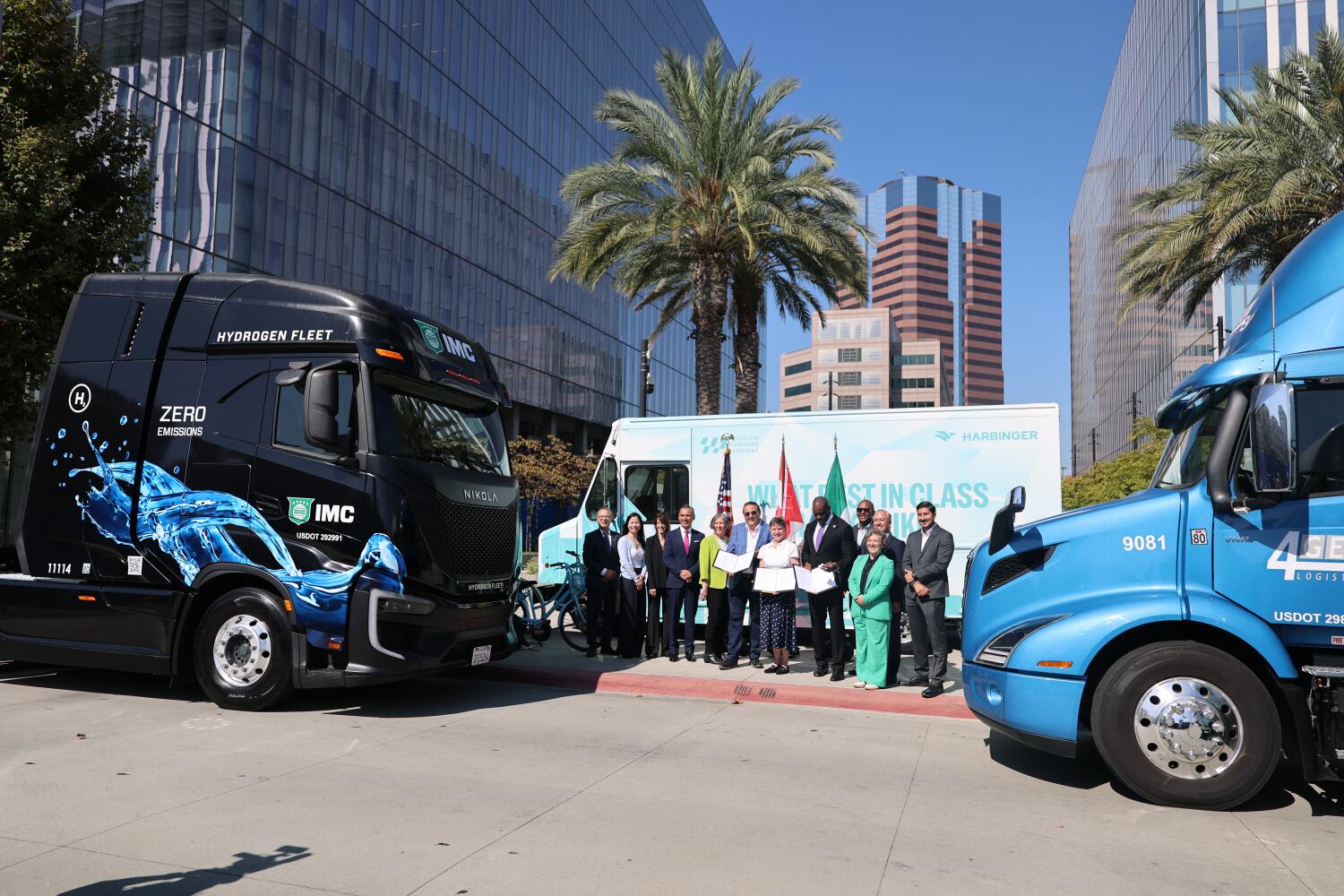
The grand vision of an uninterrupted zero-emission freight network spanning from the tip of Baja California to Vancouver, British Columbia, sounds like a triumph of cross-border diplomacy. Government officials recently gathered at the Port of Long Beach to formally announce the British Columbia to Baja California Zero-Emission Vehicle Corridor, known as BC2BC. On paper, this multi-jurisdictional pact promises to align technical standards, pool resources, and support the roughly 10,000 heavy-duty trucks moving along Interstate 5 and connecting routes on any given day. Yet a stark chasm separates political ambition from electrical engineering.
Fleets navigating this international trade artery do not suffer from a lack of political enthusiasm. They suffer from a profound lack of megawatt-scale power availability. Also making headlines lately: The Heavy Chair Waiting in the Smoke.
Announcing an initiative that intends to build an initial network of twenty electric truck charging stations and three hydrogen fueling sites is an important milestone for public relations. It papers over the reality that drawing enough electricity to fast-charge lines of heavy-duty semi-trucks requires localized power capacity equivalent to a small town. Transport ministers can sign memoranda of understanding across international boundaries, but electrons cannot be negotiated into existence.
The Megawatt Math Nobody Wants to Compute
A standard Class 8 battery-electric truck requires charging infrastructure capable of delivering between 350 kilowatts and over one megawatt per plug to achieve turnaround times that make economic sense for freight operators. Multiply that demand across a multi-bay depot designed to handle a steady stream of interstate haulers, and the local substation requirements skyrocket into the tens of megawatts. Further insights on this are covered by CNBC.
Most public utilities along the West Coast are already struggling to maintain grid reliability under normal residential and commercial loads, let alone during peak summer air-conditioning spikes or wildfire season curtailments. Upgrading a single transmission corridor to handle industrial-scale charging demands involves multi-year permitting battles, transformer manufacturing backlogs that stretch for years, and billions of dollars in capital expenditure.
Consider a hypothetical logistics depot outside of Seattle or Sacramento attempting to pull five megawatts of continuous power. That facility requires dedicated feeder lines, heavy-duty switchgear, and localized battery buffering systems just to avoid tripping local grid protections. When politicians promise seamless cross-border transit from Canada to Mexico, they rarely mention that utility interconnection queues alone often take up to seven years.
Regulatory Whiplash Versus Interstate Realities
The regulatory environment governing this transnational route is fractured at best. California enforces aggressive mandates like the Advanced Clean Fleets rule, forcing a gradual ban on internal combustion engines within state lines. Oregon and Washington have mirrored parts of these stringent policies, creating a regional bubble of compliance along the upper West Coast.
Moving south into Baja California or north into British Columbia introduces entirely different regulatory regimes, taxation structures, and fuel standards. While the BC2BC initiative explicitly aims to harmonize these technical frameworks, achieving regulatory alignment between federal, state, provincial, and municipal entities across three distinct nations is notoriously difficult.
Fleet owners operate on razor-thin operating margins where asset utilization is everything. If a battery-electric truck is parked waiting for a functioning charger, or if a driver crosses a jurisdictional line only to find incompatible billing networks and communication protocols, the entire economic model collapses. Capital investment follows certainty, and right now, the regulatory patchwork provides anything but certainty.
The Hydrogen Paradox
Amid the heavy focus on battery-electric semis, the inclusion of three initial hydrogen fueling stations highlights an ongoing technological hedge. Fuel cell trucks offer faster refueling times and greater payload capacity compared to heavy battery packs, making them theoretically ideal for long-haul routes spanning thousands of miles from Baja to British Columbia.
The fatal flaw remains the fuel supply chain itself. Green hydrogen requires massive amounts of renewable electricity to split water via electrolysis, meaning it suffers from the exact same grid constraints as direct battery charging, compounded by an inefficient conversion cycle. Building a reliable hydrogen distribution network along a thousand-mile corridor requires cryogenic transport and specialized storage infrastructure that barely exists outside of pilot projects.
Private fleet operators have burned their fingers on premature alternative fuel transitions before. Without a dense, operational network of high-pressure hydrogen pumps backed by redundant supply lines, commercial operators will refuse to commit millions of dollars to fuel-cell semi-truck fleets.
The Real Timeline for Freight Decarbonization
The public launch events featuring gleaming zero-emission prototypes from major manufacturers obscure a gritty operational truth. While regional drayage operations running short loops around ports like Los Angeles and Long Beach can successfully return to central yards for overnight charging, long-haul interstate freight is an entirely different beast.
Drivers are bound by strict federal hours-of-service regulations. Every minute spent searching for an available, operational high-power charger or waiting in a queue behind other commercial trucks directly cuts into a driver's legal working hours and corporate profitability. Until the physical reality of the electrical grid catches up with executive announcements, the dream of an emissions-free corridor from the Canadian border to Mexico remains a paper tiger.
The concrete work happening behind the scenes by state agencies, utilities, and research institutions is necessary, but it operates at a glacial pace compared to political election cycles. Until heavy-duty charging plazas boast the same ubiquitous reliability and speed as diesel islands, freight carriers will keep their diesel engines running.