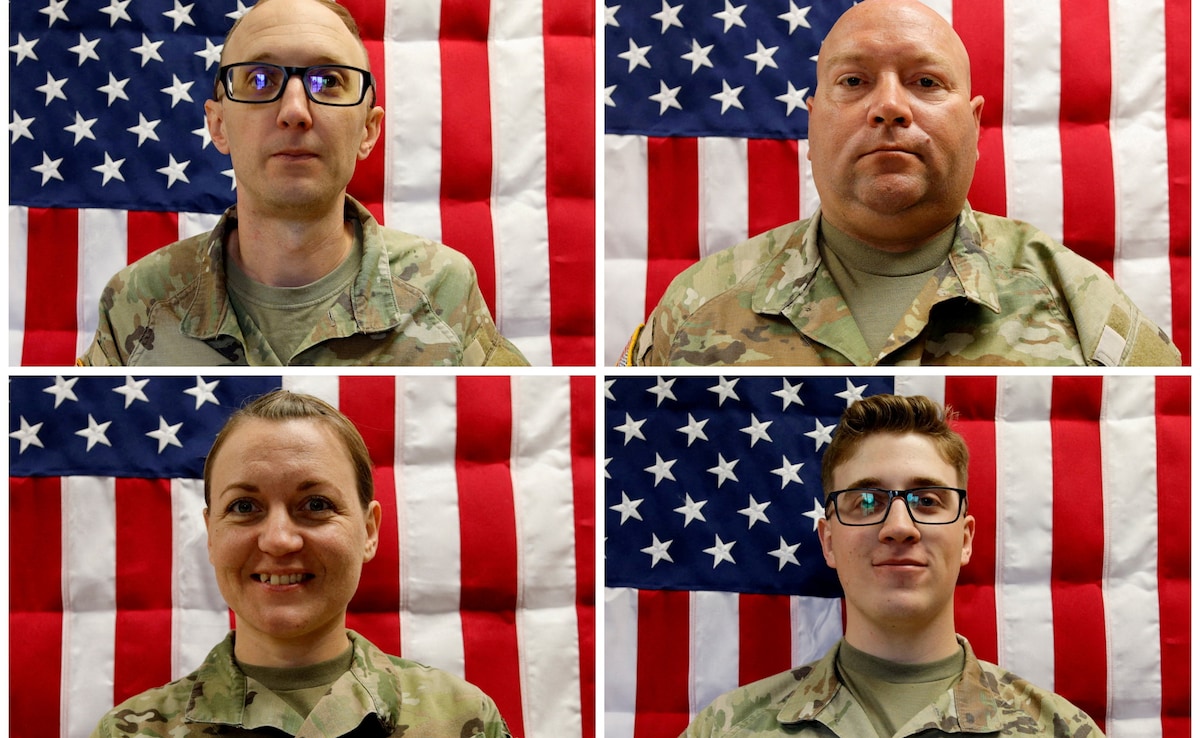
The wind in the Jordanian desert doesn’t just blow; it scours. It carries a fine, invasive grit that finds its way into the seals of high-tech equipment and the seams of a soldier's soul. At a remote outpost known as Tower 22, located near the jagged intersection of the Jordanian, Syrian, and Iraqi borders, the silence of the night is usually heavy. It is the kind of quiet that feels earned by the boredom of a long deployment.
Then came the drone. Discover more on a similar issue: this related article.
It didn’t arrive with the cinematic roar of a jet or the whistling descent of a mortar. It was a low-budget shadow, a piece of repurposed tech that slipped through the cracks of a sophisticated defense net because it looked too much like one of our own. When it struck the living quarters in the early hours of a Sunday, it didn't just break the silence. It shattered four lives that represented the very best of a country that often forgets the names of those standing guard in the dark.
We talk about "strikes" and "regional escalations" as if they are chess moves on a plexiglass board. We use cold, antiseptic language to describe the geopolitical friction between Washington and Tehran. But geopolitical friction doesn’t bleed. People do. Additional journalism by NBC News explores similar perspectives on this issue.
The Weight of a Name
Sgt. William Jerome Rivers was 46 years old. In the world of the Army Reserve, that makes you a statesman. A veteran of the Iraq War, Rivers wasn't some wide-eyed kid looking for adventure. He was a man from Carrollton, Georgia, who understood the grind. He knew the smell of diesel and the specific, metallic taste of water from a plastic bladder.
Rivers represented the backbone of the American military—the "citizen-soldier." These are the individuals who leave behind steady jobs and Sunday dinners to sit in a shipping container in the middle of a wasteland because someone signed a piece of paper. When the drone hit, it didn't just take a Sergeant; it took a father and a husband who had already given the best years of his life to a uniform.
Then there was Specialist Kennedy Ladon Sanders. She was 24. Back home in Waycross, Georgia, she was a daughter of the community. Her parents, both deeply involved in local leadership, spoke of a woman who didn't just serve because she had to, but because she possessed a restless sense of purpose. She volunteered for this deployment. She wanted to be there.
There is a specific kind of cruelty in the death of a 24-year-old in a conflict that isn't even technically a war. It is a theft of decades. It is the loss of the weddings she would have attended, the career she would have built, and the quiet mornings she deserved to have back in Georgia, far away from the threat of Iranian-backed militias.
The Invisible Geography of Risk
To understand why these four were there, you have to look at the map—not the one in a textbook, but the one written in blood and influence. Tower 22 sits as a logistical shadow to the Al-Tanf garrison in Syria. It is a tripwire. It exists to prevent the "land bridge" that would allow Tehran to move weapons and influence unimpeded to the Mediterranean.
It is a high-stakes game played with human lives as the currency.
Specialist Breonna Alexsondria Moffett was only 23. She had just celebrated a birthday. Think about that for a second. The transition from 22 to 23 is usually marked by the beginning of "real life." It’s the age of first apartments and navigating the complexities of adulthood. For Moffett, it was marked by a drone strike in a desert where the sun feels like a physical weight.
She was a horizontal construction engineer. That’s the Army’s way of saying she built things. She created the infrastructure that kept others safe. There is a profound, aching irony in someone whose job is to build being taken by a weapon designed solely to destroy.
The fourth name, Sgt. 1st Class Robinson A. Sablan, brings a different kind of gravity to the list. A veteran with nearly two decades of service, Sablan was the kind of leader who younger soldiers looked to when the sandstorms got too thick or the news from home got too heavy. He was the institutional memory of his unit.
When you lose a senior NCO like Sablan, you don't just lose a soldier. You lose the glue. You lose the person who knows exactly how to fix a generator in the dark and exactly what to say to a homesick private.
The Cost of the Perimeter
We often view these events through the lens of "retaliation." The news cycles focus on how many Tomahawk missiles we fire back or which warehouse in Baghdad we turn to rubble. This focus is a distraction. It's a way to avoid looking at the empty chairs at the kitchen tables in Georgia.
The reality of serving at a place like Tower 22 is a cocktail of monotony and sudden, jarring terror. You spend weeks doing maintenance, checking IDs, and staring at a horizon that never changes. You start to feel invisible. You start to believe that because the world isn't talking about your outpost, the enemy isn't looking at it either.
But they are always looking.
The drone that killed Rivers, Sanders, Moffett, and Sablan was a calculated gamble. The groups launching these attacks—proxies funded and directed by a regime miles away—aren't looking for a conventional victory. They are looking for the breaking point of American resolve. They are betting that if they kill enough kids from Georgia, the public will demand a retreat.
Consider the psychological toll on the survivors. Over 40 other soldiers were injured in that same attack. Some wounds are visible—shrapnel, burns, broken bones. Others are the kind that manifest six months later when a car backfires or a door slams too hard. They are the invisible casualties of a shadow war.
Beyond the Briefing Room
In Washington, the deaths of these four soldiers sparked a flurry of activity. Briefings were held. Press secretaries used words like "unacceptable" and "proportional response." These words are shields. They protect the speakers from the raw, jagged reality of what happened in that dormitory.
They don't mention that Kennedy Sanders’ father had to find out his daughter was gone from men in Class A uniforms standing on his porch. They don't mention the specific silence that falls over a neighborhood when a hero comes home in a flag-draped casket.
We have become accustomed to the "small" casualties of our era. Because it wasn't a thousand people on a battlefield, we treat it as a tragic cost of doing business in the Middle East. This mindset is a failure of empathy.
Each of these four individuals was a universe. They had favorite songs, unfinished arguments, and plans for the upcoming summer. Rivers probably had a list of things he wanted to fix around the house. Moffett likely had a playlist she listened to while she worked. Sablan had years of wisdom he was supposed to pass down to his children.
The Echo in the Desert
The conflict with Iran is often described as a "Cold War" of the 21st century. It is a series of jabs and parries, a dance of drones and sanctions. But for the families of the fallen, there is nothing cold about it. It is white-hot grief.
We owe it to them to look past the headlines. We owe it to them to understand that Tower 22 isn't just a coordinate on a military map. It is a place where four Americans stood their ground so that the rest of us didn't have to think about what happens in the gaps between borders.
The drone didn't just hit a building. It hit a community. It hit the belief that we can put soldiers in harm's way without consequence.
As the sun rises over the Jordanian desert today, the wind still scours the landscape. The grit still finds its way into everything. But there is a hole in the line. There is a silence at Tower 22 that wasn't there before—a silence shaped like four soldiers who were simply doing their jobs when the world decided to remind them how dangerous a "quiet" deployment can be.
The tragedy isn't just that they died. The tragedy is that we might let their names become nothing more than a footnote in a policy debate about a war we refuse to call by its name.
Rivers. Sanders. Moffett. Sablan.
Say the names. Remember the chairs they left behind. Understand that every "regional escalation" has a zip code, a family, and a face that will never again see the Georgia sun.
Would you like me to research the specific history of the units these soldiers belonged to, or perhaps look into the current status of the injured survivors from the Tower 22 attack?