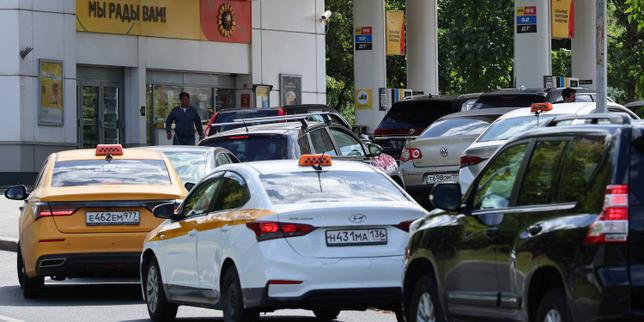
The morning air in the provincial Russian town of Voronezh carries the sharp, unmistakable tang of stale gasoline and sudden panic. Alexei stands by his gray Lada, staring down at a digital pump display that reads zero. There is no fuel. Not expensive fuel. Not rationed fuel. Just nothing. The rubber hose hangs limp against the yellowed metal of the dispenser, a quiet monument to a logistics chain that has quietly, steadily, snapped.
Distance creates comfort. To look at a map of Eastern Europe from thousands of miles away is to see lines, arrows, and casualty counts. It is an abstract exercise in geometry and geopolitics. But on the ground, war is measured in millimeters of fuel gauge needles sinking toward the red mark. It is measured in the cold bite of autumn wind against the face of a driver who has waited four hours outside a shuttered depot, only to be told that the pumps are dry until Tuesday. Don't forget to check out our recent coverage on this related article.
Ukraine's long-range drones have done what years of diplomatic hand-wringing and economic sanctions promised but struggled to deliver. They have brought the conflict home to the asphalt.
Refineries are not invincible monuments of steel. They are delicate, breathing complexes of fractionating columns, high-pressure pipes, and volatile hydrocarbons. When a precision-guided drone carrying a few kilograms of explosives strikes a primary processing unit deep within Russian territory, the fire is only the beginning. The real damage is invisible. It lives in the weeks of specialized repair work, the scarcity of Western replacement parts due to sanctions, and the cascading failure of distribution networks that supply everything from tractor-trailers to commuter sedans. To read more about the context of this, The Washington Post offers an excellent summary.
Consider what happens when the blood of an industrial economy stops pumping.
In several Russian regions stretching from the fertile agricultural belts to the industrial hubs closer to the front, local authorities have quietly instituted fuel rationing. Regular citizens are restricted to twenty or thirty liters per visit. Emergency services take precedence. Collective farms, staring down the barrel of the crucial autumn harvest, watch their diesel reserves dwindle with a sinking dread. A combine harvester does not run on willpower. It runs on thousands of liters of refined distillate. Without it, millions of tons of wheat rot in the mud.
This is the hidden cost of modern attrition.
Alexei is not a politician. He is a logistics clerk who needs to visit his aging mother in a village forty kilometers away. He is the hypothetical everyman who populates the quiet margins of history books—the person who simply wants to go to work, buy groceries, and live a life unmoored from grand ideological crusades. Yet, history has reached into his pocket, drained his wallet, and left him stranded in a concrete queue that stretches down the block.
The strikes represent a fundamental shift in the architecture of this war. For a long time, the narrative was defined by trenches, artillery duels, and frozen mud in the Donbas. The rear was a sanctuary. Families in central and southern Russian provinces watched the news on television, feeling the sting of inflation perhaps, but largely insulated from the physical reality of destruction. That insulation has burned away.
When the Ryazan refinery blazed into the night sky weeks ago, it illuminated more than just the horizon. It cast a harsh, unforgiving light on the vulnerability of centralized energy infrastructure. Russia is a petrostate, a colossal engine of oil and gas that feeds the global market and fuels its own war machine. Yet, a nation can float on a sea of crude oil and still starve for lack of gasoline if its refining capacity is systematically chipped away.
Refining is a bottleneck. You cannot simply pour crude oil into a tank and drive away. It must be cracked, treated, and distilled into high-octane gasoline and ultra-low-sulfur diesel. When specialized processing units are knocked offline, the output drops instantly. Fixing them requires microchips, specialized catalysts, and engineering expertise that domestic alternatives cannot easily replace on short notice.
The queues grew slowly at first. A rumor on a local Telegram channel. A handwritten sign taped to a glass door: No AI-95 today. Then came the official statements from regional governors, carefully worded to avoid panic while confirming the inevitable restrictions. They spoke of temporary logistical adjustments, maintenance schedules, and high seasonal demand. But the drivers idling their engines in the autumn chill knew better. They watched the price boards flicker and the supply dry up.
Panic is a self-fulfilling prophecy. Once drivers suspect the fuel might run out, they fill jerrycans, top off half-full tanks, and hoard whatever they can scavenge. This sudden surge in local demand shatters the already strained distribution network, emptying underground storage tanks in hours instead of days.
The psychological toll on the home front is subtle, corrosive, and persistent. It transforms routine life into a scavenger hunt. Every errand requires a mental calculation. Do I have enough fuel to get to the grocery store and back? Can I afford to idle the engine to keep warm while waiting for my daughter to finish school? These small, grinding anxieties accumulate, eroding the invisible social contract that sustains wartime populations. As long as the lights stay on and the gas flows, the war remains a distant television broadcast. When the pump runs dry, the war sits in the passenger seat.
Strategic bombing campaigns have always aimed at the heart of an adversary's industrial capacity. From the Ruhr Valley in the Second World War to the oil fields of the Middle East, the logic remains brutally consistent. Cut the fuel, and the army stalls. Cut the fuel, and the economy grinds to a halt. The twist in this modern iteration is the asymmetric nature of the weapon. Inexpensive, commercially available drone technology, guided by satellite navigation, can inflict hundreds of millions of dollars in damage on facilities guarded by expensive air defense systems that were designed to intercept ballistic missiles, not low-flying lawn-mower drones.
The implications ripple outward. Higher fuel prices bleed into the cost of food, transportation, and consumer goods. Agricultural producers, already squeezed by labor shortages and export restrictions, face crippling operational costs just to get their crops to market. The economic friction builds day by day, creating a domestic drag that no amount of state spin can entirely mask.
Back in Voronezh, the attendant finally flips the switch on the master panel. A faint hum vibrates through the concrete. Alexei steps forward, grips the cold rubber nozzle, and listens to the mechanical clicks of the meter as the numbers climb, each liter a reminder of how fragile the modern world really is, and how quickly the distance between the front lines and the driveway can vanish.