The paint in the smallest bedroom of our house is a shade called morning mist. It is a soft, pale gray that changes with the light, turning almost blue when the sun hits it just right. We picked it because it felt peaceful. We picked it because we thought it would be the backdrop to a lifetime of scraped knees, bedtime stories, and messy art projects.
Today, the room remains exactly as it was four years ago. The crib is assembled. The mattress is still wrapped in its protective plastic, a crinkly sound that punctures the silence whenever the wind hits the windowpane. A stuffed bear sits in the center of the crib, staring out into the empty space.
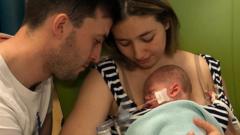
Our son, Leo, lived for exactly thirty-six hours.
For forty-eight months, my husband and I have existed in a strange, parallel dimension. Outside our front door, the world moves with a frantic, predictable rhythm. People complain about traffic. They fret over their credit scores. They celebrate promotions. Inside our house, time stopped when Leo’s heart did. But the hardest part of this grief is not just the absence of our son. It is the absolute, terrifying void where an explanation should be.
We still do not know why he died.
The Weight of an Unanswered Question
In the modern world, we are conditioned to expect answers. If your car breaks down, a mechanic plugs a diagnostic tool into the dashboard and hands you a code. If your computer crashes, an error log explains the failure. When a human being dies, especially in a state-of-the-art hospital surrounded by monitors and specialists, you expect a definitive conclusion. You expect a medical term. A genetic anomaly. A hidden defect. Something you can point to and say, There. That is the villain.
Instead, the medical community handed us a stack of papers filled with negatives.
Tests were run. Autopsies were performed. Tissue samples were sent to specialized labs across the country. Every single report came back with the same agonizing word: unremarkable. Leo’s organs were perfectly formed. His placenta was healthy. There were no signs of infection, no genetic mutations, no trauma. By all measurable accounts, our baby was perfect.
Except he was gone.
Medical science calls this Unexplained Infant Death, a subset of Sudden Infant Death Syndrome (SIDS) or Sudden Unexpected Infant Death (SUID) that occurs even after a thorough post-mortem investigation. According to data from public health agencies, thousands of families face this exact scenario every year. Healthy babies simply stop breathing, leaving behind a wake of devastation and a medical community that can only shrug its shoulders.
To live without an answer is to live in a state of perpetual self-recrimination. Without a medical explanation, the mind fills the vacuum with guilt.
I spent the first two years retracing every single day of my pregnancy. Did I drink too much coffee in the first trimester? Did I sleep on my back instead of my left side during those final weeks? Was it the stress of my job? My husband blamed himself for not checking the crib more frequently during those brief hours we had Leo at home, even though the monitors showed his heart rate was stable until the exact moment it wasn't.
We became detectives in our own tragedy, searching for clues in a crime scene where no crime had been committed.
The Illusion of Certainty
Consider a hypothetical couple, Sarah and David. They are sitting in a pristine, fluorescent-lit office, waiting for the results of their baby's autopsy. In their minds, they believe there are only two outcomes: either the doctors will find a reason, or the doctors failed to look hard enough. They do not yet understand that medicine, for all its staggering advancements, is still a map with vast, uncharted oceans.
We often mistake medical technology for omniscience. We see MRIs and gene sequencing and assume that the human body is a fully decoded machine. But the reality is far more humbling.
Think of the human body as a complex symphony. Thousands of instruments—genes, proteins, chemical signals, physical structures—must play in perfect synchronization. If a violin breaks, the conductor notices. If the sheet music is missing, the mistake is obvious. But sometimes, the symphony just stops. The instruments are intact. The sheet music is correct. Yet, the music ceases, and we are left standing in the quiet, unable to find a single broken string.
This is the frontier where pediatric pathology currently sits. Doctors explain that some infant deaths likely result from a combination of subtle metabolic vulnerabilities, minor environmental stressors, and critical developmental periods that standard autopsies simply cannot detect yet. It is not a failure of care; it is a limitation of current human knowledge.
Knowing this intellectually does very little to quiet the emotional noise.
When you lose a child and you have a reason—say, a congenital heart defect—the grief is sharp, but it has boundaries. You can mourn the specific tragedy. You can join support groups for parents who lost children to that specific condition. You can raise money for research to cure that specific ailment. Your grief has a name.
When your child dies without a reason, your grief is a ghost. It shifts shapes. It follows you into every room, whispered in every silence, asking the same four-word question over and over again: What did I do?
The Geography of Grief
The social landscape changes when you are a parent of a ghost. In the beginning, people are terrified of your grief. They bring casseroles and speak in hushed, reverent tones. But as the months turn into years, an invisible expiration date passes. The world expects you to find closure.
But how do you close a book when the final chapter is missing?
People ask us if we plan to have more children. It is a well-meaning question, designed to offer a glimpse of a brighter future. What they do not understand is that pregnancy after an unexplained loss is an exercise in terror. If you do not know what killed your first child, how can you possibly protect your second? Every sneeze, every nap, every moment of quiet becomes a potential catastrophe. The fear is not rational; it is cellular.
We tried going to therapy. We tried grief groups. But we found that our story made people uncomfortable in a way that other losses did not. In a world desperate for order and predictability, our story is a reminder of absolute chaos. It proves that you can do everything right—eat the right food, take the prenatal vitamins, follow every safe-sleep guideline perfectly—and still walk out of the hospital with empty arms.
That realization is too heavy for most people to bear. They want to believe that bad things only happen to people who make mistakes. They want to find the flaw in your routine so they can assure themselves that their own children are safe. When we tell them there was no flaw, we see the flicker of fear in their eyes. They pull away.
Learning to Breathe in the Dark
Four years have taught us that healing does not mean finding answers. Healing, if you can call it that, is the slow, agonizing process of learning to live alongside the question.
The anger used to be a raging fire. It burned through friendships, through energy, through hope. Now, it is more like a low ember. It sits in the chest, warm and heavy, but no longer consuming everything in sight. We have stopped calling the hospital for updates on research that doesn't exist yet. We have stopped re-reading the medical reports, looking for a typo or a missed detail that might unlock the mystery.
We have accepted that we may live our entire lives without knowing why Leo’s life was cut short.
Yesterday, I stood in the doorway of the morning mist room. The sun was setting, casting long, amber shadows across the untouched carpet. I didn't cry. I just watched the dust motes dance in the fading light, suspended in the air, moving to a rhythm I couldn't hear.
The crib is still there. The bear is still waiting. We are still here, surviving the silence, holding onto the memory of a boy who left no explanations, only love.