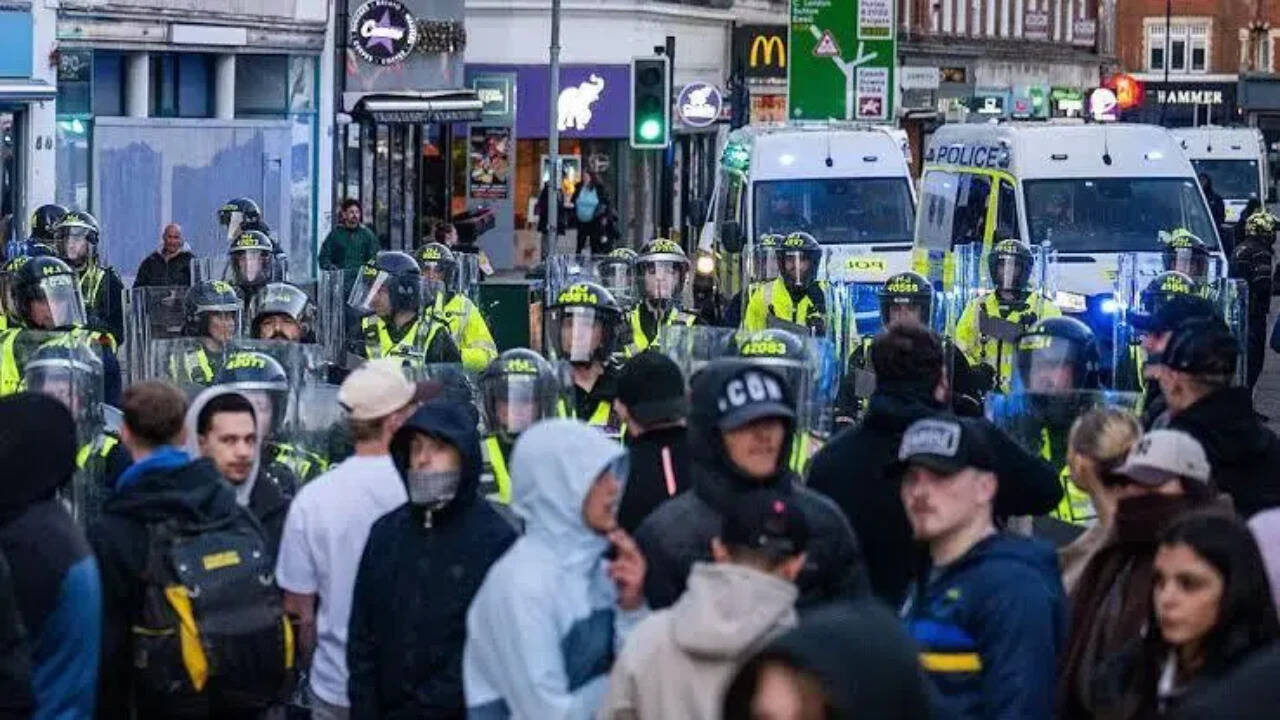
You’ve probably seen the headlines or the tense footage from Epsom this week. A quiet Surrey town suddenly looks like a standoff zone, with riot shields, chanting crowds, and a whole lot of anger. It all started with a report of a horrific gang rape outside a Methodist church on Ashley Road. But now, Surrey Police are saying they’ve found no evidence the attack happened as reported.
It’s a messy situation that taps into a massive nerve in Britain today. People are frustrated, suspicious, and tired of feeling like they’re being kept in the dark. On one side, you’ve got a police force trying to manage a sensitive investigation without any concrete leads. On the other, you’ve got a community—and a wider online audience—convinced that facts are being suppressed for the sake of optics.
What actually happened on Ashley Road
According to the initial report, a woman in her 20s left the Labyrinth nightclub in the early hours of Saturday, April 11, 2026. She claimed she was followed and then assaulted between 2 am and 4 am right outside Epsom Methodist Church.
The police didn't just sit on this. They assigned a specialist Sexual Offences Liaison Officer to the victim. They did the house-to-house knocks. They scoured hours of CCTV from the club, the church, and the surrounding streets. They looked for forensic markers. But on Friday, Assistant Chief Constable Sarah Grahame dropped a bombshell: after all that work, there's literally no evidence that the offence took place "as reported."
That phrasing is specific. It doesn't necessarily mean the woman lied, but it means the physical and digital trail doesn't match the story. In a world where every inch of a town centre is usually caught on a ring doorbell or a council camera, a total lack of footage for a gang assault is a huge red flag for investigators.
The suspicion over suspect descriptions
The real fire started when the police refused to release descriptions of the suspects. If you’re a local, you want to know who to look out for. When the police say they don't have "sufficient information" to describe the attackers, people naturally fill in the blanks themselves.
This isn't happening in a vacuum. We’ve seen cases like the Southport tragedy in 2024 where misinformation moved faster than the truth. In Epsom, rumors immediately pinned the alleged attack on asylum seekers or immigrants. Because the police were quiet, the "cover-up" narrative took hold.
Surrey Police eventually had to be blunt. They’ve stated clearly that there is no evidence immigrants or asylum seekers were involved. But for the crowd that gathered in the town centre on Wednesday, that's just more "official-speak." When trust in institutions is this low, a denial often sounds like a confirmation to those already looking for a reason to be angry.
Protests and the Danny Tommo factor
The protest on Wednesday wasn't just a spontaneous local gathering. It was amplified online by figures like Danny Tommo, a known associate of Tommy Robinson. This turned a local crime report into a flashpoint for national identity politics.
The scene was intense. Dozens of officers in helmets and shields faced off against residents and activists. People were throwing things. Roads were blocked. It felt less like a quest for justice for a victim and more like a venting of general rage against the system.
It’s worth noting the reaction from the community itself. Rev. Catherine Hutton of the Epsom Methodist Church—the very spot where the attack allegedly happened—called the protests "intimidating." She argued that hate isn't the answer, even when people are scared. It’s a tough sell when people feel like their safety is at stake, but it highlights the divide between those who live there and those who showed up to make a point.
Why the police are playing it this way
I’ve seen how these investigations go. If you release a vague or incorrect description, you ruin the chance of a fair trial later, or worse, you incite a lynch-mob against an innocent person. Surrey Police are stuck between a rock and a hard place. If they say nothing, they're "covering up." If they say "we have no evidence," they're "dismissing the victim."
But think about the logistics. If a woman is attacked by a group of men in a busy town centre area at 2 am, and not one CCTV camera, dashcam, or doorbell captures a group of men fleeing the scene, the case starts to crumble. Detectives don't like closing high-profile cases with "no evidence" because it makes them look bad too. They only do it when the facts simply aren't there.
What you should do now
If you’re in the Surrey area, don't get caught up in the social media whirlwind. Most of the people shouting the loudest on X (formerly Twitter) aren't even in the same county.
- Wait for the forensics. The police are still technically investigating. If forensic evidence turns up that contradicts the CCTV, the story will change again.
- Report what you actually saw. If you were at Labyrinth or near Ashley Road between 2 am and 4 am on April 11, call 101 or use the Surrey Police website. Don't report "what you heard," report what you saw with your own eyes.
- Check the source. If a "news" account is posting "leaked" suspect descriptions that the police haven't verified, it’s almost certainly fake. These accounts thrive on your engagement and your anger.
The tension in Epsom isn't going to vanish overnight. There's a deep-seated feeling that the public is being managed rather than informed. But in this specific case, the lack of evidence is the story. Until something new shows up on a camera or in a lab, there's no "suspect" to hunt down. Stay alert, but don't let the rumor mill run your life.