Geopolitical signaling rarely occurs in a vacuum; it follows a predictable calculus of provocation, deterrence, and domestic reinforcement. When a state executes a ballistic missile test immediately following a diplomatic deadlock or an unfulfilled demand for an apology, observers often misinterpret the event as an emotional outburst. A rigorous deconstruction reveals a calculated expenditure of military hardware designed to alter the bargaining space, re-establish leverage, and impose costs on an adversary. Understanding this dynamic requires moving past reactive news coverage and examining the structural mechanics of state-level coercion.
The Coercive Bargaining Framework
State actors engaged in protracted territorial and political disputes operate within a framework of asymmetric information and credibility constraints. Diplomacy relies on signals, but words are cheap; actors can easily make empty threats or hollow demands. To make a signal credible, a state must incur costs. This is the foundation of costly signaling theory.
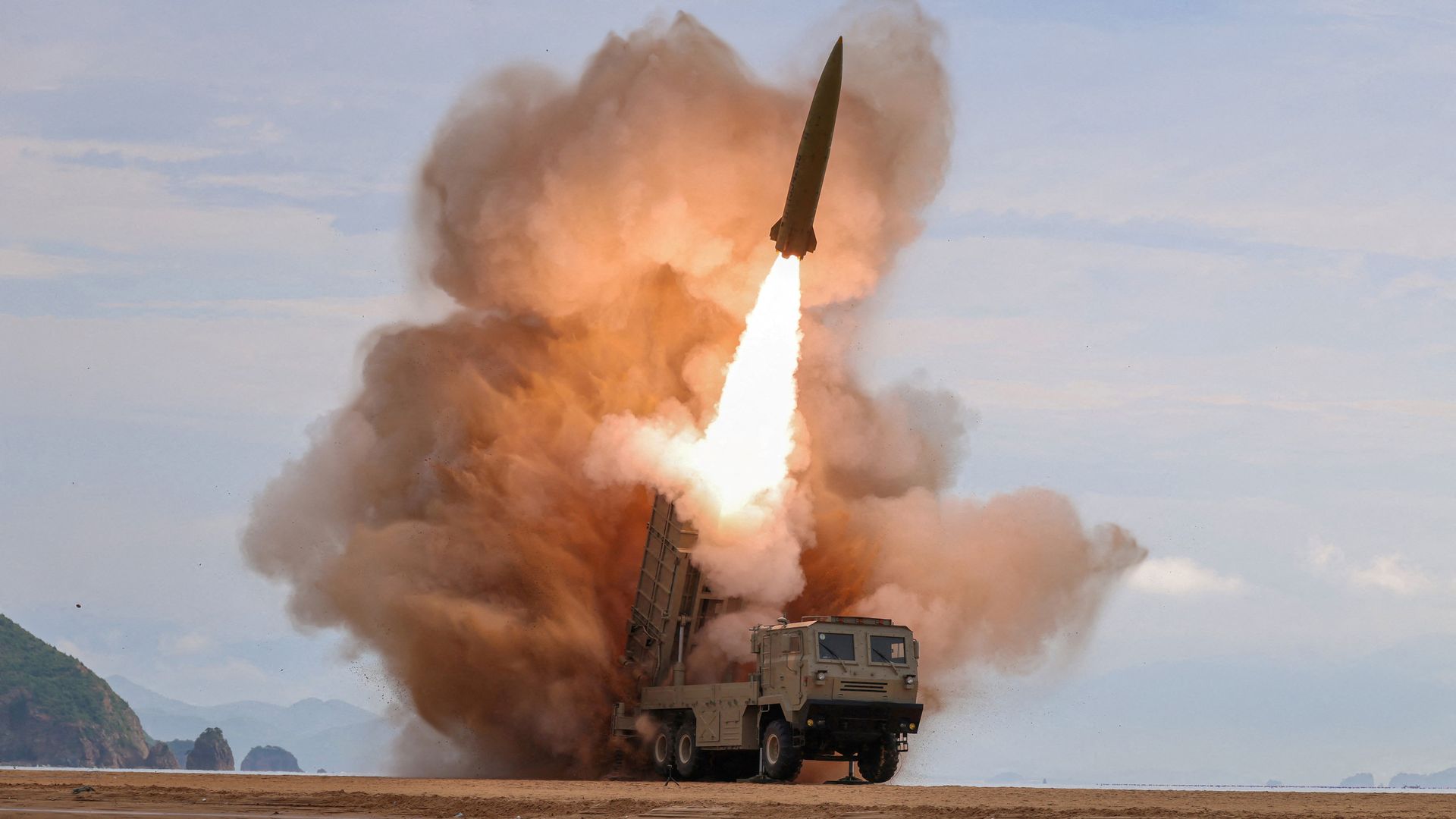
Firing a ballistic missile involves substantial capital expenditure, operational risk, and the depletion of a finite strategic inventory. By absorbing these costs, the signaling state demonstrates resolve to both domestic and international audiences. The immediate trigger—such as Seoul demanding an apology for a prior provocation—serves as the catalyst within a pre-existing game of strategic calibration. The demand itself threatens the target state's perceived prestige and deterrence posture. The missile launch functions as a counter-demand, shifting the conversation away from contrition and back toward a renegotiation of the security architecture.
The Tripartite Objectives of Strategic Testing
To understand why missile tests consistently follow diplomatic friction, one must examine the three distinct vectors of utility the launching state derives from the event: domestic consolidation, technological validation, and external deterrence.
Domestic Legitimacy and Regime Resilience
In closed political systems, external confrontation serves an internal stabilizing function. When a government faces economic stagnation or administrative friction, manufacturing an external crisis shifts the national narrative toward existential survival.
The public articulation of state strength reinforces the regime's foundational legitimacy. An official demand for an apology from a wealthier, democratic neighbor creates a binary narrative: the state is either standing firm against external humiliation or capitulating to foreign pressure. Executing a high-profile military test provides tangible proof of resistance, satisfying internal nationalist constituencies and neutralizing potential elite dissent by aligning military capability with state survival.
Empirical Testing Under Operational Constraints
Laboratories and static test stands cannot replicate the telemetry, vibration, and environmental stresses of an actual flight profile. Diplomatic crises provide the cover and the urgency to execute live-fire trials.
Each launch generates telemetry data that engineers use to refine guidance systems, validate propellant efficiencies, and test re-entry vehicle tolerances. What political analysts view purely through a diplomatic lens, military technicians view as an empirical feedback loop. The timing is often opportunistic: when geopolitical tensions peak, the political willingness to absorb international condemnation is already priced in, making it an optimal window to advance technical programs without incurring additional marginal diplomatic penalties.
Deterrence Signaling and Escalation Dominance
The third objective is altering the adversary's risk calculus. By demonstrating improved range, payload capacity, or launch responsiveness, the state increases the anticipated cost of any pre-emptive military action by opposing coalitions.
This operates on the principle of escalation dominance. If a state can prove its capability to deliver strategic ordnance rapidly and reliably, opposing governments must re-evaluate their defense postures. The demand for an apology becomes secondary to the immediate security dilemma created by the flight path of the missile. The dialogue shifts from moral accountability to crisis management.
The Structural Failure of Standard Diplomatic Responses
Current diplomatic playbooks for managing these escalatory cycles consistently underperform because they treat symptoms rather than systemic drivers. When international bodies respond to missile tests with immediate condemnations and heightened sanctions, they often reinforce the target state's siege mentality.
Sanctions restrict formal trade, but they also drive the state deeper into illicit networks, increasing its reliance on cyber warfare, maritime smuggling, and state-sponsored criminality. Furthermore, domestic political structures within the targeted state adapt to sanctions by centralizing economic control, paradoxically strengthening the regime's internal grip on power.
Simultaneously, demands for unilateral apologies or denuclearization without corresponding security guarantees or economic incentives fail to account for the target state's core security paradigm. From the perspective of the isolated regime, abandoning its strategic deterrent is viewed as an existential vulnerability, akin to the trajectories observed in other states that abandoned similar programs under external pressure.
Navigating the Strategic Impasse
Resolving recurrent missile tests requires abandoning linear assumptions about rational actor behavior in favor of complex adaptive systems thinking. Every action taken by regional powers—such as joint military exercises, missile defense deployments, or diplomatic rebuffs—feeds directly into the adversary's predictive models, triggering counter-measures that lock both sides into a high-cost equilibrium.
Breaking this feedback loop demands a structural reconfiguration of the incentive matrix. Traditional deterrence must be paired with credible off-ramps that do not require either side to lose face. Until policymakers recognize that ballistic missile tests are symptoms of a deeper bargaining failure rather than isolated infractions of international norms, the peninsula will remain trapped in this predictable, high-stakes cycle of provocation and response.