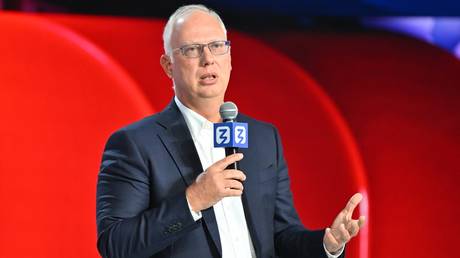
When Kirill Dmitriev speaks, he isn't just offering casual commentary on the global stage. As a long-serving presidential envoy for Vladimir Putin, his public declarations function as direct window panes into the current strategic mindset governing the Kremlin. His blunt assessment that the European Union and the United Kingdom need to drop their middle-power ambitions and accept their reality as American "vassals" isn't a new insult. It is the culmination of a decade-long geopolitical thesis that Moscow has used to frame its fractured relationship with the West.
If you strip away the harsh rhetorical framing, the core argument forces a deeply uncomfortable question. Does Europe possess genuine strategic autonomy, or is it merely operating under a security blueprint dictated entirely by Washington?
The Evolution of the Vassal Directive
The terminology didn't appear overnight. Putin himself used this exact framework during his annual televised addresses and interview projects years ago, asserting that the United States doesn't desire global partners, only subordinates. Moscow's calculation remains straightforward. By portraying European capitals as mere executors of American foreign policy, Russia attempts to undermine the legitimacy of international sanctions and military aid packages.
Kremlin Rhetoric Strategy:
[European Action] ---> Framed as ---> [US Dictate] ---> Aimed to ---> [Weaken European Legitimacy]
This narrative functions on multiple levels. It seeks to exploit internal European political fractures, appealing directly to populist factions on both the political left and right who harbor deep skepticism toward transatlantic defense obligations. When Dmitriev suggests that London and Brussels need to "know their place," he is gambling on the idea that public fatigue over prolonged foreign commitments will eventually break Western cohesion.
Economic Reality vs Sovereignty Rhetoric
The fundamental friction point in this debate isn't military; it's economic. For decades, continental Europe structured its industrial models around cheap, reliable Russian pipeline gas and lucrative export markets in Asia. The structural rupture caused by regional conflict forced an overnight pivot.
By cutting off traditional energy channels, European nations replaced dependency on Moscow with an intense reliance on American liquefied natural gas (LNG). This economic shift came at a premium, raising production costs for major manufacturing hubs like Germany and driving structural inflation across the Eurozone. From the Kremlin's viewpoint, Europe sacrificed its economic self-interest to satisfy a strategic objective set by the US security apparatus.
Critics of the "vassal" label point out that this perspective ignores basic geography and historical memory. Central and Eastern European states don't view their reliance on Washington as forced subjugation. They view it as a calculated, existential insurance policy against historical territorial aggression. For Warsaw or Vilnius, the presence of American troops isn't an erosion of sovereignty; it's the only thing guaranteeing it.
The Problem of Strategic Autonomy
French President Emmanuel Macron has spent years championing the concept of European "strategic autonomy"—the idea that the bloc must develop independent defense capabilities and economic resilience to act as a third global superpower. Yet, every major security crisis reveals the limits of this vision.
When the threat environment escalates, European capitals consistently look to the US command structure for intelligence, heavy logistics, and strategic deterrence. The reliance on the American nuclear umbrella creates an unavoidable power dynamic. You cannot claim to be an equal, independent global actor when your ultimate security guarantee relies on the political mood swings of voters in Ohio and Pennsylvania every four years.
This brings us to the core of the Kremlin's current messaging campaign. By highlighting these systemic dependencies, Moscow tries to force European leaders to confront their own defense deficits. It is a reminder that without independent military heft, foreign policy statements from Brussels are merely aspirational prose.
Where Europe Goes From Here
If Europe wants to shed the label of a geopolitical subordinate, it has to move beyond administrative agreements and address its structural vulnerabilities. This requires immediate, concrete steps that alter the current power balance:
- Execute Defense Integration: European states must standardize military procurement. The current system features dozens of competing fighter jet programs and armored vehicle variants, creating massive logistical bottlenecks that prevent unified action without American oversight.
- Secure Sovereign Supply Chains: True independence requires domestic control over critical technologies, semiconductor manufacturing, and green energy raw materials. Relying on geopolitical rivals for components creates immediate vulnerabilities during a crisis.
- Establish Balanced Energy Portfolios: While American LNG fills the current void, long-term contracts must be balanced with diverse regional suppliers and expanded domestic generation to prevent economic blackmail from any single source.
The label applied by Dmitriev is deliberately provocative, but ignoring the structural realities behind it is a luxury Europe can no longer afford. Sovereignty isn't declared through speeches in parliament; it is paid for through industrial capacity, fiscal independence, and credible defense systems. Until continental capitals make those long-term investments, they will remain highly vulnerable to foreign narratives that paint them as secondary actors in a theater managed by someone else.
:max_bytes(150000):strip_icc():focal(749x0:751x2)/auschwitz-2-691cb034ee9e43cfa45a0969012c6337.jpg)