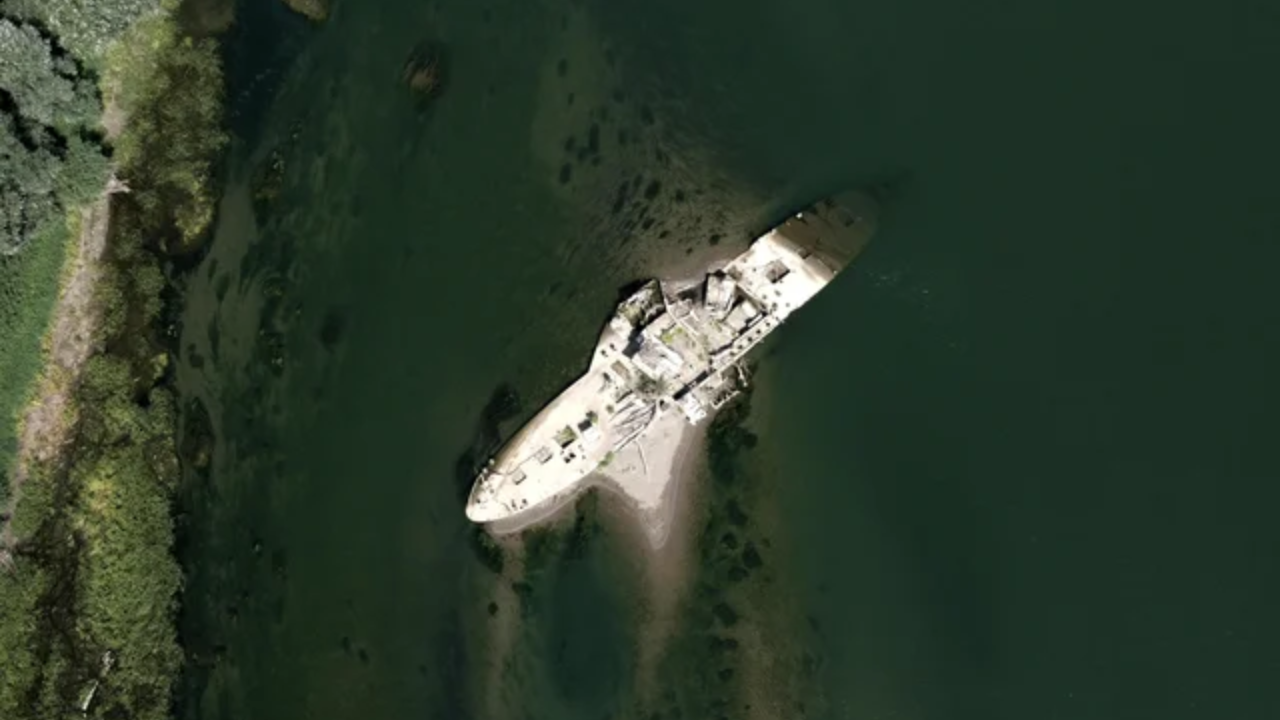
When the water disappears, the past comes back to haunt us. Right now, across Serbia and the broader European continent, an intense, brutal drought is stripping away the lifeblood of our inland waterways. It’s not just an environmental crisis; it’s an archaeological reveal.
The most striking example is the rusting hull of the Slovenian, a 177-foot steam tugboat now looming over the bed of the Sava River near Sremska Mitrovica. Locals have taken to calling it "Sava’s Titanic." It’s an easy nickname, but it misses the point. This isn't just a grim curiosity for picnic-goers to gawk at. It’s a physical manifestation of a continent pushed to its absolute limits by heat and a lack of rain. If you liked this post, you might want to look at: this related article.
A Century of Turbulence Exposed
This tugboat has a story that reads like a map of 20th-century geopolitical chaos. Built in 1913 in Budapest, it started its life as the Vag under the Austro-Hungarian Empire. After the First World War shattered the old order, it was handed over to the Kingdom of Serbs, Croats, and Slovenes as war reparations and rechristened the Slovenian.
It spent decades pulling cargo, surviving two world wars, and witnessing the birth and death of nations. Its final moment came in April 1945. As Nazi forces retreated and the region burned in the final gasps of the Second World War, the ship was carrying wounded soldiers. A German magnetic mine ended its journey in an instant. It sank into the silt and vanished for nearly 80 years. For another look on this event, see the recent update from Travel + Leisure.
Now, because of record-low water levels, the river has essentially vomited this history back onto the surface. Historian Andrija Popovic, who leads the town museum nearby, notes that while bits of the wreck have poked out of the water during minor dry spells before, this is different. The river is so low that you can walk up and see the guts of the ship.
It’s Not Just One Ship
If you think the Slovenian is an isolated case, you haven't been paying attention to the Danube. Further east, near Prahovo, a massive fleet of sunken Nazi warships is emerging. These weren't lost to mines or bad luck; they were scuttled by retreating German forces in 1944 to block Soviet ships from advancing.
There are roughly 200 of these wrecks resting in the mud. They’ve appeared before—notably during the droughts of 2022 and 2024—but their reappearance today is a blunt reminder that our climate is shifting into a cycle of extreme, punishing aridity. It’s not just metal, either. In Bulgaria, receding Danube waters recently gave up the bones of a woolly mammoth. We are essentially digging up centuries of history without picking up a shovel.
The Real Cost of Dry Rivers
This isn't a museum exhibit. It’s a warning. When a river like the Danube or the Sava hits record lows, it does more than just show off sunken boats:
- Energy Disruption: Nuclear power plants in Hungary and Romania rely on river water for cooling. Low levels put these facilities under immense pressure, threatening the very power grid that keeps the lights on.
- Trade Collapse: These rivers are the continent's second-largest waterway. When they drop, barge traffic stops. That means fuel, food, and industrial supplies don't move.
- Agricultural Ruin: A monthslong drought from the Netherlands to Bosnia doesn't just make for a dry lawn; it kills crops. The food security of the entire region is tied to these water levels.
You might find the sight of an 80-year-old shipwreck fascinating, and you should. History is worth looking at. But look past the rust. The fact that we can see these ships today means the natural systems that support millions of people are failing in real-time.
What You Should Do
If you find yourself near these sites, look but don’t touch. These wrecks are often unstable and, in the case of the Nazi fleet, sometimes still packed with unexploded munitions from the 1940s. The local authorities in places like Prahovo have had to clear explosives from these hulks before.
If you're a traveler, document what you see responsibly. These are fragile, historically significant sites that are currently suffering from the same environmental stress that is affecting modern infrastructure. Respect the history, respect the warning, and start paying attention to the water levels in your own backyard. Things are drying up much faster than most people realize.
The story of the Sava's Titanic
This video provides a firsthand look at the exposed wreck of the steam tugboat and illustrates the severity of the river's receding water levels.