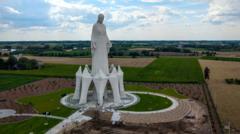
Media outlets swooned over the drone footage. A towering 14-meter effigy of the Virgin Mary rising above the rolling green hills of rural Poland, crowned in gold and draped in concrete reverence. Headlines hailed it as a triumph of faith, a beacon of spiritual revival in an increasingly secular continent, and a monumental architectural feat for a small community in the countryside.
They got it entirely backward.
This isn't about devotion. It is a desperate, misallocated capital expenditure by a region terrified of demographic irrelevance. When a municipality opts for a colossal fiberglass-and-concrete monolith instead of fixing its infrastructure or attracting productive enterprise, you are not witnessing a renaissance of the soul. You are watching a local economy build its own gravestone and call it a monument.
Let us look past the incense and examine the balance sheet.
The Economics of Gigantism
Rural depopulation is the silent killer of Central and Eastern Europe. Young talent migrates to Warsaw, Berlin, or London for high-yield employment. The tax base shrinks. Municipal budgets shrivel.
Faced with structural collapse, local leaders have two choices: invest in modernization, digital literacy, and SME incentives, or build something big enough to trick tour buses into stopping for twenty minutes.
Guess which one is easier to finance with regional development grants and church donations?
Monuments of gigantism are the ultimate vanity metrics of civic planning. They cost millions upfront, generate negligible recurring revenue, and require ongoing maintenance that bleeds municipal coffers dry. A gift shop selling plastic rosaries and lukewarm coffee does not a sustainable economy make. It creates low-wage, seasonal gig work that does nothing to retain university graduates or build long-term regional wealth.
When mayors trade structural transformation for spectacle, they are playing a zero-sum game of attention economics. And they are losing.
The Lazy Consensus on Secularism Versus Piety
The standard narrative frames these mega-statues as a cultural counter-offensive against European secularization. The narrative goes that while Western Europe tears down traditions and builds glass-and-steel temples to corporate finance, Eastern Europe stands defiant, anchoring its identity in timeless spiritual symbols.
This is a lazy, superficial framing that collapses under basic historical scrutiny.
Throughout history, societies do not double down on monumental religious construction during periods of confident expansion; they do it when they feel cornered. Look at late-medieval cathedral building sprees or baroque architectural booms. They often coincided with profound social anxiety, economic shifts, and institutional defensiveness.
Building a taller statue does not reverse secular trends. It merely provides a temporary dopamine hit for local politicians looking for a ribbon-cutting ceremony before the next election cycle. It substitutes physical altitude for actual cultural and economic relevance. If height correlated with spiritual vitality or societal strength, medieval cathedral towns would be dominating the Fortune 500.
The Opportunity Cost Nobody Mentions
Let us talk about opportunity cost, the concept economists love and politicians ignore.
Suppose a project like this absorbs the equivalent of several million dollars in public subsidies, private donations, and municipal coordination. What else could that capital have bought in a rural Polish district?
- High-speed fiber-optic rollout for local small businesses.
- Vocational training partnerships with nearby manufacturing hubs.
- Modernized healthcare logistics for aging rural populations.
- Incubator spaces for agricultural tech startups.
Instead, the community got a Virgin Mary that astronauts might squint and see if the cloud cover cooperates.
I have watched companies and regional authorities make this exact mistake across three continents. They confuse visibility with viability. They think that if enough people look at a landmark, prosperity will magically precipitate from the sky like holy water. It never does. Visibility without utility is just expensive tourism.
The Uncomfortable Truth About Religious Tourism
Proponents point to religious tourism as a bulletproof economic engine. Look at Lourdes. Look at Częstochowa.
Here is the catch: mega-sanctuaries scale well only when supported by massive transport infrastructure, hotel chains, and year-round institutional backing. A random village in rural Poland lacks the hotel capacity, the culinary ecosystem, and the transit links to convert a day-tripping busload of pilgrims into overnight stay tourists who spend real capital.
Tourists arrive, take a selfie beneath the crown, buy a packaged snack from a roadside kiosk, and drive back to a major city before dinner. The local economy captures a fraction of a percent of the transaction value. The rest evaporates into the margins of fuel costs and regional conglomerates.
It is trickle-down economics with divine branding, and it leaks like a sieve.
What Real Regional Revival Looks Like
If you want to save rural communities from fading into picturesque open-air museums for retirees, you have to stop looking backward toward the Middle Ages and start looking at logistics, connectivity, and value-added production.
Successful rural turnarounds share three unsexy characteristics:
- Relentless digital infrastructure: A software developer in a village needs the same latency as one in Frankfurt.
- Specialized micro-industries: Niche manufacturing, automated agriculture, or specialized craftsmanship that exports high-value goods globally.
- Educational retention: Programs that tie local schooling directly to regional economic demands rather than forcing kids to flee for urban centers.
None of these things fit neatly on a postcard. None of them yield a dramatic photograph for the evening news. None of them allow a local dignitary to stand beneath a towering fiberglass halo and bask in the camera flash.
That is precisely why politicians choose the statue. It is an expensive monument to short-term political survival, paid for by the long-term stagnation of the people it pretends to honor.
Stop building monuments to your anxieties. Build economies that can stand on their own two feet without needing a crane to hold them up.