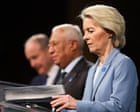
Henry Kissinger famously complained that Europe didn't have a single phone number to call during a crisis. Half a century later, Brussels finally created the job, hired a former prime minister to fill it, gave her a diplomatic corps of 144 delegations, and then publicly locked her out of the room when the biggest security negotiation of the decade actually started.
If you're trying to figure out who speaks for Europe abroad right now, the honest answer is messy. It isn't Kaja Kallas, the European Union's High Representative for Foreign Affairs and Security Policy.
When EU heads of state gathered in Dublin on November 13, 2026, to finalize Europe's negotiating team for Russia-Ukraine peace talks, European Council President António Costa announced a hybrid lineup. The seats went to the E5—a five-nation group comprising France, Germany, Italy, Poland, and the non-EU United Kingdom—alongside representatives from the offices of Costa and European Commission President Ursula von der Leyen. Kallas, the person formally paid to run EU foreign and security policy, didn't get a seat.
That single decision in Dublin strips away years of polished Brussels rhetoric about "geopolitical awakening" and "strategic autonomy." You can't claim to speak with one voice on the world stage while sidelining your own chief diplomat in front of Washington, Moscow, and Kyiv.
What Actually Happened at the Dublin Summit
To understand why the Dublin snub matters so much, you have to look at what was at stake in mid-November 2026. Following talks in Abu Dhabi and shifting signals from US envoys Steve Witkoff and Jared Kushner, negotiations over ending Russia's war in Ukraine expanded beyond a simple ceasefire to touch Europe's entire post-Cold War security architecture. Moscow's negotiators had been demanding "a new Yalta and Potsdam" and floating bilateral non-aggression pacts designed to hollow out NATO's mutual defense guarantees.
Kyiv, Washington, and even Italian Prime Minister Giorgia Meloni had pushed for Europe to name a single, empowered envoy. Kallas made her bid publicly before the summit even began. "I am the one who represents Europe in foreign and security policy," she told reporters in Dublin, pointing directly to the June 2024 European Council mandate that appointed her. She also preempted the most obvious objection from hesitant capitals: "I know the Russians don't want me, but do we decide who represents Russia?"
European leaders ignored her anyway.
Instead of trusting the institutional office designed for this exact scenario, the 27 member states fell back on the "Dublin Format"—pairing five major European capitals (including Britain, which left the EU six years ago) with aides from Costa and von der Leyen. When pressed on the omission, von der Leyen offered no defense of her own Commission Vice-President, stating flatly that "we decide for ourselves who will represent us". German Chancellor Friedrich Merz waved away the controversy, arguing that existing big-power formats had already proved themselves and there was no need for an institutional debate.
Smaller EU nations were furious. Lithuania's foreign minister, Kęstutis Budrys, captured the frustration of frontline states in seven words: "We cannot speak with 27 microphones. We need one". Spain criticized the exclusionary big-country club. Norway, outside the EU but vital to northern European security, publicly questioned its exclusion.
Why the EU Treaties Built a Three-Headed Monster
This isn't just a personality clash between Kallas, von der Leyen, and Costa. It's a structural flaw baked directly into the Treaty of Lisbon, which took effect in December 2009.
When European leaders drafted the Lisbon Treaty, they wanted to give the bloc a coherent international profile without surrendering national sovereignty over war, peace, and diplomacy. The compromise they invented created three overlapping presidents and chiefs with blurry, competing job descriptions:
- The President of the European Council (António Costa): Under Article 15(6) of the Treaty on European Union, Costa ensures the external representation of the EU on Common Foreign and Security Policy (CFSP) issues at the level of heads of state and government. When presidents and prime ministers meet, he claims top billing.
- The President of the European Commission (Ursula von der Leyen): Under Article 17(1), the Commission represents the Union externally on everything outside CFSP—which happens to include trade, sanctions enforcement, financial aid, energy policy, and EU enlargement. In modern geopolitics, money and sanctions are foreign policy, giving von der Leyen massive leverage over Kallas.
- The High Representative (Kaja Kallas): Designed as a "double-hatted" bridge, Kallas chairs the Foreign Affairs Council of national foreign ministers, runs the European External Action Service (EEAS), and simultaneously serves as a Vice-President of the European Commission. On paper, she links national capitals with Brussels' financial muscle. In practice, she has no vote in the European Council and zero independent military or budgetary authority.
I've watched this institutional tug-of-war play out across four consecutive High Representatives—Catherine Ashton, Federica Mogherini, Josep Borrell, and now Kallas. Every single one discovered the same harsh truth. The job title sounds like a European foreign minister, a phrase actually used in the failed 2004 Constitutional Treaty before national capitals panicked and watered it down. In reality, the High Representative is a coordinator who only speaks when 27 fractious governments unanimously let her.
Three Real Reasons Capitals Bypassed Kaja Kallas
If the treaties are ambiguous, why did Paris, Berlin, and other Western capitals specifically sideline Kallas in November 2026? Three political calculations drove the decision.
1. Fear of Her Hawkish Reputation
As Estonia's former prime minister, Kallas spent years warning Western Europe about Russian imperialism before most capitals took the threat seriously. She has spoken bluntly about accountability for war crimes, strict sequencing—ceasefire first, peace deal second, broader security talks last—and even the historical breakup of the Russian empire. To Baltic and Nordic governments, that clarity is her greatest asset. To cautious diplomats in Berlin, Paris, and Brussels, it makes her a non-starter in a room with Kremlin envoys. Several Western European officials quietly argued that Moscow would use Kallas's presence as an excuse to stall talks before they even began.
2. The Quiet Turf War Over the EEAS
Behind closed doors in Brussels, a fierce bureaucratic battle has been raging all autumn over the future of the European External Action Service. France and Germany have backed proposals to absorb key parts of the EEAS—particularly development, neighborhood, and crisis-response instruments—directly into the European Commission. Meanwhile, budget negotiations for the EU's next multi-year financial framework have featured steep proposed cuts to external action spending. Von der Leyen has spent her second term centralizing security, defense procurement, and major geopolitical files inside her own inner circle on the 13th floor of the Berlaymont building. Handing Kallas the lead negotiator role in Ukraine talks would have reversed that power grab overnight.
3. The Democratic Legitimacy Gap
When push comes to shove, voters don't elect the High Representative, and EU institutions don't deploy soldiers or underwrite security guarantees with national blood and treasure. One senior EU diplomat summed up the blunt logic behind the E5 format after Dublin: Brussels institutions simply lack sufficient political legitimacy in the eyes of domestic voters when existential war-and-peace deals are on the table. If a peace settlement requires domestic parliamentary ratification, peacekeeping troops, or bilateral security commitments, leaders like Friedrich Merz, Emmanuel Macron, and Keir Starmer want their own people in the room—not an appointed Brussels envoy they can't fully control.
Why the "E5 Plus Brussels" Compromise Is a Trap
Defenders of the Dublin arrangement argue that pairing the E5 with Costa's and von der Leyen's aides is pragmatic realism. It brings the United Kingdom—Europe's other nuclear power alongside France—back into the core European diplomatic fold without getting bogged down in post-Brexit legalisms. It also ensures that the biggest military and financial contributors in Europe are directly invested in whatever deal emerges.
That sounds neat in a Brussels press briefing. At a high-stakes negotiating table against seasoned Russian and American operators, it's a structural gift to Europe's adversaries.
Here is why the committee approach breaks down under pressure:
- Divide-and-rule becomes effortless: When seven different European delegations sit across the table—five national governments plus two rival EU presidents—Moscow and Washington know exactly where the seams are. Russian diplomacy thrives on exploiting subtle differences between Berlin's caution, Warsaw's urgency, and Paris's desire for European autonomy.
- Decision speed drops to a crawl: A single envoy operating under a clear mandate can pivot in real time during late-night negotiations. A seven-headed delegation has to check back with five national capitals and two Brussels cabinets before conceding a comma.
- Smaller EU states lose their shield: The entire point of pooling foreign policy in Brussels was to give countries like Estonia, Lithuania, Ireland, and Portugal a seat at the global top table through a shared representative. Replacing the High Representative with an informal directory of big powers tells smaller members that when the real decisions happen, they don't count.
Brussels commentator Dave Keating didn't mince words the day after the Dublin summit, writing that if he were in Kallas's shoes, he would resign rather than participate in the farce. Even analysts more sympathetic to the E5 format admit it only works if every single person in the room sticks religiously to the exact same script—something European leaders rarely manage for more than forty-eight hours.
What Needs to Change Before Europe Loses Its Seat at the Table
Europe's foreign policy problem isn't a shortage of talent, money, or diplomatic missions. The EU remains the world's largest trading bloc and Ukraine's biggest combined financial and military backer. Its problem is an unwillingness to match its institutional rhetoric with actual political trust.
If European policymakers and observers want to evaluate whether Brussels is actually becoming a serious geopolitical actor—or just staging expensive summits—watch three specific pressure points over the coming months:
- Track who actually speaks in bilateral rooms: Don't judge EU foreign policy by press releases from the Foreign Affairs Council. Watch who gets invited into closed-door trilateral meetings with Washington and Kyiv, and whether Costa and von der Leyen continue sending separate diplomatic advisers instead of coordinating through the EEAS.
- Watch the EEAS budget and restructuring fight: Keep a close eye on whether member states allow the Commission to strip foreign policy instruments away from the High Representative's diplomatic service during the ongoing budget negotiations. If the EEAS loses its operational tools, the High Representative post becomes purely ceremonial.
- Demand majority voting on foreign policy implementation: As long as a single national government can veto EU foreign policy decisions—or bypass Brussels entirely through ad hoc big-power clubs—no High Representative will ever hold real leverage abroad. Moving from unanimity to qualified majority voting on sanctions and diplomatic mandates is the only way to give Europe's top diplomat genuine teeth.
Until national capitals stop treating their own foreign policy chief like an inconvenient bystander, Kissinger's old joke still holds. Europe finally installed the phone line, hired someone to answer it, and then unplugged the cord the moment the call came through.