You don't usually see European Union navies buying their major warships from outside the continent. For decades, legacy shipbuilders in France, Germany, Italy, and Spain held a tight grip on Western naval procurement. But that tradition just cracked wide open.
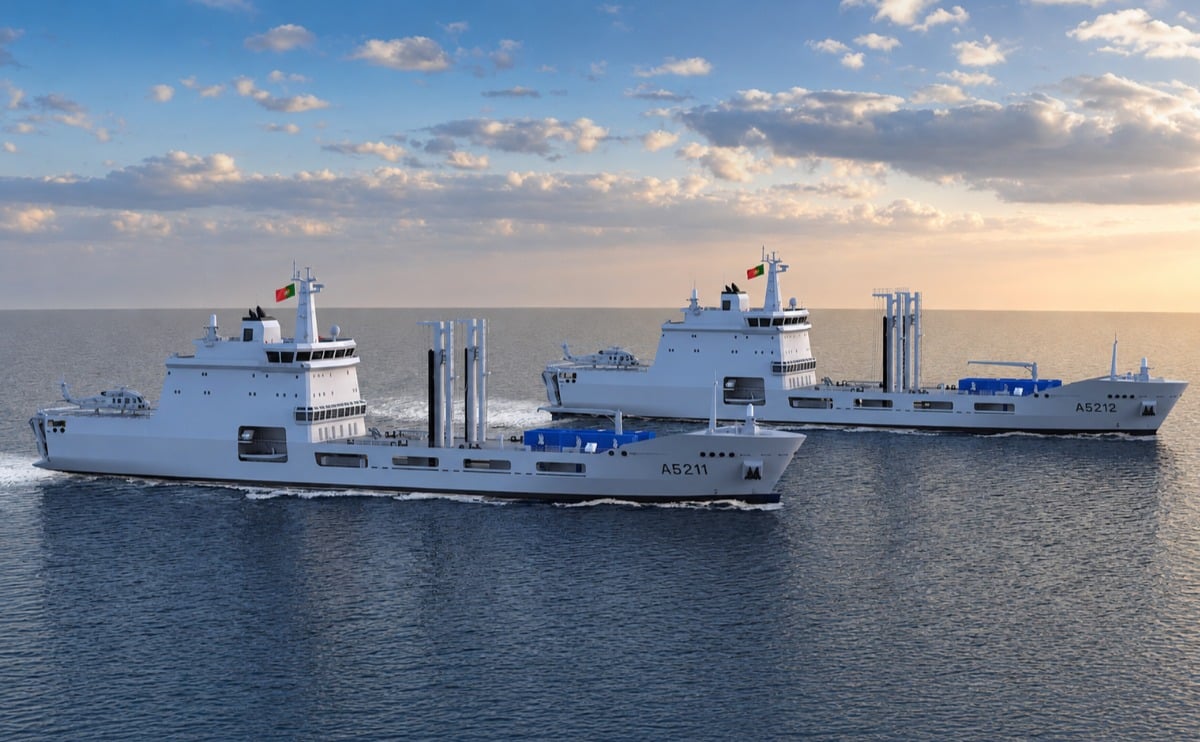
On June 18, 2026, a steel-cutting ceremony in Istanbul marked the official start of construction on the N.R.P. D. Dinis (A5212). It's the second of two massive logistics support ships being built for the Portuguese Navy by the Turkish defense firm STM. The first ship, the Luís de Camões, already had its keel laid back in January. If you enjoyed this article, you should read: this related article.
This isn't just another routine industrial milestone. It's the first time a Turkish shipyard has secured a major naval export contract for an EU and NATO member state. STM didn't win this by default, they beat out Europe's most established naval powerhouses in a brutal competitive tender.
If you want to understand how the global defense balance is shifting, you have to look at what these ships actually do and why Lisbon chose Ankara over its own neighbors. For another look on this development, refer to the recent update from Al Jazeera.
Breaking Down the Tech Behind Portugal's New Auxiliary Oilers
Naval logistics ships are rarely glamorous. They don't have the sleek lines of a stealth frigate or the raw firepower of a destroyer. But without them, a navy is functionally useless beyond its own coastline. They are the floating lifelines that keep a fleet running.
Portugal needed something highly versatile to replace its aging auxiliary fleet. What STM designed is a 137-meter, 11,000-ton multi-role powerhouse known technically as an Auxiliary Oiler Replenisher and Logistics Ship, or AOR+.
The raw specifications reveal exactly why this platform won the contract:
- Range and Endurance: The ships can travel over 14,000 nautical miles at a 14-knot cruising speed, staying at sea for up to 90 days without pulling into port.
- Liquid Cargo: They carry 4,000 cubic meters of F-76 military diesel, 350 cubic meters of F-44 aviation fuel, and 650 cubic meters of fresh water.
- Dry Cargo and Vehicles: A heavy-duty stern roll-on/roll-off (ro-ro) ramp allows the ship to swallow up to 20 light tactical armored vehicles. The deck also holds six standard 20-foot shipping containers.
- Aviation and Drones: The aft features a flight deck capable of handling heavy helicopters, alongside a dedicated hangar designed specifically to store and maintain unmanned aerial vehicles (UAVs).
The propulsion setup is equally smart. It uses a diesel-variable pitch propeller system combined with an electric motor. When the ship needs to move fast, the diesel engine pushes it past 18 knots. When it's just idling or conducting quiet operations, it switches to electric propulsion to sip fuel at 6 knots.
Why a Modular Design Matters in Modern Naval Warfare
Most old-school logistics ships were single-purpose tankers. If they weren't pumping fuel, they were dead weight. STM's approach relies heavily on modular architecture. They built a multi-mission cargo bay that can change roles depending on the crisis.
Say a major earthquake hits an island territory or a humanitarian crisis unfolds in the Atlantic. The D. Dinis can instantly pivot. The ship features onboard medical spaces, including an infirmary, a dedicated treatment area, an isolation room, and a fully stocked pharmacy. It can temporarily house 100 evacuated civilians or extra troops on top of its standard 50-person crew and 50-person specialist detachment.
But don't mistake this for a defenseless cargo container. European waters are getting increasingly contested. The Portuguese Navy insisted on serious teeth for these ships.
Instead of relying solely on escort frigates, these logistics platforms are equipped with their own advanced combat systems. They feature an Integrated Communication System paired with Link 16 and Link 22 tactical data networks, letting them act as command-and-control hubs for an entire fleet. For self-defense, they carry close-in weapon systems (CIWS), two 12.7 mm remote-controlled gun stations, and active chaff and decoy launching systems to throw off incoming anti-ship missiles. They are optimized specifically for anti-air warfare defense, a massive priority given recent drone threats in global shipping lanes.
The Strategic Shift Passing Under the Radar
There is a lesson here for the broader defense industry. For years, Western European shipbuilders relied on their historical reputation to secure contracts. But they've struggled heavily with ballooning costs, rigid bureaucratic designs, and severe supply chain delays.
Türkiye took a completely different path. Companies like STM, working alongside local private facilities like ADA Shipyard, spent the last decade building dozens of complex ships for their own navy under the national MILGEM program. They built up massive domestic capacity, streamlined their engineering, and learned how to build NATO-compliant warships quickly without breaking the bank.
When Portugal opened the bidding for its AOR+ program, STM didn't just offer a cheaper price tag. They offered speed and customization. The contract was signed in late December 2024. By mid-2026, the first ship is deep into construction and the second has already tasted steel. Both are on track for a 2027 launch and a 2028 delivery. That kind of aggressive timeline is virtually unheard of in contemporary Western shipbuilding.
This project tears down the psychological barrier that kept Eastern European and Mediterranean NATO allies from looking to Türkiye for tier-one military hardware. Romania has already been looking closely at Turkish naval solutions after facing years of internal delays with domestic modernization projects.
If you are tracking naval defense procurement, stop looking exclusively at the traditional hubs in Lorient or Kiel. The center of gravity for efficient, modular naval engineering is visibly shifting eastward toward the Bosphorus. Keep a close eye on upcoming naval tenders in Southeast Asia and South America, because the playbook STM used to win in Lisbon is exactly what they are deploying globally next.