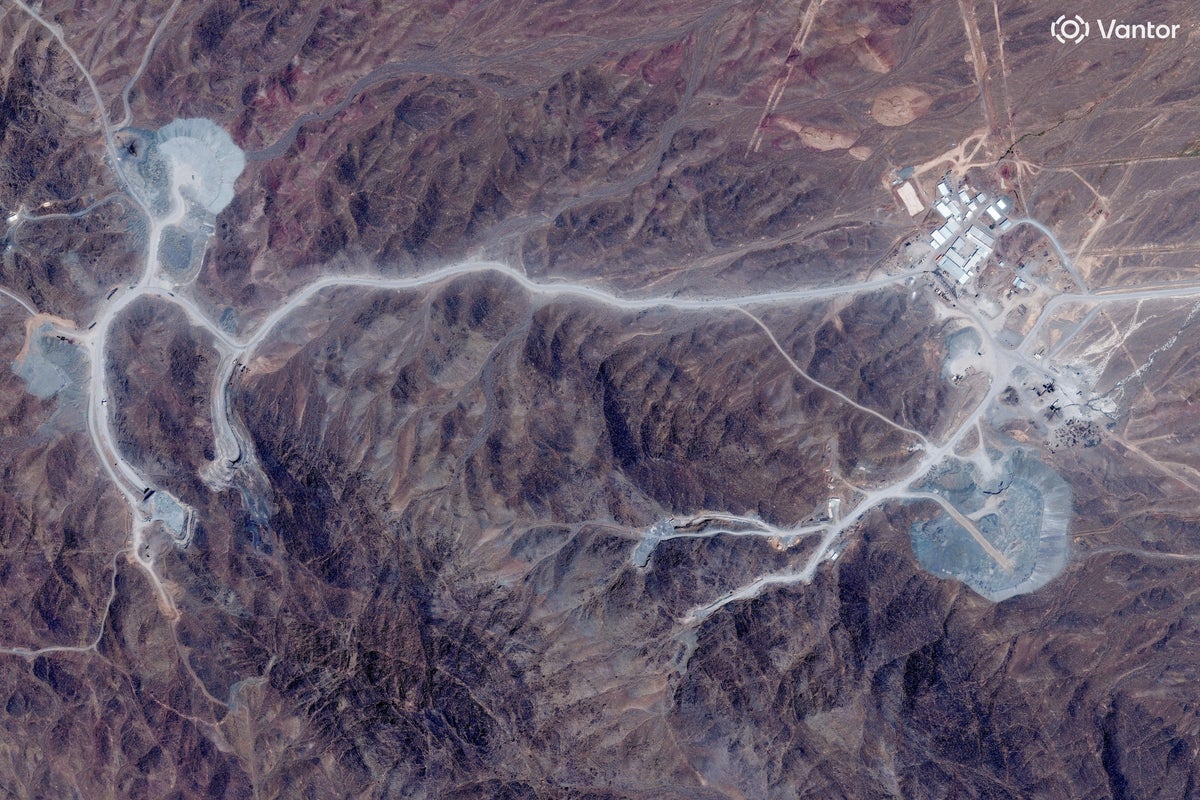
Presidents love talking about heavy ordnance. When Washington drops names like Pickaxe Mountain into a Sunday morning interview, television anchors scramble for maps while viewers wonder if a wider war is starting. But if you look past the White House podium statements and the breathless news alerts, the reality of Iran's most fortified subterranean project is a lot more complicated than a simple countdown to an airstrike.
Let's look at what is actually happening beneath the arid Central Plateau.
Why Pickaxe Mountain Exists Right Now
Known locally as Kuh-e Kolang Gaz La, this heavily guarded complex sits roughly 220 kilometers south of Tehran and barely two kilometers from the long-standing Natanz nuclear complex. It didn't appear overnight. Construction kicked off back in 2020 after an explosion and fire ripped through Natanz's above-ground centrifuge assembly plant—an incident Iranian officials blamed on sabotage.
Tehran's logic was straightforward. If above-ground workshops keep getting blown up by mysterious blasts or targeted by precision raids, you move the operation deep inside solid rock.
Independent nonproliferation analysts, including experts at the James Martin Center for Nonproliferation Studies and the Institute for Science and International Security, have spent years tracking the site via commercial satellite imagery. They estimate the main underground halls are buried between 80 and 100 meters beneath the surface. Some structural engineers argue it could be even deeper.
That depth changes the military math entirely.
The Physics Problem Plaguing American Planners
When politicians talk about taking out a bunker, they usually envision a clean Hollywood explosion. Real-world geotechnics are stubborn.
The United States maintains the GBU-57 Massive Ordnance Penetrator, a massive 30,000-pound precision-guided bomb designed specifically to smash through hardened concrete and dense earth before detonating. Pentagon testing suggests it can plow through roughly 60 meters of earth under optimal conditions.
Pickaxe Mountain sits deeper than that threshold.
James Acton, co-director of the Nuclear Policy Program at the Carnegie Endowment for International Peace, has pointed out that destroying a facility buried under 100 meters of solid mountain rock with conventional weapons is practically impossible. At best, an air campaign can collapse the tunnel portals, trap heavy machinery inside, and seal the access roads. It's a demolition job on a massive scale, not an instant vaporization.
This brings us to the core disagreement between intelligence agencies and political rhetoric.
Centrifuges Versus Actual Fuel
If you listen to high-ranking officials, Iran has packed thousands of advanced centrifuges into Pickaxe Mountain's tunnel network. Western intelligence suspects Tehran wants to use the bunker as a hidden, highly secure uranium enrichment plant.
Iran maintains a different story. Tehran has consistently claimed the underground halls are simply a replacement workshop for manufacturing centrifuge components, not enriching uranium. The International Atomic Energy Agency hasn't been allowed inside to verify either claim. Inspectors are locked out, leaving satellite photos as the primary source of truth.
Yet uranium enrichment requires two vital components: the machines to spin the gas, and the uranium material itself.
As President Donald Trump noted during an Oval Exchange with reporters, empty tunnels don't equal a working weapon. "We follow the material, that's where the action is," he said. Much of Iran's known stockpile of enriched material remains tied to previously targeted surface and near-surface facilities rather than fully integrated into the deepest chambers of Pickaxe Mountain.
What Happens Next on the Ground
Construction vehicles keep moving dirt, and security perimeters keep expanding. Satellite updates show fresh concrete reinforcements around the tunnel entrances alongside efforts to harden headwalls against potential blast damage.
Iran is betting that depth equals immunity. Washington and its allies are calculating how much structural damage a succession of heavy penetrator bombs can actually inflict on a granite ridge. Until inspectors get unrestricted boots on the ground—an unlikely prospect given current geopolitical hostility—Pickaxe Mountain remains a high-stakes guessing game wrapped in reinforced concrete.