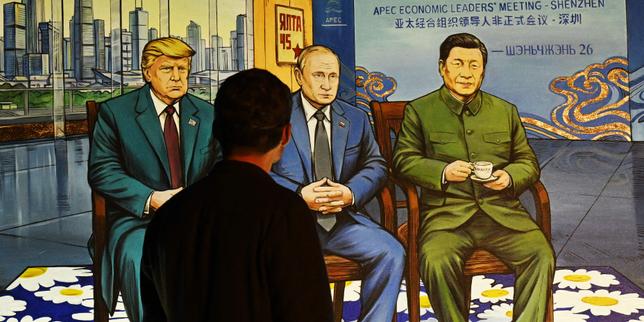
Most headlines framed the November 19, 2026 trilateral summit in Shenzhen as a potential turning point for the war in Ukraine. They got the headline wrong.
When Donald Trump, Xi Jinping, and Vladimir Putin sat down together at Kylin Villa on the sidelines of the APEC forum, the world watched for a ceasefire announcement. Instead, they got a four-point "Declaration toward Peace" that didn't mention Kyiv once. Not a single word. If you enjoyed this piece, you might want to look at: this related article.
If you're looking for diplomatic theater, Shenzhen delivered in spades. If you're looking for an end to the nearly five-year invasion of Ukraine, you walked away empty-handed. Honestly, anyone who has tracked great-power diplomacy over the past decade saw this coming from a mile away. Live coverage of the event focused heavily on the visual optics of the three men shaking hands, missing the far more cynical reality happening beneath the surface.
Why Ukraine Was Left Off the Final Statement
Putin explicitly brought up the war in Ukraine during his opening remarks, claiming Washington, Beijing, and Moscow share "many converging interests" when it comes to resolving global conflicts. Trump had already discussed the conflict during an earlier bilateral sit-down with the Russian president. Yet when the ink dried on the official U.S.-Russia-China Heads of State Declaration toward Peace, Ukraine had vanished from the text. For another angle on this story, check out the recent update from TIME.
Why? Because none of the three leaders actually wanted to make the concessions required to stop the fighting.
- Moscow's calculus: Putin isn't looking for a compromise mediated by Beijing and Washington. He's looking for legitimacy. Standing shoulder-to-shoulder with the American and Chinese presidents breaks his diplomatic isolation without forcing him to surrender a single inch of occupied Ukrainian territory.
- Washington's distraction: Trump arrived in southern China bogged down in a costly, escalating military conflict with Iran. Earlier in November, the U.S. brokered a fourth round of Russia-Ukraine negotiations in Abu Dhabi that went nowhere. With domestic pressure mounting over the Middle East, Trump needed a quick diplomatic win on camera, not a grueling territorial negotiation.
- Beijing's balancing act: Xi Jinping wants to be seen as the indispensable global peacemaker, yet he refuses to pressure Putin into a settlement that weakens Russia as a strategic counterweight to the West.
As Liana Fix, a senior fellow for Europe at the Council on Foreign Relations (CFR), pointed out after the summit, the symbolic costs for the West weren't offset by any real progress on territorial disputes or security guarantees. European leaders reacted with predictable alarm. Finnish Foreign Minister Elina Valtonen summed up the continent's mood bluntly: there can be no decisions about Ukraine without Ukraine, and no decisions about European security without Europe.
The Real Agenda Behind Closed Doors
If Shenzhen wasn't about saving Ukraine, what was it actually about? Follow the grievances.
Look closely at the four-point joint statement issued from Kylin Villa. Instead of addressing active battlefields, the three leaders targeted international courts, nuclear treaties, and global oil supplies. They struck a deal to boost the production and supply of refined petroleum products "for the benefit of all nations," a move aimed directly at stabilizing energy prices rattled by the Iran conflict and ongoing sanctions.
More telling was their coordinated attack on international legal institutions.
Trump slammed the International Criminal Court (ICC) as "out of control," echoing language that landed straight in the final declaration. The text insists that international tribunals "must not abuse their jurisdiction" and demands strict respect for state consent and the immunity of government officials.
Connect the dots. The ICC issued an arrest warrant for Putin in March 2023 over the unlawful deportation of Ukrainian children. Neither the United States nor China has ratified the Rome Statute, meaning neither country is legally bound to arrest him. By signing a joint statement defending official immunity, Trump handed Putin a massive political shield against war crimes accountability.
Nuclear Risks Without a Treaty
Arms control dominated the rest of the conversation, though it produced more rhetoric than rules. The New START treaty—the last remaining pillar capping U.S. and Russian deployed strategic nuclear warheads at 1,550 each—expired back in February 2026.
Putin had previously offered to stick to those limits voluntarily for a year, an offer Trump rejected because he wants a three-way pact that ropes in China's rapidly expanding nuclear arsenal. In Shenzhen, Trump called the three nations "uniquely positioned" to shrink their stockpiles. Xi responded with lofty talk about eventually prohibiting and destroying all nuclear weapons.
Don't mistake that for a breakthrough. Beijing has spent years refusing formal arms control caps until its arsenal reaches parity with Washington and Moscow. Agreeing to "dialogue to reduce nuclear risks" costs Xi nothing while allowing him to look like a responsible statesman. Erin Dumbacher, a nuclear security expert at CFR, noted that while any risk-reduction talk is welcome, it's lightyears away from an enforceable treaty.
Who Actually Won in Shenzhen
Analysts quickly started comparing the Shenzhen meeting to the 1945 Yalta Conference, where Franklin Roosevelt, Winston Churchill, and Joseph Stalin carved up the post-war world. That comparison falls apart under basic scrutiny.
Eric Olander, editor-in-chief of the China-Global South Project, called the summit "purely performative" rather than serious diplomacy. Unlike 1945, global power today is too fragmented for three men to dictate terms to the rest of the planet. Still, walking away from Guangdong province, one leader clearly got more out of the photo op than the others.
Xi Jinping was the undisputed winner. Hosting both the American and Russian presidents on Chinese soil—and chairing their first-ever three-way summit—handed Xi a massive domestic propaganda victory. He used the stage to warn against a "Thucydides Trap" and frame China as the central hub of global diplomacy. Better yet, he kept Washington talking ahead of a looming deadline: the current U.S.-China trade truce expires on January 10, 2027.
Putin came in a close second. He got his return to the top table of global politics, secured an implicit endorsement of sovereign immunity against the ICC, and avoided any new pressure over Ukraine.
Trump got the thinnest return. He walked away with a talking point for domestic audiences—"no peace was ever forged by declining opportunities for engagement"—and a vague pledge on refined fuel supplies. In exchange, he legitimized Putin's diplomatic rehabilitation and alienated European allies who already doubt Washington's commitment to NATO's eastern flank.
How to Read the Next Phase of Great-Power Diplomacy
If you follow international markets, energy policy, or European security, don't get distracted by the "peace declaration" branding. Watch the calendar instead. Three concrete dates over the next eight weeks will show whether Shenzhen was a real shift or just expensive theater:
- Monitor the G20 Summit in Miami (December 14–15, 2026): Trump is hosting world leaders at his Doral resort. Xi is expected to attend, and Putin has an open invitation. Watch whether European leaders boycott or push back publicly if Putin shows up on American soil.
- Track the U.S.-China Trade Truce (January 10, 2027): With the tariff pause expiring in early January, look for whether Beijing's hospitality in Shenzhen translates into actual trade concessions or export-control relief. If tariffs snap back, the "spirit of Shenzhen" died on arrival.
- Watch the Abu Dhabi Backchannel: Real movement on Ukraine won't happen in front of cameras in China. Keep your eye on the quiet, lower-level negotiations in the United Arab Emirates. Until Moscow and Kyiv agree on binding security guarantees and ceasefire lines, trilateral summits remain pure spectacle.
Pay attention to what these leaders sign, not what they say at the podium. In Shenzhen, they signed a pact to protect themselves from international courts and keep oil flowing—leaving Ukraine to fight on alone.