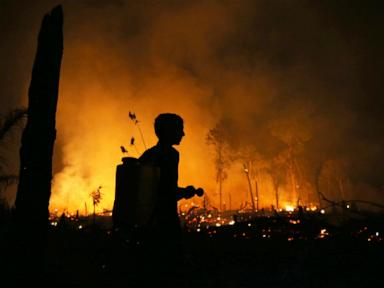
Choking smoke in Manaus. Flights grounded hundreds of miles away. Emergency task forces announced in Brasília.
Every time a headline screams that Brazil investigates Amazon wildfires that disrupt daily life, the media script writes itself. Officials promise crackdowns. Activists point to arsonists. Commentators treat the smoke as an isolated seasonal shock or a simple law-and-order failure.
That script is lazy. Worse, it misses the real mechanics grinding cities, airports, river barges, and agricultural hubs to a halt.
When Brazil investigates Amazon wildfires that disrupt daily life, the inquiry usually stops at the match or the chain saw. Fire is visible. Smoke photographs well. Investigations love a culprit you can point a finger at on a press conference stage. Yet treating the blaze as the whole story mistakes the symptom for the operating system.
The Lazy Consensus Around Smoke and Crackdowns
Standard coverage runs on three comforting assumptions:
- The fire is the primary disruption. Smoke grabs attention because you taste it in the air and see it on satellite loops. In reality, low river levels, heat stress, supply-chain bottlenecks, and regional moisture shifts often hit daily life harder than the flames alone.
- Criminal investigations solve the structural trigger. Arresting illegal loggers or issuing fines matters, yet enforcement in vast, poorly mapped territories collides with land-tenure disputes, weak local capacity, and economic incentives that reward clearing first and litigating later.
- Intact rainforest never burns. Many people assume a healthy tropical forest is fireproof. It isn't. Severe droughts dry out leaf litter and understory vegetation, turning standing forest into fuel and letting escaped agricultural fires creep inward.
I have watched policy teams and corporate risk managers burn millions chasing reactive fixes after smoke blankets a metro area. They buy air-quality dashboards, launch short-term PR responses, and fund emergency relief once hospitals fill up. Six months later, when conditions dry out again, the exact same disruptions return because nobody fixed the underlying land-use and hydrological pressures.
Wildfire vs. Megafire: Getting the Terms Straight
Before diagnosing what breaks daily life, we need clean definitions.
A surface fire moves slowly across the forest floor, consuming fallen leaves, twigs, and low brush. Mature rainforest trees with thick bark can sometimes survive light surface burns, though repeated fires weaken them and open the canopy.
An understory or escaped fire creeps into degraded edges, logging slash, or pasture borders where sunlight dries out the soil and fuels build up. Once the canopy thins, temperatures rise and humidity drops, creating a feedback loop that makes future fires easier to ignite.
Wildfire smoke is not just grey haze. It is a complex cocktail of fine particulate matter, carbon monoxide, volatile organic compounds, and gases that travel far beyond the burn scar. When atmospheric transport aligns with regional wind patterns, smoke from forest clearing and pasture burning drifts over cities, highways, and airports hundreds of kilometers away—turning a local land dispute into a public-health and logistics headache.
Scientists who study Amazonian fire ecology and hydrology—including researchers affiliated with Brazil's National Institute for Space Research (INPE) and the Amazon Environmental Research Institute (IPAM)—have long shown that fire in the basin sits at the intersection of climate variability and human land management. Drought sets the stage; clearing, pasture maintenance, and land speculation provide the sparks.
Why We Are Asking the Wrong Question
Ask "Why are Amazon wildfires disrupting daily life?" and you get an investigation into burn hotspots and emergency decrees.
Ask "What makes whole regions vulnerable to smoke, drought, and logistical breakdown in the first place?" and the picture changes completely.
Daily life does not get disrupted in a vacuum. A city experiences disruption when three things collide: ignition sources (land clearing, pasture renewal, escaped agricultural burns), fuel readiness (drought stress, logging debris, fragmented forest edges), and exposure pathways (wind corridors carrying smoke toward populated areas, low water levels slowing river transport, heat waves straining grids and health clinics).
Investigations that only look for illegal ignition miss fuel readiness and exposure. You can prosecute a land grabber and still leave a river port stranded or a hospital ward overwhelmed by fine particles drifting in from a neighboring state.
"People Also Ask" — Dismantled and Answered Honestly
Are Amazon wildfires mostly natural or human-caused?
Most fires in the Amazon are tied to human activity—clearing land, managing pastures, preparing fields, or burning waste—supercharged during dry spells when fire escapes control. Calling them "natural" lets bad land management off the hook. Calling every single spark a coordinated crime ignores how easily routine agricultural fire spreads when drought dries out the landscape.
Why do fires far in the interior disrupt daily life in cities?
Because the atmosphere and river basins connect distant places. Smoke rides prevailing winds over hundreds of kilometers, degrading air quality, reducing visibility for aviation, and forcing schools and outdoor workers to adjust. At the same time, dry conditions and land-use changes across the basin can alter rainfall patterns and lower river levels, affecting transport, hydropower, and food supply chains far from the flames.
Can government investigations stop the smoke quickly?
Investigations can map illegal clearing, support prosecutions, and guide targeted enforcement, especially when paired with satellite monitoring. Alone, they do not stop smoke quickly across millions of square kilometers. Enforcement without viable land governance, clear property titles, and economic alternatives simply pushes clearing into quieter corners or delays it until enforcement attention shifts.
A Thought Experiment on Smoke and Incentives
Imagine a scenario where a regional government doubles environmental fines overnight and deploys extra inspection teams during peak dry season, while leaving unclear land titles, cheap pasture expansion incentives, and unmonitored secondary roads untouched.
In the short term, headline enforcement numbers climb. A few high-profile offenders get caught. Yet smallholders and speculators operating on contested land still face strong financial pressure to clear or maintain grazing land before dry weather peaks. Some shift burning to night hours or smaller plots; others clear earlier in the year. When drought hits hard, even legal or semi-legal burns can escape into neighboring forest.
The lesson isn't that rules don't matter. It's that enforcement without structural incentives treats symptoms while leaving the pressure cooker sealed.
Where This Contrarian View Can Go Wrong
Being contrarian for sport is cheap. Being honest means admitting where challenging the conventional narrative creates blind spots.
Downplaying immediate fire suppression or criminal investigations in favor of "long-term structural reform" is a trap if it leads to inaction during an acute crisis. When smoke chokes a city or an uncontrolled fire threatens communities and biodiversity right now, people need immediate firefighting, health warnings, and law enforcement. Long-term reform takes years; lungs and river barges cannot wait a decade for a policy white paper.
There is also a risk of over-generalizing across a region the size of a continent. Fire dynamics in Acre are not identical to those in Mato Grosso, Pará, or Amazonas. Local ecology, road networks, and economic drivers vary sharply. Treating the Amazon as one uniform block can produce blunt policies that miss local realities.
What Actually Works When Daily Life Is on the Line
If you run operations, shape policy, or manage risk in a region hit by smoke and seasonal extremes, stop waiting for a single investigation to fix everything. Do this instead:
- Track exposure, not just hotspots. Monitor wind trajectories, fine-particulate air quality, and river water levels alongside satellite fire alerts. A smaller fire upwind of a population center or critical transport route matters more operationally than a distant burn dispersing harmlessly.
- Separate emergency response from structural reform. Fund rapid suppression, air-filtration protocols, and health-system readiness for immediate spikes, while tying long-term financing and supply-chain contracts to verified deforestation-free and fire-smart land management.
- Fix land tenure and fire management together. Clear property boundaries, support community fire brigades, and build practical alternatives to burning for land clearing and agricultural residue.
- Stress-test supply chains for compound shocks. Plan around smoke and low water and extreme heat happening in the same season, because compound disruptions hit logistics far harder than any single hazard alone.
Investigations make great headlines. Changing how land is valued, governed, and managed is the hard part nobody wants to put on a press release.

