You would think that an underground cave monitored for over thirty years by field researchers would yield zero biological surprises. Bobcat Cave in northern Alabama sits securely inside the Redstone Arsenal, a heavily guarded federal installation. Biologists have crawled through its limestone passages quarterly for decades, mostly tracking the endangered Alabama cave shrimp.
Yet, beneath that strict security and heavy scientific scrutiny, an entirely unknown genus of vertebrate quietly swam in plain sight.
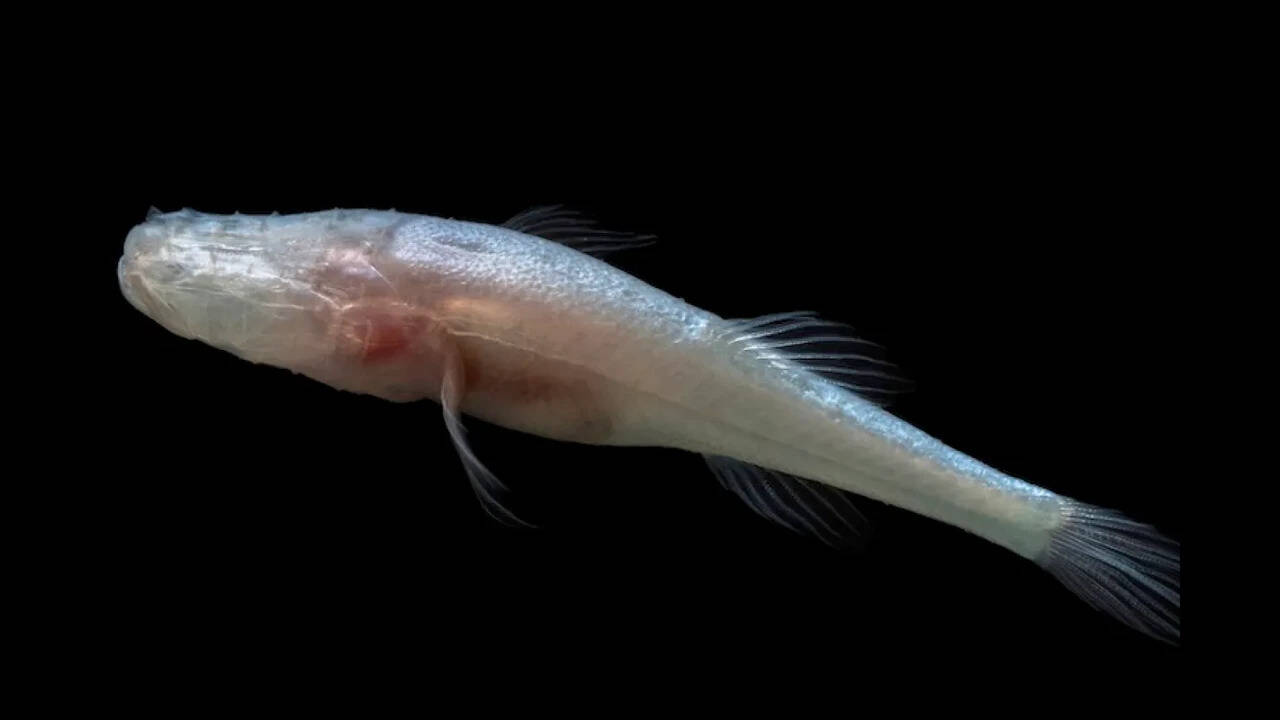
Meet Demogorgonichthys arcanus, commonly dubbed the Demon Cavefish. It is a ghostly, pale creature sporting a faint electric blue hue in life, completely devoid of eyes, and genetically distinct from anything scientists expected to find in North America. Finding a new species in a well-studied habitat is rare enough. Discovering an entirely new biological genus right where scientists had been looking for generations is practically unheard of.
The Mask of Convergent Evolution
How did this fish stay hidden for so long? The answer comes down to a classic biological trick called convergent evolution.
When unrelated species live in identical, pitch-black subterranean environments, nature tends to shape them the same way. The Demon Cavefish shares its underground pools with the Southern Cavefish (Typhlichthys subterraneus). Both species lost their eyes. Both lost their skin pigmentation, turning translucent and ghostly pale.
To field researchers conducting routine population counts with flashlights, the fish looked identical. Nobody thought to look closer because the visual box had already been checked. You see a pale, eyeless fish in an Alabama cave, and your brain automatically registers it as the common Southern Cavefish.
That complacency nearly kept Bobcat Cave's true resident secret forever.
Spotting the Difference
In February 2025, researcher Matthew Niemiller from the University of Alabama in Huntsville was surveying the cave. He noticed something slightly off about a specimen swimming in the pool. Its snout shape and overall body proportions didn't match the standard mental template of the local fauna.
Niemiller collected specimens and sent them to Auburn University for rigorous biological analysis. That is when the scale of the discovery became clear.
Researchers deployed high-resolution CT scans to examine the fish's skeletal structure. They ran genetic sequencing to trace its evolutionary tree. The results confirmed that the Demon Cavefish wasn't just a weird variant of a known species. It belonged to an entirely separate genus.
Geneticists also looked at the rhodopsin gene, which is responsible for light detection in vertebrates. In the Demon Cavefish, a massive chunk of this genetic recipe is entirely missing. Without those base pairs, the protein cannot form. Generations of living in total darkness stripped away even the blueprint for sight.
Where Did the Name Come From?
Taxonomy meets pop culture with the scientific moniker Demogorgonichthys arcanus.
The genus name references the underworld creature popularized by modern fantasy games and television shows like Stranger Things, though the name itself traces back through older literary traditions like John Milton's Paradise Lost. The species name, arcanus, translates to hidden or secret.
It is a fitting title for a predator that likely spends the vast majority of its existence deep within inaccessible, water-filled aquifer channels far below the cave floor, only occasionally venturing upward into the pools where humans can spot them.
Why This Discovery Matters Now
We like to think we have mapped every corner of the planet. Satellite imaging covers the globe, and DNA barcoding catalogs everything from backyard insects to deep-sea squids. Yet, the Demon Cavefish proves that entire evolutionary branches can hide right beneath our feet.
It also highlights the fragility of these hidden ecosystems. Researchers have rarely counted more than twenty individuals at any single time during surveys. Because these fish grow slowly, eat infrequently, and reproduce rarely, their underground populations are exceptionally vulnerable to environmental shifts. A single chemical spill or groundwater disruption near the military base could wipe out a lineage that survived underground for millennia.
Go ahead and look at local conservation guidelines if you ever explore karst regions or cave systems. Pay attention to local water runoff. Protecting subterranean habitats requires just as much care as saving a rainforest, because once an aquifer-dwelling genus vanishes into the dark, it is gone forever.