The smell of scorched coffee and damp wool always lingers in the marble corridors of Los Angeles City Hall after a rainstorm. For decades, that scent was the perfume of a very specific kind of hard-won influence. If you walked down the third floor in the late nineties or the early two-thousands, you knew who held the keys to the city’s conscience. You saw it in the crisp suits of the South Los Angeles councilmembers, heard it in the booming baritones echoing out of committee rooms, and felt it in the unspoken rule that nothing major happened in the nation’s second-largest city without the blessing of its Black political establishment.
Today, those same corridors feel quieter. The footsteps sound different.
Mayor Karen Bass sits in the corner office, the first woman and only the second Black person to hold the title in a city of nearly four million souls. On paper, this should be the zenith of Black political power in Southern California. It is the realization of a generational dream that began with Tom Bradley’s historic victory in 1973, a moment when a coalition of South L.A. voters and Westside progressives rewrote the rules of American urban politics. Yet, beneath the surface of Bass’s historic tenure, a quiet, gnawing anxiety is spreading through the barbershops of Leimert Park, the pulpits of West Adams, and the living rooms of Baldwin Hills.
The numbers tell a cold story, even before you listen to the whispers.
For years, Black residents made up a shrinking percentage of Los Angeles’s overall population, dropping from roughly seventeen percent in 1980 to just over eight percent today. Demographics are not destiny, of course, not in politics. Money, organization, and sheer force of will can often outpunch raw headcounts. But in Los Angeles, the demographic shift has collided with a series of brutal institutional blows, leaving the city’s Black leadership staring at a terrifying possibility. They are not just losing seats at the table. They are watching the table itself get moved to another room.
Consider a hypothetical afternoon in the life of a veteran community organizer we will call Marcus. Marcus has spent thirty years knocking on doors from Crenshaw to Watts, translating the dense, bureaucratic language of city budgets into paved streets, after-school programs, and police accountability. Twenty years ago, when Marcus needed a pothole filled or a youth center funded, he made two phone calls. One went to a Black councilmember who chaired a major committee; the other went to a longtime chief of staff who grew up three blocks from Marcus’s grandmother. The wheels turned. Today, Marcus dials those same extensions and hears unfamiliar voices, or worse, polite deflections from aides who view South L.A. not as the beating heart of the city’s moral coalition, but as just another competing interest group in a sprawling, hyper-fragmented metropolis.
This is the invisible crisis haunting Karen Bass’s administration as she navigates the treacherous waters of governance and prepares for the political battles ahead.
To understand why L.A.’s Black leaders are so deeply unsettled, you have to look beyond the mayor’s office and examine the fractured foundation beneath her feet. Politics in Los Angeles is often compared to a massive, intricate clockwork mechanism, but a better analogy is a game of musical chairs played in a room where the walls keep expanding. Every ten years, redistricting redraws the boundaries of power. Every election cycle brings new money, new ideological factions, and new demographic realities. And right now, the Black political bloc—once the undisputed kingmaker of the city—is operating with less institutional muscle than at any point in the modern era.
Look at the City Council. Out of fifteen districts, only three are currently represented by Black councilmembers: Marqueece Harris-Dawson in the Eighth, Curren Price in the Ninth, and Heather Hutt in the Tenth. Even that modest stronghold has been battered by scandal, legal peril, and bitter internal divisions. Remember the leaked audio tape from 2022? That single, sordid recording—in which three Latino councilmembers and a powerful labor leader casually discussed carving up Black political districts while spewing racist remarks—did not just spark outrage. It exposed a raw, unfiltered truth about how precarious Black representation had become. The tape was a flare fired into the night sky, illuminating the exact moment when historical alliances began to fray under the pressure of zero-sum municipal politics.
"We are watching an erosion that nobody wants to say out loud," one longtime South L.A. strategist told me recently, staring down at an untouched plate of catfish in a Crenshaw diner. "Karen is at the top of the mountain, yes. We love her. We fought for her. But look down the slope. The base camp is shrinking."
The strategist’s fear is rooted in hard arithmetic and brutal political reality. When Tom Bradley governed Los Angeles for twenty years, he did so by stitching together an ironclad alliance between Black voters in the south and white liberals on the west side. It was a marriage of shared ideals and mutual necessity. For half a century, that coalition dictated the city’s trajectory.
That coalition is gone.
In its place is a fractured political landscape where progressive democratic socialists, moderate business-backed Democrats, and an ascendant, increasingly diverse Latino electorate all compete for dominance. In neighborhoods like Koreatown, Mid-City, and parts of South L.A. itself, the streets have transformed. Spanish and Korean storefronts line boulevards where Black-owned businesses once stood as anchors of civic life. New residents arrive with different priorities, different histories, and no inherited loyalty to the civil rights machinery that built modern Black L.A.
And right in the middle of this swirling storm stands Karen Bass.
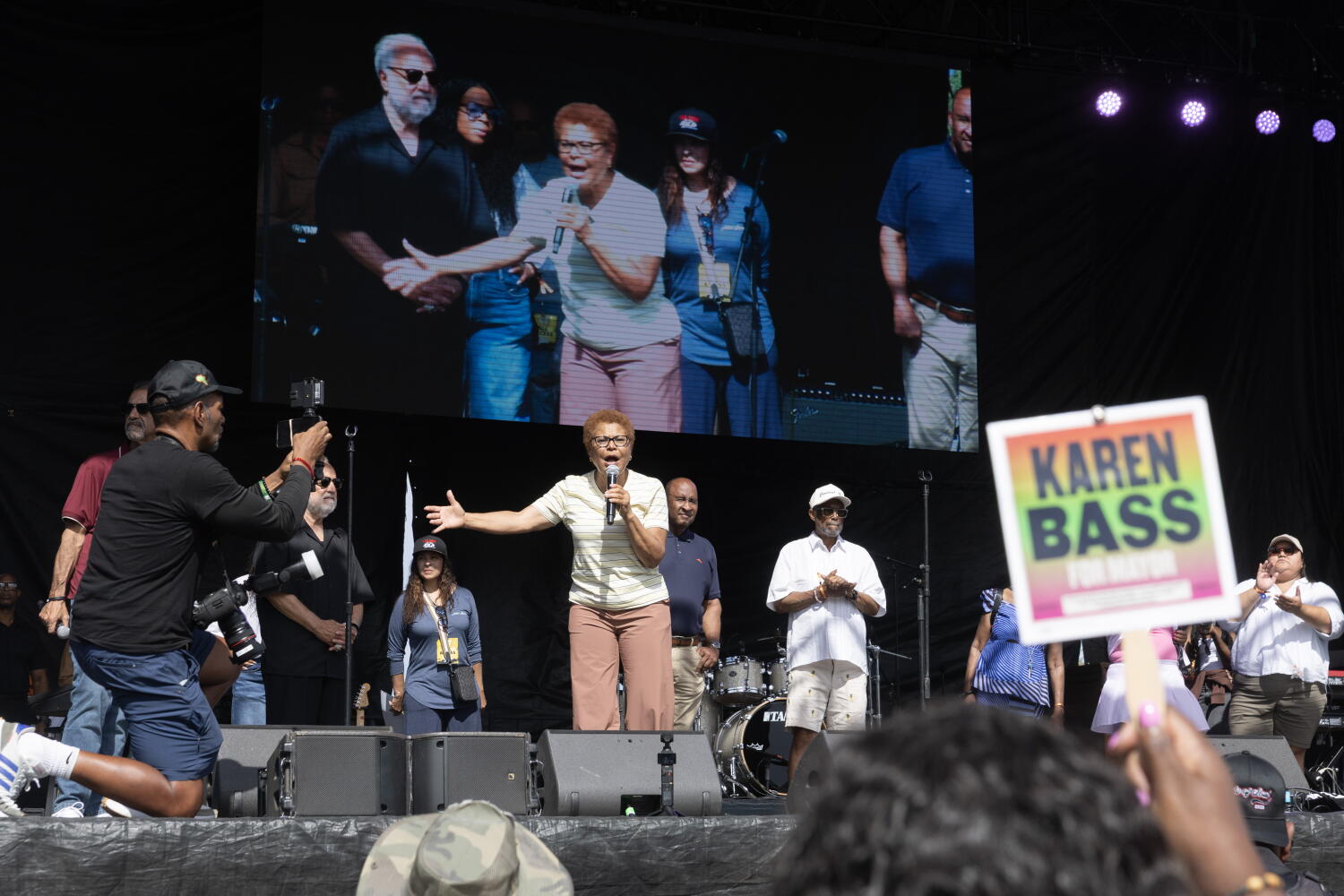
Bass is a consensus builder by nature, a former community organizer and congressional leader whose superpower has always been her ability to lower the temperature in a boiling room. When she defeated billionaire developer Rick Caruso in 2022, she did it by promising a new era of cooperation, bringing together warring factions to tackle the humanitarian catastrophe of homelessness. Her Inside Safe initiative moved thousands of people off the sidewalks and into motels, earning her early praise and a honeymoon period that felt almost miraculous in a cynical city.
Honeymoons, however, do not survive contact with a billion-dollar budget deficit.
As Los Angeles stares down severe financial headwinds, the cost of Bass’s signature programs has come under ferocious scrutiny. Critics from both the right and the left are circling. Business leaders grumble about taxes and slow permitting; progressive activists demand deeper cuts to the police budget and faster action on tenant protections; suburban homeowners in the San Fernando Valley—the very voters who nearly handed the mayor’s office to Caruso—are growing restless over crime rates and the slow pace of visible change on their neighborhood streets.
For Black leaders, the danger is painfully clear. If Bass’s approval ratings slip, or if the sheer weight of governing an ungovernable city leaves her vulnerable in future elections, there is no deep bench of institutionally powerful Black officials ready to catch the baton.
Think about what happens when a political movement loses its institutional memory. It is like an old house where the foundation settles unevenly; at first, you only notice a door sticking in the hallway, or a hairline crack above a window frame. You ignore it because the roof is still solid. Then one day, a heavy storm hits, and the whole structure groans under weight it used to carry effortlessly.
In Los Angeles, the hairline cracks are everywhere.
Take the Tenth Council District, historically the crown jewel of Black political empowerment in the city, stretching from Koreatown down through Mid-City and into Crenshaw. For years, that seat was mired in chaos following the federal corruption conviction of Mark Ridley-Thomas, a towering figure whose downfall left a vacuum that still hasn’t been fully filled. The appointment and subsequent election of Heather Hutt stabilized the seat, yet the bruising battles over who truly speaks for the district revealed deep fissures between older, church-based Black voters and younger, multi-ethnic progressive coalitions.
Meanwhile, in the Ninth District, veteran Councilmember Curren Price faces felony embezzlement and perjury charges that have cast a long shadow over his office, even as he remains in his seat fighting the allegations. When two of the three historically Black council districts are dealing with the fallout of legal battles and institutional trauma, the collective leverage of the entire caucus diminishes. Committee assignments get traded away. Budget priorities get watered down. When the mayor needs votes on the council floor to pass a difficult measure, she can no longer rely on an automatic, cohesive Black voting bloc to muscle it through.
I remember standing outside a community meeting in Leimert Park last autumn, watching an elderly woman in a purple Sunday hat argue with a twenty-something housing activist wearing a keffiyeh and carrying a clipboard. They were shouting past each other about a proposed apartment development near the new K Line metro station. The woman saw the project as another brick in the wall of gentrification, a sleek glass box designed to price her grandchildren out of the neighborhood their family had fought redlining to buy into in 1962. The young activist saw her as an obstacle to density, an obstructionist standing in the way of solving the housing crisis.
Neither of them was wrong. And both of them were losing.
That argument on the sidewalk is the microcosm of Karen Bass’s dilemma. How do you protect the cultural and political survival of a historic community when the very definition of progress in your city requires transforming the neighborhoods that community calls home? If Bass leans too hard into the demands of her traditional Black base—prioritizing legacy businesses, cautious development, and targeted investments in South L.A.—she risks alienating the younger, citywide progressive electorate that demands sweeping, universal policies. If she pivots toward the center to appease the San Fernando Valley and the downtown business establishment, she risks dampening the enthusiasm of the Black voters whose turnout was the absolute bedrock of her 2022 victory.
Turnout. That single word keeps political consultants awake at three in the morning.
In the 2022 general election, Black voters turned out at remarkably high rates to push Bass over the finish line against Caruso’s hundred-million-dollar self-funded juggernaut. They showed up because they saw one of their own on the ballot, a daughter of Venice and Fairfax who understood the texture of their lives without needing a briefing book. They showed up because the alternative felt like a hostile takeover of City Hall.
But enthusiasm is a perishable commodity. It cannot be stored in a vault and withdrawn four years later.
Across South Los Angeles, there is a growing sense of frustration that the tangible dividends of having a Black mayor have been too slow to materialize. Walk down Crenshaw Boulevard or Manchester Avenue and ask business owners how their year is going. They will tell you about the suffocating cost of commercial rent, the bureaucratic nightmare of getting a simple health permit approved, and the persistent sting of property crime that drives customers away after sundown. They see billions of dollars flowing into homelessness initiatives and Olympic preparations for 2028, yet they struggle to see how that river of money is watering their own dry soil.
"We didn't march and vote just to have a nice portrait hanging in the lobby," a barbershop owner near Slauson Avenue told me, wiping down a leather chair with practiced, rhythmic strokes. "We wanted our streets safe. We wanted our kids to have jobs building those stadiums and train lines. Right now, it feels like everybody is eating at the banquet except the folks who cooked the food."
This sentiment is not unique to Los Angeles, of course. Across major American cities—from Chicago to New York, from San Francisco to Atlanta—Black mayors are grappling with the exact same paradox. They have inherited the executive offices of great metropolises at the precise moment when urban governance has become nearly impossible. Post-pandemic tax revenues are stagnating. Federal stimulus dollars are drying up. The housing crisis has metastasized into a permanent state of emergency. Being the mayor of a major American city in the mid-twenties is less like being a triumphant general and more like being the captain of a ship trying to patch leaks in the hull while the crew argues over which way is north.
Yet in Los Angeles, the stakes carry a distinct, aching weight because of what the city once represented.
For generations, L.A. was the promised land for Black families fleeing the suffocating Jim Crow South. It was a place where working-class men with union jobs at the Goodyear tire plant or the Bethlehem Steel mill could buy a stucco house with a lemon tree in the backyard and send their kids to college. Out of that prosperity grew a political machine of extraordinary sophistication. Leaders like Tom Bradley, Mervyn Dymally, Yvonne Brathwaite Burke, and Maxine Waters didn't just win elections; they built an ecosystem. They trained staffers, mentored judges, steered contracts to minority-owned firms, and ensured that Black voices were woven into the DNA of municipal decision-making.
When current leaders look around today, they worry that the pipeline has rusted shut.
Where are the thirty-something Black aides learning the dark arts of budget reconciliation in City Hall? Where are the next-generation organizers being groomed to run for council seats in districts that are no longer majority-Black? For years, the political establishment relied on the comfort of safe seats and predictable coalitions. They assumed the machine would keep running on inertia. Now, as veteran leaders age out or step down, they are discovering that the next generation of ambitious young politicos is often bypassing traditional Black civic institutions altogether, aligning instead with labor unions, ideological caucuses, or issue-based nonprofits that view race through a very different lens.
None of this means Karen Bass is doomed, nor does it mean Black political power in Los Angeles is dead. Politics is cyclical, brutal, and endlessly surprising. Bass remains one of the most skilled retail politicians in California, capable of walking into a hostile room and leaving with three new allies and a commitment for funding. Her relationships in Washington and Sacramento still give her leverage that few mayors in America can match, a lifeline that could prove decisive as L.A. prepares to host the World Cup and the Summer Olympics.
Furthermore, crisis has a funny way of clarifying minds. The very anxiety gripping South L.A.’s leadership today has sparked an urgent, behind-the-scenes reckoning. Over the past few months, quiet strategy sessions have convened in church basements and living rooms across the city. Civil rights veterans, labor leaders, business owners, and young activists are finally having the uncomfortable conversations they avoided during the euphoria of Bass’s inauguration. They are talking about candidate recruitment, voter registration drives in apartment complexes, and how to build durable alliances with Latino and Asian American neighbors without erasing their own political identity.
Still, you cannot shake the feeling that an era is slipping through their fingers like dry sand.
Late one evening last week, long after the tourists and lobbyists had cleared out of the civic center, I watched a group of Black city staffers standing on the concrete steps outside City Hall, waiting for their rideshares. They were laughing about something, their voices echoing off the limestone facade, briefcases slung over their shoulders. Above them, the twenty-seven-story tower of City Hall glowed against the bruised purple of the downtown sky, a monument to permanence in a city built on fault lines.
Inside that tower, the lights in the mayor’s office were still burning. Karen Bass was still working, trying to hold together a fragile city, a shrinking coalition, and the heavy expectations of a people who fought for generations just to get her through the front door. Outside, the traffic roared down Spring Street, indifferent to history, rushing toward a future that nobody in the building can quite control anymore.