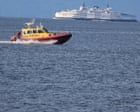
Six lives were cut short off the Canadian coast when a commercial charter vessel sank under conditions that marine investigators initially labeled as baffling. The primary failure in the immediate aftermath of the tragedy was a rush to blame rogue waves or freak weather, distracting from the systemic safety deficits that plague the commercial charter industry. A deeper analysis reveals that the vessel's sinking was not an unpredictable act of God, but the predictable consequence of regulatory gaps, delayed emergency signaling, and outdated stability requirements for modified civilian craft.
The investigation into the incident has forced a harsh spotlight onto how coastal regulators monitor small to mid-sized passenger vessels. While public attention naturally gravitates toward dramatic rescue efforts, the real story lies in the dry, bureaucratic failures that happen at the dock long before a ship ever faces heavy seas.
The Illusion of Coastal Safety
When a charter boat goes down rapidly, the immediate reaction from operators is often defensively focused on the environment. They point to shifting currents, sudden squalls, or unpredictable swells. Yet the North Atlantic and Pacific coastal waters of Canada are heavily monitored, and seasoned captains operate with highly sophisticated meteorological data.
The hard truth is that the margins for error on commercial charter boats have been shrinking for years.
To maximize profit margins, many operators push their vessels to the absolute limit of their legal capacity. A boat originally designed to carry a small crew and a light load is frequently retrofitted to accommodate dozens of tourists, heavy sport-fishing gear, and massive livewells filled with water.
The Hidden Danger of Vessel Modification
Every time a boat is altered to add more passenger space or upper-deck seating, its center of gravity shifts upward. This structural alteration compromises the vessel's ability to right itself after taking a wave.
- Top-heavy configurations significantly reduce the maximum roll angle a ship can endure before capsizing.
- Enclosed cabins added after market can trap air or, conversely, trap passengers when a vessel turns over rapidly.
- Aft-weighted loads decrease the bow’s clearance, making the vessel highly vulnerable to taking on water from behind, a phenomenon known as pooping.
When these modified vessels encounter standard coastal chops, they do not behave the way their original naval architects intended. A wave that a factory-standard hull would easily deflect can become a catastrophic event for a top-heavy, overloaded charter craft.
The Fatal Delay in Emergency Communications
In high-seas emergencies, time is measured in heartbeats. Yet in this latest disaster, a significant gap existed between the moment the vessel took on water and the moment regional joint rescue coordination centers received a distress signal.
This delay points directly to a reliance on manual distress signaling over automated systems. Many charter operations still utilize standard VHF radios as their primary means of calling for help. If a vessel capsizes rapidly, a captain cannot spend precious seconds reaching for a radio microphone, dialing in coordinates, and broadcasting a Mayday.
Why Automated Beacons Fail in Practice
The maritime industry has long championed Emergency Position Indicating Radio Beacons (EPIRBs). These devices are engineered to float free from a sinking ship and automatically broadcast location data to satellites. However, regulatory loopholes often exempt smaller charter vessels from carrying the most advanced hydrostatic-release EPIRBs, allowing them to rely on cheaper, manually deployed units instead.
If an EPIRB is mounted inside a wheelhouse rather than on an open deck, it can easily become trapped inside the sinking superstructure. It cannot float free. It cannot signal the satellite network. The crew is left entirely reliant on their own ability to survive in frigid waters until someone on shore notices they are overdue. By then, the window for a successful rescue operation has closed.
Regulatory Blind Spots in Commercial Outfitting
Canada's Transport Marine Safety guidelines are extensive on paper, but enforcement remains a chronic issue. Oversight agencies are perennially understaffed, leading to a system that relies heavily on self-reporting and infrequent physical inspections for smaller commercial hulls.
Consider the inspection regime for vessels under fifteen gross tonnage. These boats carry the vast majority of coastal tourists, yet they face a fraction of the scrutiny applied to large commercial ferries or cargo ships. An inspector might check the expiration dates on life jackets and flares, but they rarely conduct physical stability tests to account for years of accumulated modifications, heavier modern engines, or structural wear.
Vessel Class           Inspection Frequency   Stability Verification
---------------------------------------------------------------------
Large Commercial Ferry Annual                 Rigorous / Calculated
Small Charter (<15 GT) Quadrennial / Random   Visual / Self-Reported
This dual standard creates a false sense of security for paying passengers. They step onto a boat assuming that because it operates commercially, it has cleared the highest hurdles of safety engineering. In reality, it may be operating on an inspection framework that hasn't changed fundamentally in decades.
The Myth of the Freak Accident
Naval history shows that true freak accidents are vanishingly rare. What look like sudden, inexplicable sinkings are almost always the final link in a long chain of human errors, deferred maintenance, and regulatory compromises.
When a hull breaches, it is usually because a through-hull fitting failed, a bilge pump choked on debris, or a deadlight window shattered under the weight of a routine boarding wave. None of these events are mysterious. They are mechanical failures that occur when equipment is pushed past its service life in an environment that forgives nothing.
The industry must move away from treating maritime tragedies as unpredictable anomalies. Until regulators mandate automated, hydrostatic-release tracking systems across all passenger-carrying hulls, regardless of size, and enforce strict, calculations-based stability audits, the coastal charter sector will continue to experience these sudden, devastating losses. The cost of bureaucratic inertia is no longer abstract; it is written in the names of those lost to the sea.


