The room is dark. You cannot move your legs. You cannot move your arms. Worst of all, your chest refuses to expand. The air sits just inches from your lips, but it might as well be on the moon. You are suffocating in your own bed, and the only sound you can physically manage is a rhythmic clicking of your tongue against the roof of your mouth.
Click. Click. Click.
In the early 1950s, hospital wards across America were filled with that sound. It was the collective noise of paralyzed children desperately signaling for a nurse to adjust their mechanical breathers. It sounded, as Martha Lillard once recalled, like a room full of chickens.
Martha was one of those children. She was diagnosed with polio in 1953, right on her fifth birthday. She had woken up to a bright, sunny Oklahoma morning, eager to celebrate, but her neck throbbed with a blinding pain. Within days, she was completely paralyzed. Jonas Salk’s life-saving polio vaccine was still two years away from being declared safe. Martha missed safety by a mere twenty-four months.
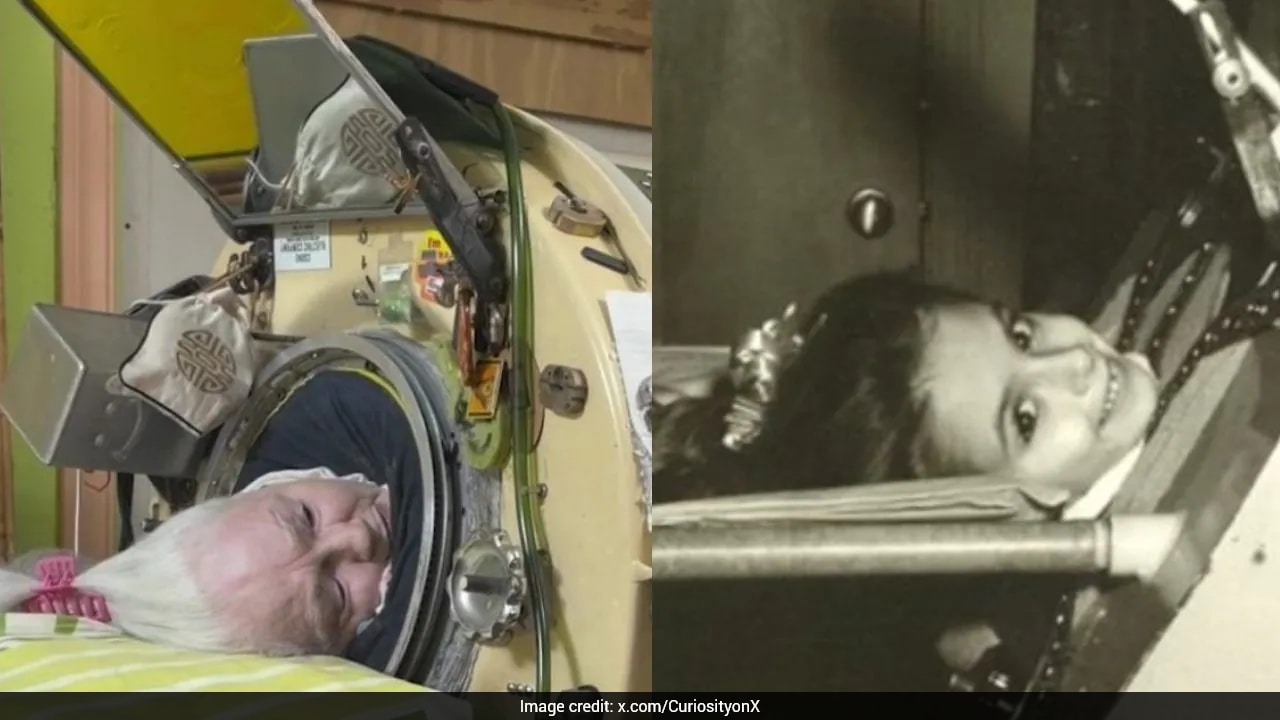
To save her life, doctors slid her small body into a massive, yellow steel cylinder known as an iron lung. It was a negative-pressure ventilator, a technological marvel of the mid-twentieth century that worked by altering the air pressure inside the tank to force the lungs to expand and contract. For Martha, entering that heavy metal capsule wasn't a horror. It was a rescue. It felt good to breathe again.
The doctors told her family she would not live past the age of twenty. They were wrong.
Martha lived to be seventy-eight. When she passed away on June 26, 2026, she took with her the final, living link to an era of American medical terror. She was the last known person in the United States who still relied on the iron lung to survive.
Life Inside the Iron Cylinder
Consider what happens when the world moves on from a technology that keeps you alive.
By the late twentieth century, modern positive-pressure ventilators—devices that push air directly into the airway via tubes—had completely replaced the bulky iron lungs. Production of the giant steel cylinders ceased entirely. Parts vanished from medical supply catalogs. Repair technicians retired and passed away.
Yet, Martha stayed with her machine. Modern ventilators required invasive procedures, and because of her severe scoliosis and the specific damage polio had done to her body, the ancient iron lung remained her best, safest option. For decades, she lived independently in Shawnee, Oklahoma, stepping out of the machine during the day to cook her own meals, paint, and care for her beloved beagles using the limited movement in her left arm. But every single night, she had to crawl back into the metal tube to sleep. It was her sanctuary, and it was her cage.
As the years ticked by, maintaining the machine became a terrifying logistical nightmare. When parts broke, Martha and her sister, Cindy McVey, had to hunt through vintage collections, old warehouses, and online enthusiast forums just to find a replacement gasket or a functioning motor.
The stakes were absolute. Without power, the machine was useless. During an Oklahoma ice storm in the early 2000s, the power grid collapsed, and Martha’s emergency generator failed to kick on. Locked inside the cold metal tube, unable to move, she lay frozen as the temperature plummeted, struggling just to dial 911. She described it as the terrifying sensation of being buried alive. In 2025, a tornado knocked out the power again. That time, her husband had to give her mouth-to-mouth resuscitation in the dark until help arrived.
Love and Resilience Across an Ocean
Many people would look at a life constrained by seven hundred pounds of steel and see only tragedy. Martha did not see it that way. She possessed an indomitable drive to experience the world, even if she had to view much of it through a mirror positioned above her head.
She attended high school through a custom-built home-to-school telephone intercom system, graduating as a member of the National Honor Society. When her family went on road trips, her father built a custom trailer to haul her iron lung and called ahead to hotels to measure door frames, ensuring his daughter could see the world beyond Oklahoma.
When the internet arrived, it became Martha's window to the cosmos. After the tragedy of September 11, 2001, she logged into international chat rooms, driven by a deep desire to understand the perspectives of people outside her borders. There, she met a man named Baha Salh living in Egypt.
What began as a conversation between strangers turned into a deep, decades-long romance. They talked, shared their lives, and loved each other through screens for twenty-two years. In February of 2026, after a lifetime of waiting and navigating complex visa systems, Baha finally arrived in Oklahoma. They were married. For a brief, beautiful window of time, the woman who spent her life in a machine found her perfect soulmate by her side.
The Invisible Threat
We often treat historical diseases as ghosts that can no longer touch us. Polio was officially eradicated in the United States in 1979, fading into text books and black-and-white photographs. We forgot the panic of summers when public pools were drained and parents locked their children indoors out of sheer terror.
But the past always casts a long shadow. Martha survived the great epidemic of the 1950s with less than twenty-five percent of her lung capacity. She spent seventy-three years fighting a daily battle against gravity and muscular decay.
Ultimately, it was not the old virus or a mechanical failure of her iron lung that took Martha’s life. It was a modern contagion. Martha contracted COVID-19 twice during the global pandemic, leaving her with the debilitating, lingering exhaustion of long-haul COVID. The virus compromised what little respiratory reserve she had left. For the final eight months of her life, she could no longer leave the machine at all. She was confined to the cylinder twenty-four hours a day, her world shrinking back to the dimensions of the metal tank that had claimed her childhood.
Martha knew her time was short. She wrote her own obituary, focusing not on her limitations, but on her volunteer work with the Humane Society and her love for animals. She left a legacy of fierce independence, proof that a human spirit can thrive even when the body is trapped in a monument of mid-century engineering.
When she closed her eyes for the last time on June 26, the rhythmic, mechanical sigh of her iron lung finally stopped. For seventy-three years, that machine had pumped life into her chest, breath by mechanical breath. Now, the last cylinder sits empty, its long vigil over, marking the quiet conclusion of a chapter of human suffering we must never forget.