The modern battlefield does not roar. It buzzes.
It is a high-pitched, persistent whine, like a swarm of mosquitoes trapped inside your helmet. For a soldier sitting in the back of an armored personnel carrier, that sound is the most terrifying thing on earth. It means a first-person-view (FPV) drone, packed with high explosives, is hunting.
Consider a young infantry sergeant, someone we can call Marcus. He is racing through a dirt corridor, eyes scanning a blank sky. He knows the math. If an FPV drone crests the tree line at ninety kilometers per hour, Marcus has roughly four seconds to live.
Historically, defense meant turning a weapon toward the threat. But humans are slow. Mechanical gears are slow. Even the most advanced motorized turrets require a fraction of a second to slew, aim, and lock. When a drone is closing at twenty-five meters per second, those fractions are a death sentence. If a swarm attacks from three directions at once, traditional defense systems simply choke on the geometry of their own limitations. They cannot be everywhere at once.
The industry tried to solve this with electronic warfare, flooding the skies with jamming signals to sever the link between the drone and its pilot. For a while, it worked. Then the enemy got smarter. Today, troops face fiber-optic drones that unspool a microscopic glass thread behind them as they fly, or autonomous sub-munitions guided entirely by internal computer vision. They emit no radio signals. They do not care about jamming. Against this breed of threat, electronic warfare is entirely useless.
You cannot hack a piece of flying glass. You have to break it.
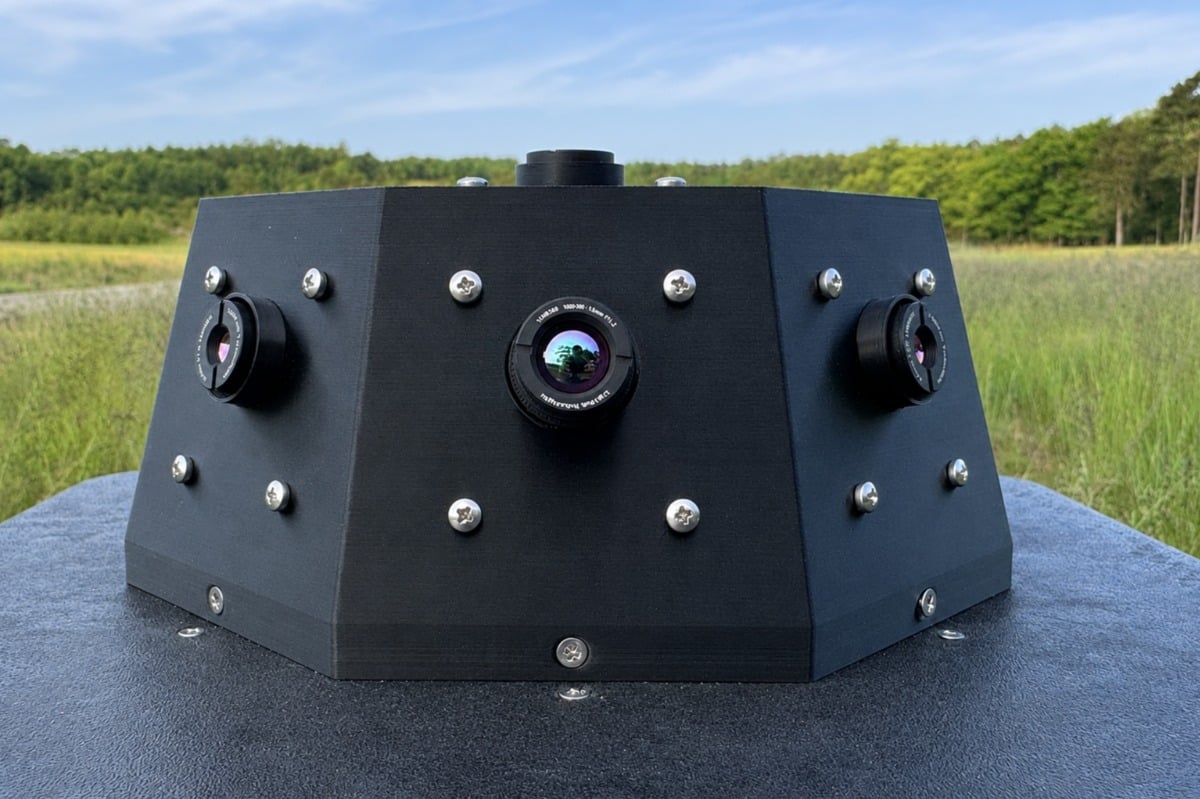
This reality forced a radical shift in perspective, culminating in a bizarre, pot-shaped machine unveiled by an American startup called Picket Defense Systems. They call it the Inferno Rotating Turret Close-In (RTC).
The machine looks less like a weapon and more like a massive, metallic beehive. Instead of a single barrel that must awkwardly swing toward a target, the Inferno RTC uses a continuously spinning dome peppered with dozens of fixed barrels pointing at every conceivable angle. The lighter forty-five-pound version bristles with thirty-six barrels firing shotgun shells and rifle rounds. The heavier ninety-pound variant uses fifty-four barrels capable of painting the sky with 12-gauge buckshot and 40mm low-velocity munitions.
It is a brute-force answer to an elegant nightmare. The turret does not waste precious milliseconds aiming. Because its barrels cover a full hemisphere, a firing solution is always aligned with the threat. The moment a drone enters the kill zone, the system simply fires the barrel that happens to be pointed at it. Aiming latency is reduced to absolute zero.
But a weapon is only as good as its eyes.
Until recently, close-in defense relied heavily on compact radar systems to spot incoming projectiles. But radar has a fatal flaw on the modern battlefield: it broadcasts. Turning on a radar array is the electronic equivalent of lighting a flare in a dark room. Every electronic intelligence sensor within fifty miles immediately locks onto your position. You might shoot down the drone, but you invite an artillery barrage five minutes later.
To survive, a weapon must be completely silent. It must watch without being seen.
The Inferno RTC originally achieved this by listening, using a three-dimensional acoustic microphone array combined with optical cameras to track the distinctive whine of drone rotors. But sound can be tricked by wind, ambient combat noise, or topographic echoes. Sight can be blinded by thick fog, battlefield smoke, or the blinding glare of the setting sun.
To close this vulnerability, Picket Defense Systems took a step that reshapes the mechanics of survival. They integrated a 360-degree passive infrared sensing architecture into the core of the turret.
Infrared sensing does not emit a signal. It does not project radar waves or lasers. Instead, it sits in absolute silence, reading the thermal signature of the universe. Every object with a temperature above absolute zero radiates heat. A drone, no matter how small, possesses a hot electric motor, a warming battery, and friction across its synthetic propellers. To a passive infrared sensor, that tiny plastic aircraft glows against the cold backdrop of the sky like a match struck in a coal mine.
By pairing acoustic tracking with thermal vision, the system removes the variables of human error and atmospheric deception. The internal artificial intelligence processes the multi-spectral data stream locally, without relying on external networks or cloud computing that could be intercepted or disrupted. It calculates the trajectory, prioritizes the closest threat in a multi-angle swarm, and triggers the correct barrel. All within a split second. All while remaining entirely invisible to enemy sensors.
It creates a hard, forty-meter dome of survival. If a drone crosses that line, it is met with a wall of lead and fire, triggered by a machine that saw the heat of its engine before the human ear could even register its pitch.
The technology is undeniably elegant, but we must acknowledge the profound discomfort of where this path leads. We are looking at a world where human reflexes are no longer fast enough to survive the weapons humans created. Marcus cannot save himself. His survival relies entirely on an autonomous, 3D-printed resin pot spinning on the roof of his vehicle, making life-and-death calculations at the speed of microprocessors.
There is an undeniable terror in trusting our lives to algorithms that hunt the heat signatures of machines. Yet, as the sky continues to fill with automated hunters, the only shield left may be the one that watches in total darkness, waiting for the warmth of an enemy approaching in the night.