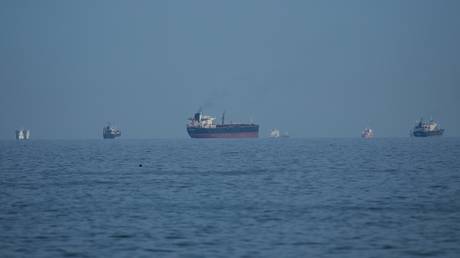
The Black Sea does not care about borders, but it has a memory for heat. On a night that should have been defined by the rhythmic, salt-heavy pulse of the tide against the Krasnodar coast, the darkness was instead punctured by a jagged orange bloom. It was a vessel on fire. To a casual observer on the shore, it was a tragedy of wood and steel. To the man watching from the sprawling, billion-pound fortress tucked into the cliffs of Gelendzhik, it was a message.
Vladimir Putin’s "palace"—a monument to absolute power complete with an underground hockey rink, a strip club, and a church—is designed to be a sanctuary of total control. It is a physical manifestation of the idea that if you build enough walls, the world’s problems stop at the perimeter. But as the smoke from a burning ship drifted toward the manicured gardens of the Praskoveevka estate, that illusion of distance evaporated. The war, which for years was a curated series of images on a flickering screen in Moscow, finally found its way to the backyard.
The Architect of Shadows
Imagine a man who has spent two decades building a labyrinth. Every brick is placed to ensure that no one can reach the center without permission. Every guard is vetted; every piece of fruit is tested for toxins. This is the life of a leader who has traded the open air for the security of a bunker. Intelligence reports suggest that the Russian President has become increasingly isolated, retreating into a world of encrypted lines and long tables.
This isolation isn't just physical. It is psychological. When you are surrounded by "yes-men" whose survival depends on your mood, the truth becomes a secondary concern. You begin to believe your own mythology. You believe that the Black Sea is a private lake and that the coastline of southern Russia is an impenetrable shield. Then, a ship ignites.
The fire on the water was not an accident of nature. It was a symptom of a shifting front. Ukraine’s reach has grown long and nimble, utilizing maritime drones and long-range capabilities that ignore the traditional rules of engagement. For the occupant of the palace, the sight of flames through a telescope is more than a tactical loss. It is a puncture wound in the narrative of invincibility.
The Palace of Paranoia
The Gelendzhik estate is often described as a "palace," but that word implies a place of gathering and celebration. This structure is a fortress. It is estimated to cost over £1 billion, funded by a complex web of oligarchic "contributions" that track back to the very dawn of the Putin era. It sits on a cliffside, overlooking the water, yet it is honeycombed with tunnels that lead deep into the earth.
These tunnels are not just for escape. They are for survival in a world that has grown increasingly hostile. The architecture tells a story of fear. Why does a man who claims to be the father of a nation need a nuclear-hardened bunker beneath his vacation home? Because the father knows that the children are restless, and the neighbors are armed.
The ship burning in the distance served as a lighthouse for the reality Putin has tried to ignore. It illuminated the fact that the Russian Navy—once the pride of the Tsars—is struggling to protect its own shores. The spectacle of a vessel engulfed in flames, visible from the windows of the nation’s most expensive private residence, is a PR disaster that no state-controlled news cycle can fully erase. People have eyes. They see the smoke. They hear the sirens.
The Invisible Stakes of a Floating Pyre
War is often discussed in terms of "territorial gains" or "attrition rates," but the real war is fought in the minds of those who start it. For the Russian elite, the safety of the Black Sea coast was a given. It was their playground, their Riviera. When the violence of the conflict spills into these protected zones, it creates a friction that cannot be oiled away by propaganda.
Consider the sailors on that ship. While the world focuses on the "tyrant in the bunker," there are men whose lives are consumed by the heat. They are the collateral of an ambition they didn't script. Their screams are muffled by the distance, but the fire they leave behind speaks volumes. It tells the residents of the nearby villages that the front line is no longer "over there." It is here. It is in the water they fish. It is in the air they breathe.
This is the hidden cost of the bunker mentality. When a leader retreats from reality, the reality has to scream louder to be heard. A burning ship is a very loud scream.
A Fortress Built on Sand
There is a profound irony in the location of the palace. It sits on the edge of a cliff, a place where the land is constantly being eroded by the very sea Putin claims to dominate. Geologists might call it coastal instability; historians might call it fate.
The security apparatus around the palace is legendary. No-fly zones, no-sail zones, and a forest guarded by the Federal Protective Service (FSO). Yet, a drone or a missile doesn't care about a "no-fly" sign. The technology of modern warfare has rendered the classic fortress obsolete. You can build a wall a mile high, but the sky is still open. You can dig a bunker a mile deep, but the oxygen still has to come from the surface.
The "paranoid tyrant" trope is common in Western media, but it misses the nuance of the tragedy. It isn't just paranoia; it is the logical conclusion of a life spent prioritizing power over people. If you treat the world as a chessboard, you eventually realize that you are just another piece, and the board is on fire.
The Cracks in the Concrete
The fire eventually died down, as all fires do. The blackened hull of the ship drifted or sank, and the morning sun likely hit the gold-plated fixtures of the palace with its usual indifference. But something changed in the silence that followed.
Every time a ship burns within sight of the palace, the walls of the bunker feel a little thinner. The guards at the gate look at the horizon a little longer. The staff inside the palace, the cleaners, the cooks, and the technicians, begin to wonder if the concrete above their heads is thick enough.
Information in Russia is a restricted commodity, but gravity is not. The weight of the war is pulling everything downward, toward the center, toward the man who thought he could outrun the consequences of his own choices. The palace was meant to be a legacy—a monument to a new Russian Empire. Instead, it is becoming a gilded cage, a front-row seat to the dismantling of the very security it was built to provide.
The fire is gone, but the smoke lingers in the curtains and the carpets. It lingers in the mind of the man who watches the sea, waiting for the next spark to appear on the waves. The war has come to the door, and no amount of billion-pound masonry can keep the heat from seeping through the cracks.
The sea remains. The palace remains. But the peace is a ghost, burned away in the sight of a house that was never meant to be a home.