Paint peels. Wood rots. Gravity wins.
Every homeowner knows this quiet, relentless war against entropy, though few fight it under the glare of a million tourist cameras. Stand on the grass at Alamo Square on a Tuesday afternoon, and you will see them—hundreds of visitors angling their phones toward that famous row of Victorian houses known as the Painted Ladies. To the crowd, those seven structures are a postcard, a frozen relic of nineteenth-century optimism, or the opening credits to a nineties sitcom they watched in their childhood living rooms. If you found value in this post, you should look at: this related article.
To the people who actually own them, they are hungry beasts that eat money, sleep, and sanity.
A few years ago, one of those iconic houses—specifically, the pink one at 714 Steiner Street—changed hands for $1.85 million. In San Francisco, a city where a windowless basement studio can command the price of a Midwestern mansion, $1.85 million sounded almost like a clerical error. A steal. A golden ticket. For another look on this story, see the latest update from ELLE.
Then the doors opened, and the reality of what $1.85 million actually bought in San Francisco came spilling out. It wasn't a home. It was a shell. A gutted, sagging, unlivable skeleton of redwood and plaster that hadn't been touched in decades, waiting for someone brave—or reckless—enough to pour a fortune into its veins. Now, after a grueling, multi-year resurrection, that same house has returned to the market with a price tag of $5.595 million.
Numbers like that make people angry. They provoke knee-jerk cynicism about greed, gentrification, and the broken math of American real estate. If you look at the transaction purely as a spreadsheet—buy at $1.85 million, list at $5.595 million—it looks like an effortless $3.7 million windfall. A flip. A quick coat of trendy pastel paint and some brass cabinet pulls.
Look closer, though, and the spreadsheet dissolves into sawdust, permit delays, and structural terror.
The Anatomy of a Beautiful Wreck
To understand why a Victorian house in San Francisco can leap nearly four million dollars in value without growing an inch in square footage, you have to understand what happens behind the gingerbread trim.
Let's imagine a hypothetical buyer—call him Arthur—who walked into 714 Steiner Street back when it was priced under two million. Arthur isn't a cartoon villain in a tailored suit; he's an architect or a seasoned builder who knows how to read the bones of an old building. When Arthur steps across the threshold, he doesn't see the charming bay windows that tourists photograph from across the street. He smells damp earth. He sees floorboards sloping at a four-degree angle toward the neighbor's foundation. He looks up and sees knob-and-tube wiring from the 1910s, brittle as dry pasta, snaking through walls packed with nothing but horsehair plaster and cold Pacific fog.
In San Francisco, a "fixer-upper" isn't a weekend project with a tile saw and a YouTube tutorial. It is an archaeological dig governed by some of the strictest building codes and historic preservation laws on the planet.
Because 714 Steiner Street sits inside a designated historic district, you cannot simply knock down a rotting wall and replace it with something modern. Every exterior detail—the corbels, the window sashes, the exact profile of the wooden trim—is policed by city planners and preservationists. If a custom-milled piece of redwood trim takes sixteen weeks to fabricate by a specialist carpenter in Marin County, you wait sixteen weeks. While you wait, you pay carrying costs. You pay property taxes. You pay insurance on a vacant construction zone.
And that is just the skin of the house. The real money disappears underground, where nobody ever takes a selfie.
San Francisco sits on sand, landfill, and seismic faults. Most Victorian homes built in the 1890s rest on brick foundations held together by lime mortar that has slowly turned to dust over a century of minor tremors and shifting water tables. Before a single kitchen cabinet can be ordered, the entire three-story structure often has to be jacked up on steel beams while crews excavate beneath it, pouring tons of reinforced concrete to create a modern foundation and a subterranean garage.
Think about the sheer audacity of that engineering. Lifting a fragile, 130-year-old wooden house into the air while tourists pose on the sidewalk twenty feet away, hoping the plaster doesn't crack from the vibration of a passing Muni bus. That process alone—excavation, steel moment frames, underpinning—can easily swallow a million dollars before you even have a functioning toilet.
The Invisible Ledger
When people ask how a house jumps from $1.85 million to $5.595 million, they are usually asking a hidden question: Is anyone actually making money on this, or is the entire city out of its mind?
The honest answer is messy, uncomfortable, and surprisingly thin on profit margins.
If you trace the math of a full-gut luxury renovation in Northern California, the $3.745 million gap between the purchase price and the new asking price starts shrinking at a terrifying speed. High-end construction in San Francisco routinely runs between $800 and $1,200 per square foot, sometimes more when historic preservation rules dictate custom craftsmanship. On a roughly 3,000-square-foot Victorian, a down-to-the-studs rebuild—new plumbing, zoned radiant heating, seismic retrofitting, custom millwork, chef's kitchen, spa bathrooms, landscaped rear yard—easily consumes $2.5 million to $3 million in hard construction costs alone.
Then come the soft costs. Architectural fees, structural engineering, soil reports, city permitting fees that drag on for eighteen months while blueprints bounce between departments. Add another $300,000 to $400,000.
Then add the cost of money itself. Nobody buys a $1.85 million teardown and funds a $3 million renovation out of a checking account without feeling the burn of interest rates or opportunity cost. Two years of financing, property taxes, and specialized builder's risk insurance quietly eat another $300,000 to $500,000.
Suddenly, that $3.7 million "profit" looks a lot like breaking even—or gambling three years of your life and millions of dollars in capital for a ten percent return that could vanish if the market dips during a foggy autumn.
I have walked through dozens of these luxury transformations over the years, running my hand along newly plastered walls that look effortless and serene. You stand in a sunlit kitchen with a massive marble island and floor-to-ceiling steel doors opening onto a terraced garden, and it feels peaceful. Quiet. Inevitable. You don't see the three-month fight over a sewer lateral connection. You don't see the contractor who walked off the job, or the custom window shipment that arrived shattered, or the sleepless nights staring at a spreadsheet wondering if you just bankrupted yourself to save a piece of architectural history.
Living Inside a Postcard
There is another layer to this story that money doesn't solve, and it belongs to whoever actually writes the check for $5.595 million.
Buying a Painted Lady is fundamentally different from buying a mansion in Pacific Heights or a compound in Marin. Those neighborhoods offer gates, hedges, and anonymity. Steiner Street offers none of that. When you buy one of the Seven Sisters, you are buying a stage.
Consider what daily life actually looks like behind that freshly painted facade. You wake up on a Saturday morning, pull back the curtains in your primary bedroom to check the weather, and lock eyes with forty people standing across the street with telephoto lenses. You walk down your front steps to grab a bag of groceries from your car, and three different families ask you to pause so you don't ruin their framing. Drones buzz outside your third-floor windows like mechanical wasps. Delivery drivers can't find parking because tour buses double-park along the block from sunrise until dusk.
Why would anyone pay nearly six million dollars to live inside a fishbowl?
Because human beings don't buy trophy real estate with the rational part of their brains. If real estate were purely about shelter and return on investment, nobody would ever restore a nineteenth-century wooden house on a seismic fault line. We buy things like this because we want to touch permanence. In a city driven by ephemeral software, shifting valuations, and digital products that vanish overnight, a 130-year-old house that survived the 1906 earthquake and fire feels like an anchor. It is physical proof that something can endure.
The Real Cost of Preservation
There is a quiet irony in how cities treat their landmarks. Everyone loves the Painted Ladies. Politicians use them on tourism brochures; residents point to them with civic pride; visitors travel across oceans just to sit on the sloped lawn across the street and watch the late afternoon sun turn their facades gold.
Yet the city itself doesn't pay to keep them standing.
Left alone, historic houses die. Wood absorbs moisture from the coastal air, dry rot spreads through the framing like a slow cancer, foundations settle unevenly, and roofs leak until ceilings collapse. Without private buyers willing to absorb millions of dollars in construction risk, bureaucratic friction, and structural engineering, those famous postcards wouldn't be charming relics—they would be condemned eyesores behind chain-link fences.
That is the unspoken bargain of San Francisco real estate. We complain about the staggering price tags, and rightfully so; a housing market where $5.595 million is the cost of entry for a restored four-bedroom home is deeply broken for ordinary families, teachers, nurses, and artists. At the same time, preserving the physical soul of a historic city requires absurd amounts of capital, patience, and specialized labor that almost nobody possesses.
Both truths sit side by side on Steiner Street, as inseparable as the seven houses themselves.
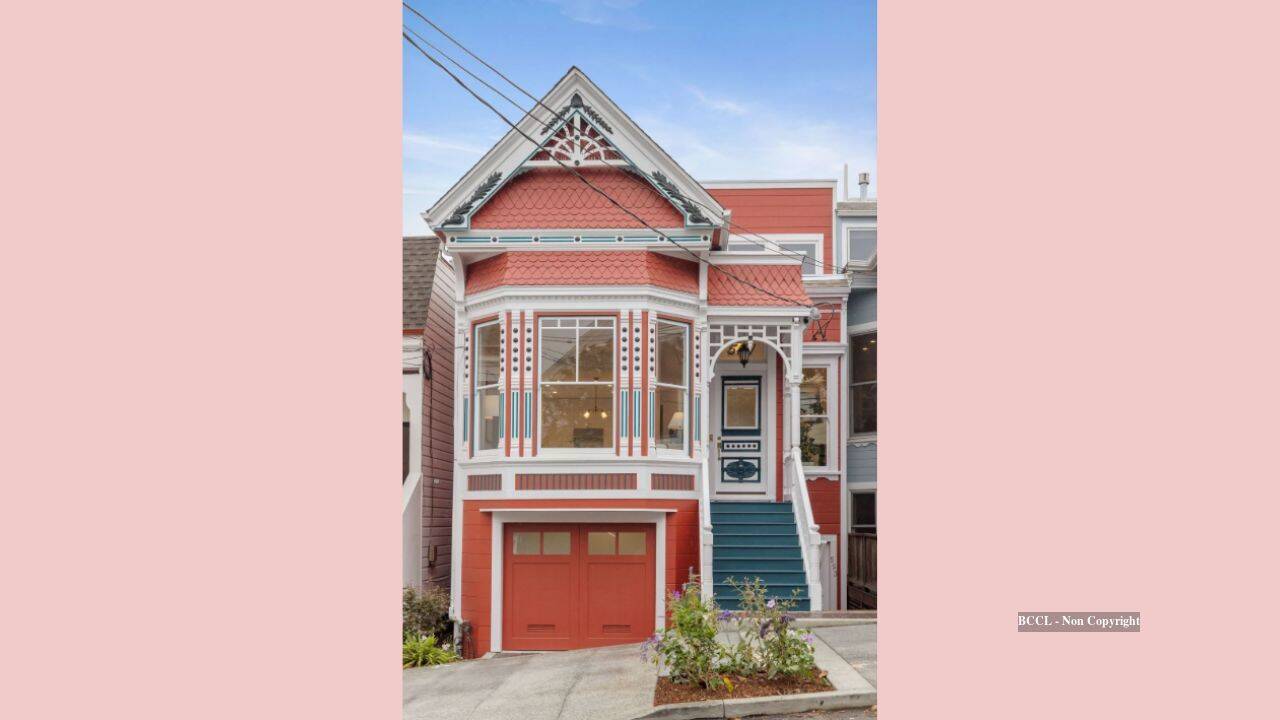
Walk past 714 Steiner Street today, and the transformation is undeniable. The facade glows in soft, freshly applied hues, every piece of trim crisp and symmetrical against the pale blue sky. Inside, the sagging floors are level, the hidden steel beams are bolted deep into fresh concrete, and the drafty rooms have been reimagined into warm, light-filled spaces built for the next century. The ghost has been given a new body.
Across the street on the grass of Alamo Square, a teenager raises a phone, lines up the row of colorful roofs against the downtown skyline, and taps the screen. The shutter clicks, capturing a fraction of a second of effortless beauty—never knowing the small fortune buried beneath the floorboards just to keep the frame from falling down.