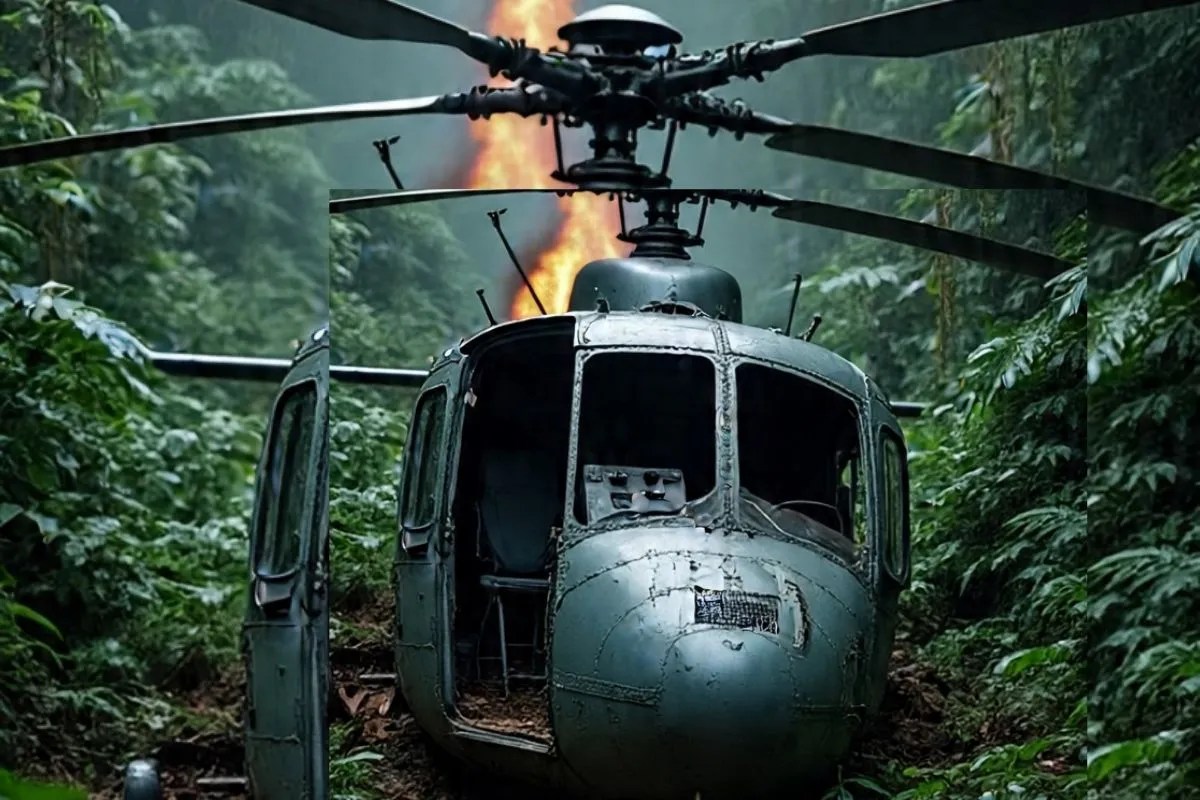
The metal was still warm when the first of the villagers reached the clearing. In the dense overhead canopy of the jungle, the air usually carries the scent of damp earth and rotting vegetation. Now, it smelled of scorched kerosene and something sharp, metallic, and final.
Eight lives don't just vanish. They leave a vacuum.
We often treat aviation statistics as math. We look at flight hours, maintenance logs, and weather charts as if they are the sum total of the event. But a helicopter crash is not a math problem. It is a sudden, violent interruption of eight different stories that were supposed to continue long after the rotors stopped spinning.
The Weight of Five Minutes
The flight began like any other routine departure. There is a specific kind of confidence that comes with a vertical takeoff—the way the ground falls away, the stomach-flipping transition from being tethered to the earth to being supported by nothing but physics and a spinning blade. For the eight people on board, those first four minutes were likely filled with the mundane. A glance at a watch. A quick adjustment of a seatbelt. Perhaps a shared look at the sprawling green carpet below.
Then came the fifth minute.
Five minutes is barely enough time to finish a cup of coffee. It is the length of two songs on the radio. In the world of aviation, however, the fifth minute is often where the invisible flaws of the machine or the environment converge. It is the moment when the "routine" dissolves.
Witnesses near the edge of the forest described a change in the acoustic signature of the engine. It wasn't a bang. It was a stutter—a rhythmic hesitation that signaled a mechanical heart failing its body. When a helicopter loses power or structural integrity at low altitude over dense terrain, the pilot isn't fighting for a landing anymore. They are fighting for seconds.
The Physics of a Falling Star
To understand what happened in that jungle, you have to understand the fragile pact between a pilot and the atmosphere. Unlike an airplane, which wants to glide, a helicopter is a collection of thousands of parts flying in close formation, all of them seemingly trying to vibrate apart.
When the aircraft began its descent, it wasn't a graceful arc. The trees in this part of the world are unforgiving. They are ancient, thick-limbed giants that do not cushion a fall; they shatter the object falling into them. The impact happens twice: first with the canopy, which strips the rotors and tears at the fuselage, and then with the ground.
The tragedy of the eight souls on board isn't just in the collision. It’s in the transition from the high-tech precision of a cockpit to the raw, indifferent silence of the wilderness.
Consider the pilot. Imagine the sudden, overwhelming workload of a cockpit filled with warning lights. There is no time for fear, only for the desperate, muscle-memory search for a clearing that doesn't exist. There is the frantic manipulation of the cyclic and collective, trying to trade airspeed for a survivable impact. Then, the green wall of the jungle rises up to meet the glass.
The Human Echo
We see the headlines: "8 Dead." We see the grainy video of smoke rising from between the trees. But the real story is in the empty chairs waiting at eight different dinner tables tonight.
One of the passengers might have been traveling for work, his mind still on a spreadsheet he never finished. Another might have been heading home, carrying a small gift in a bag that is now scattered across the forest floor. These aren't "occupants" or "victims." They were people in the middle of sentences.
The forest has a way of swallowing sound. Within an hour of the crash, the birds usually begin to sing again. The insects return to their rhythmic buzzing. To the jungle, the introduction of several tons of twisted alloy is just another layer of debris on the floor. But for the families, the silence is deafening.
Search and rescue teams often speak of the "golden hour," that window where life might still be clinging to the wreckage. In this case, the jungle was too thick and the impact too severe. By the time the rotors were still, the story had already shifted from a rescue to a reckoning.
The Invisible Stakes of Every Flight
Every time we board a craft that defies gravity, we are participating in a miracle we’ve grown bored with. We check our phones. We complain about the legroom. We forget that we are suspended in the air by a series of controlled explosions and mechanical spinning.
This crash serves as a brutal reminder of the stakes. Investigators will spend months combing through the site. They will look for fatigue in the metal. They will analyze the fuel. They will listen to the black box recordings to hear the final, desperate words of a crew trying to save their passengers.
They will find a cause. Maybe it was a bird strike. Maybe a hydraulic line gave way. Maybe a sudden downdraft caught the tail rotor.
But a "probable cause" doesn't fill the void.
The true cost of progress in aviation is written in these tragedies. We learn how to make the next flight safer by dissecting the remains of the one that didn't make it. It is a grim, necessary cycle. Every safety protocol we follow today—every redundant system and every pre-flight check—is a ghost of a past accident.
As the sun sets over the crash site, the smoke eventually clears. The recovery teams move in, their flashlights cutting through the humid dark. They move with a quiet, somber efficiency, aware that they are stepping into a graveyard that was a vibrant transport vessel only hours before.
The jungle will eventually grow over the scars in the earth. The vines will wrap around the rusted struts. The metal will disappear under a shroud of moss. But the families of the eight will never look at a clear blue sky the same way again. They will always see the five minutes that changed everything, and they will always listen for the sound of a rotor that never returned.
Death in the clouds is quick, but the grief it leaves on the ground is a long, slow walk through the dark.