The ink on the envelope is never as loud as the silence that follows its opening.
In a quiet apartment in North Rhine-Westphalia, twenty-year-old Julian stares at a piece of heavy cream-colored paper. Outside his window, the autumn rain drums a steady, indifferent rhythm against the double-paned glass. The world goes on. Cars swerve on the wet asphalt. Pedestrians pull their woolen collars tight against the chill. But inside this room, time has fractured. For another view, check out: this related article.
The letter does not scream. It does not threaten. It merely invites. It asks him to consider his civic duty, to weigh his place within the republic, to step forward and register for military service.
A few years ago, that envelope would have been an artifact of history—a ghost of an era most Germans thought they had buried alongside the Cold War. Conscription was suspended in 2011. The barracks grew quiet. The mandatory year of service became a fading memory told by older uncles over Sunday roast, stories of peeled potatoes, muddy boots, and cold dawn roll calls. The draft was a relic. Similar coverage on the subject has been provided by The Washington Post.
Until recently.
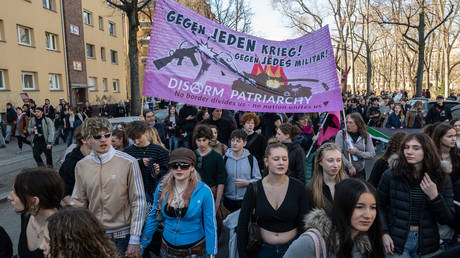
Across Germany, the math is shifting, and the change is accelerating with the quiet menace of a rising tide. Recent media reports reveal that formal objections to military service—the conscientious objector applications filed by young citizens refusing to bear arms—have tripled. Three times the friction. Three times the resistance. Three times the number of young people looking at the geopolitical map, looking at the eastern horizon, and drawing a hard, unyielding line in the sand.
To understand why this number is exploding, you have to step away from the macroeconomic forecasts and the defense ministry press briefings. You have to look at the psychological landscape of a generation that grew up believing borders were porous, peace was permanent, and war was something that happened on high-definition screens in distant time zones.
Imagine growing up in a united Europe. You catch a cheap weekend flight to Barcelona for twenty euros. You study in Vienna without a passport check. You debate climate change on TikTok with teenagers in Warsaw and Paris. Your identity is fluid, digital, and transnational. The nation-state, for many twenty-somethings, feels less like a sacred altar requiring blood sacrifice and more like an administrative convenience—a place that collects taxes, fixes potholes, and issues health insurance cards.
Then the news changes.
The war in Ukraine grinds on, turning fertile fields into modern Verdun landscapes. Politicians in Berlin begin tossing around words that haven’t been uttered in polite conversation for a generation: Kriegstüchtigkeit. Readiness for war. Deterrence. Preparedness. Defense readiness.
For Julian, and tens of thousands like him, those words are not abstract political philosophy. They are a summons. They mean the potential interruption of university degrees, tech startups, quiet romances, artistic ambitions, and the gentle rhythm of civilian life. They mean the terrifying realization that the peace dividend of the post-1989 era was not a permanent human evolution, but a temporary lease.
When the state whispers of renewed defense obligations, the citizen’s mind races. The German Basic Law—the Grundgesetz—contains a famous, hard-won sanctuary: Article 4, Paragraph 3. No person shall be compelled against their conscience to render military service involving the use of arms.
It is a constitutional promise born directly from the ashes of national catastrophe, an acknowledgment that the individual conscience must sometimes stand taller than the marching orders of the state.
Exercising that right, however, is not a simple check-box exercise. It is an ordeal of the soul.
To successfully register an objection to military service, an applicant must lay bare their innermost moral architecture. They must write long, soul-searching essays detailing why the taking of human life violates their fundamental ethical code. They must prove that their pacifism is not a sudden convenience born of fear, but a deeply rooted philosophical conviction. They must sit before review boards and defend their humanity against skepticism.
The tripling of these objections is not merely a statistical anomaly. It is a cultural tremor. It represents a massive, quiet vote of no confidence in the romanticization of geopolitical conflict by a generation that has inherited a warming planet, an unstable economy, and now, the bill for a fractured global order.
Consider what happens inside a family when that envelope arrives.
Julian’s father remembers the old days. To him, military service was a rite of passage, a grueling, sometimes absurd, but ultimately grounding social mixer where kids from rural Bavaria and industrial Ruhr valley shared bad coffee and learned how to depend on one another. He looks at his son with a mixture of paternal anxiety and lingering civic traditionalism. It builds character, the father says, using a phrase that feels increasingly hollow in the face of modern drone warfare.
Julian looks back, unpersuaded. His character is built, he feels, in the code he writes, the music he produces in his makeshift bedroom studio, the international friendships he maintains across borders that politicians are currently fortifying. Why should his generation trade their futures to resolve the failures of the generation that came before them? Why is the default response to international tension always a return to the uniform?
The debate over conscription in Germany touches a raw nerve because it forces a confrontation with the fundamental social contract. What do we owe the state? Does the state own our bodies in moments of supreme peril, or are we autonomous moral agents who retain veto power over our own survival?
In a democracy, security is supposed to protect freedom. But when security requires the suspension of individual autonomy—when the defense of liberty requires young people to surrender their liberty to the barracks—the paradox becomes blindingly sharp.
The media reports focus on the numbers: a three-hundred percent increase in conscientious objector filings. The analysts talk about troop readiness, recruitment shortfalls, and brigade structures. They draw arrows on maps and calculate artillery shell reserves.
But behind every one of those filings is a kitchen table at midnight. A glowing laptop screen. A young person biting their lip, typing out sentences about peace, human dignity, and the refusal to hate on command.
The rain continues to fall outside Julian’s window. He picks up a pen, not to sign the registration form, but to begin drafting his statement of objection. His hand is steady, though his heart is heavy. He knows the road ahead will involve bureaucratic hurdles, skepticism, and social friction.
Yet as he writes the first word, he feels a strange, quiet clarity. The world outside may be arming itself for a darker tomorrow, but inside this small room, the human conscience is holding its ground.