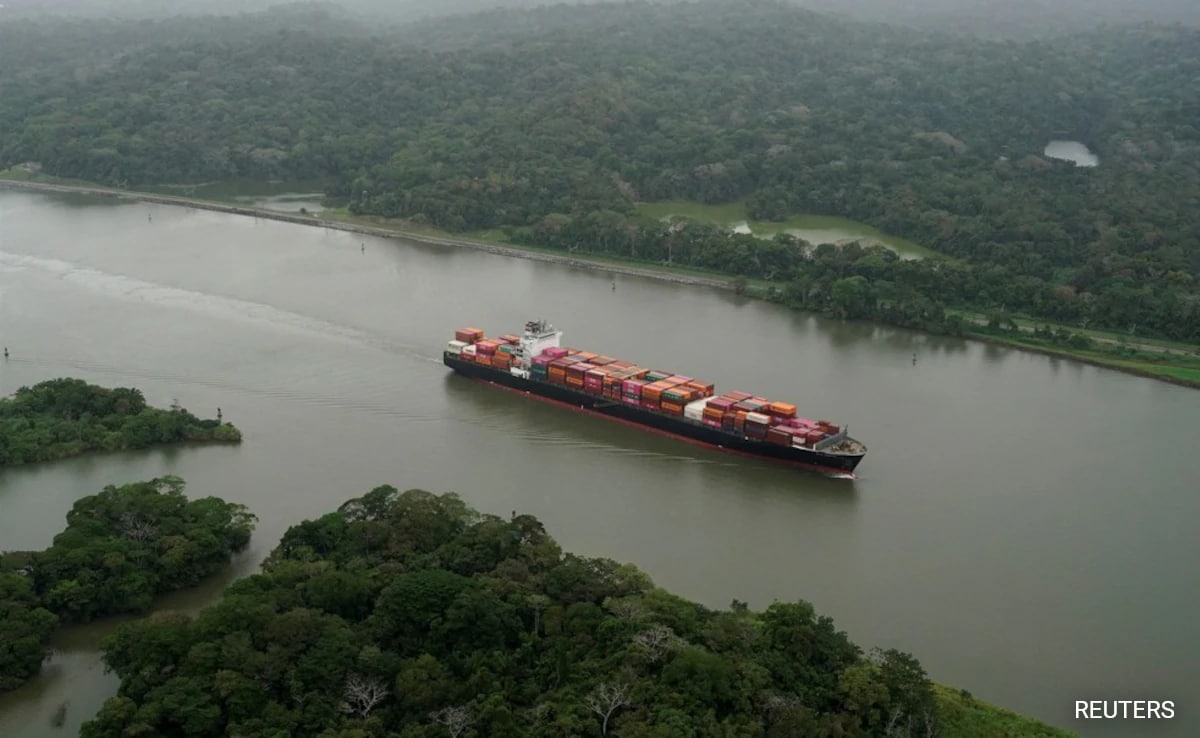
The steel hull of a Neo-Panamax vessel is a massive, indifferent thing. It doesn't care about geopolitics, and it certainly doesn't care about the dry, scratching sound of a pen against a ledger. But inside the bridge, where the air smells of stale coffee and electronic ozone, the tension is heavy enough to touch. A captain stares at a screen, watching the minutes tick away. Every hour spent idling in the shimmering heat off the coast of Panama is a wound in the company's balance sheet.
Global trade is often described as a fluid, effortless machine. We click a button, and a week later, a box appears on our doorstep. We don't see the gears. We don't see the desperation. Right now, those gears are grinding against a reality that no amount of software can fix: the world is running out of ways to move. If you liked this piece, you should look at: this related article.
The Bottleneck and the Abyss
For decades, the math of shipping was simple. You took the shortest path. If you were moving goods from Asia to the U.S. East Coast, you went through the Panama Canal. If you were heading to Europe, you took the Suez. It was a rhythmic, predictable heartbeat.
Then the heartbeat skipped. For another angle on this story, see the recent update from Reuters Business.
Halfway across the world, the Bab al-Mandab Strait—the gateway to the Red Sea and the Suez Canal—became a shooting gallery. To avoid drone strikes and boardings, massive shipping lines began diverting their fleets around the Cape of Good Hope. It is a long, brutal detour that adds ten days and millions in fuel costs to every single journey.
This brings us to the locks of Panama. With the Suez effectively crippled for many, the Panama Canal should have been the savior. Instead, it became the world’s most expensive parking lot.
A historic drought, fueled by an El Niño cycle that refused to quit, drained the freshwater lakes that feed the canal's locks. To save water, the Canal Authority did the only thing they could: they started turning ships away. They slashed daily crossings. Suddenly, the most vital shortcut on the planet was operating on a "velvet rope" policy.
The Auction of Desperation
Imagine you are a logistics manager for a global energy giant. You have a tanker full of Liquefied Natural Gas (LNG). It needs to get to its destination, or contracts will be breached, factories will go dark, and your career will likely end in a quiet HR office.
You look at the queue. There are eighty ships ahead of you. At the current rate of transit, you might be waiting two weeks. You can’t wait two weeks.
So, you enter the auction.
The Panama Canal Authority holds "slots" for those who didn't book months in advance. It is a blind, high-stakes gamble. You start at several hundred thousand dollars. The price climbs. It passes a million. Then two. You aren't just paying the standard transit fee, which is already a six-figure sum. You are paying for the right to jump the line.
In late 2023 and throughout 2024, these auctions hit fever pitches that sounded like typos in a financial report. One company paid $3.97 million. Just for the slot. Just for the privilege of not waiting.
Four million dollars.
That is more than the value of the some of the cargo on smaller ships. It is a staggering, irrational sum born from a very rational fear: if we don't move now, we don't move at all. This isn't just "business as usual." It is a scramble for survival in a world where the physical map is shrinking.
The Ghost of Gatun Lake
To understand why a canal is failing, you have to look at the water.
The Panama Canal is not a sea-level ditch like the Suez. It is an intricate staircase of water. When a ship enters the locks, gravity-fed water from Gatun Lake raises it $26$ meters above sea level to cross the continental divide. Each transit "wastes" about $50$ million gallons of freshwater, which is flushed out into the ocean.
Usually, Panama’s legendary tropical rains replenish the lake. But the sky went dry.
I want you to picture a hypothetical hydrographer named Elena. She spends her days measuring the depth of the lake. In a normal year, she sees the water lapping at the roots of the jungle trees. This year, she sees mud. She sees the skeletal remains of drowned forests from a century ago emerging from the receding tide.
For Elena, this isn't about global GDP. It’s about the fact that the same lake providing water for the canal also provides drinking water for half the population of Panama. The stakes aren't just "Can we get these sneakers to a mall in New Jersey?" The stakes are "Can we keep the taps running while keeping the world’s economy afloat?"
When the water drops, the ships must get lighter. They carry fewer containers. This creates a "phantom" inflation. You are paying more for the shipping, but the ship is carrying less. The math is brutal, and it eventually lands on your grocery bill.
The Long Way Around
When the price of the Panama shortcut hits $4$ million, some captains do the unthinkable. They turn around.
They head south, toward the bottom of South America, to navigate the Strait of Magellan or round Cape Horn. It is a journey through some of the most treacherous waters on Earth. It is a throwback to the 19th century, before the canal existed.
Consider the sheer irony. We live in an age of AI, satellite arrays, and sub-orbital rockets. Yet, because of a lack of rain in a specific jungle and a conflict in a specific desert, we are forced to sail our steel behemoths around the stormy tips of continents like we are searching for the Spice Islands in 1600.
The cost of these detours is measured in more than just dollars. It is measured in carbon.
Thousands of extra miles means millions of tons of extra $CO_2$ pumped into the atmosphere. The very climate change that is drying up the Panama Canal is being accelerated by the ships trying to avoid the dry canal. It is a feedback loop that feels almost cruel in its symmetry.
The Invisible Stakes
Why should we care if a multi-billion dollar shipping conglomerate has to cough up $4$ million for a transit slot?
Because the "chokehold" isn't just a catchy headline. It is a tightening grip on the neck of global stability. When energy prices spike because LNG tankers are stuck in a bidding war, people in cold climates choose between heating and eating. When grain shipments are delayed because they can't get through the locks, food security in developing nations begins to crumble.
We have spent the last thirty years perfecting "just-in-time" manufacturing. We stripped away the buffers. We got rid of the warehouses. We decided that the ocean was a moving conveyor belt that would never stop.
We were wrong.
The conveyor belt is stuttering. The $4$ million bid is a scream of realization from the private sector. It is an admission that the old rules are gone. Reliability is no longer a given; it is a luxury commodity available to the highest bidder.
A New Map of the World
The world is not getting bigger, but the distances between us are.
We are seeing the end of the era of "easy" geography. For a long time, we took the Earth's geometry for granted. We assumed the shortcuts would always be open, the water would always be deep, and the straits would always be safe.
Now, we are watching a massive realignment. Companies are "near-shoring," moving factories closer to home to avoid the sea altogether. Supply chains are being rebuilt not for speed, but for resilience.
But for the ships currently at sea, there is no "resilience" strategy. There is only the horizon and the ledger.
The sun sets over the Pacific, casting a long, golden shadow over a line of vessels stretching out toward the horizon. They wait in a silence broken only by the hum of generators. Somewhere in that line, a decision is being made. A finger hovers over a keyboard. A bid is submitted.
A few million dollars moves from one account to another, and a city of steel begins to move, creeping slowly toward the locks, leaving the rest of the world behind to wait for the rain.