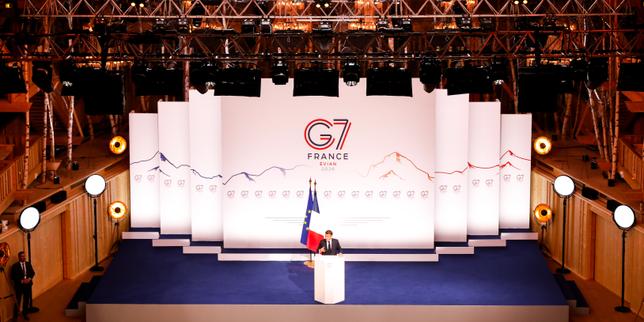
Western leaders left the recent G7 summit proclaiming a historic victory for transatlantic unity. French President Emmanuel Macron led the rhetorical charge, framing the gathering as a profound success that fundamentally altered the dynamics of international support for Ukraine. The centerpiece of this self-congratulatory narrative was a complex financial mechanism designed to turn frozen Russian central bank assets into an immediate multibillion-dollar lifeline for Kyiv.
Beneath the diplomatic theater lies a far more fragile reality. The celebrated agreement is not a simple seizure of illicit funds, but a highly leveraged financial engineering project fraught with technical vulnerabilities and political risk. By examining the structural mechanics of the loan package, the deep-seated anxieties of European regulators, and the looming threat of political shifts in Washington, it becomes clear that the summit exposed the limits of Western leverage rather than a definitive breakthrough.
The Architecture of Financial Illusion
The core achievement of the summit involves a USD 50 billion loan to Ukraine, backed by the future interest generated by roughly USD 280 billion in immobilized Russian assets. Most of these assets sit within Euroclear, a Belgium-based financial services company.
Politicians prefer simple narratives. They want the public to believe that Russia is directly footing the bill for the destruction it has caused. The financial reality is labyrinthine. The G7 is not confiscating the principal funds; doing so would trigger unprecedented legal challenges and potentially destabilize the Eurozone’s financial infrastructure. Instead, the plan treats the future interest streams of these assets as a predictable, securitized revenue source.
This approach introduces significant structural fragility. Securitization requires stability. If the underlying assets are unfrozen as part of a future peace negotiation, or if global interest rates drop sharply, the revenue stream disappears or shrinks. The agreement relies on an unspoken, precarious assumption that the war will continue indefinitely in a manner that keeps these assets locked away, or that Western taxpayers will quietly step in to guarantee the loans if the setup collapses.
The European Banking Schism
The enthusiastic rhetoric out of Paris and Washington masks a bitter technocratic divide within Europe. While political leaders demand bold action, central bankers and regulatory authorities are quietly sounding the alarm over the long-term precedent this mechanism sets.
The Euroclear system functions on international trust. Central banks around the world, including those of China, Saudi Arabia, and India, monitor how Western jurisdictions treat sovereign reserves. By weaponizing the interest generated by these reserves, the G7 has crossed a legal Rubicon. European Central Bank officials have privately warned that this move could accelerate a broader shift away from the Euro and the US dollar as reserve currencies.
- The risk of retaliatory legal action by Moscow against European financial institutions remains high.
- Diversification of non-Western state reserves into gold and alternative currencies is likely to accelerate.
- The legal justification used—labeling the interest as "windfall profits" rather than sovereign property—presents a thin veneer of legality that international courts may eventually tear down.
This is not a theoretical problem for the distant future. It represents a immediate dilution of the legal protections that have underpinned global finance since the end of the Second World War.
The Washington Wildcard and the End of Continuity
The most glaring vulnerability of the G7 plan is its dependence on long-term political continuity, particularly in the United States. The current administration has pushed aggressively for this funding structure precisely because domestic legislative paths for direct funding have become increasingly blocked.
The strategy attempts to Trump-proof future aid to Ukraine. By locking in a massive lump-sum loan now, funded by international mechanisms, planners hope to insulate Kyiv from the shifting winds of the American electorate. This assumes that a future administration would respect the spirit of an international financial agreement it had no part in designing.
If a future US president decides to withdraw diplomatic support for the sanctions regime, the entire legal framework supporting the asset freeze could unravel. European nations would then find themselves holding the bag, legally liable for a massive loan backed by assets they no longer have the political consensus to hold hostage. The summit did not solve the problem of declining political will; it merely deferred the financial consequences.
A Stalled Defense Industrial Reality
While the G7 focused heavily on financial maneuvers, the physical reality on the ground in Ukraine remains dictated by industrial capacity. Cash injections do not instantly materialize into artillery shells, air defense batteries, or armored vehicles.
European defense production lines are struggling to meet current demands, hampered by bureaucratic procurement processes, skilled labor shortages, and fragile supply chains. Injecting tens of billions of dollars into a saturated defense market will inevitably drive up costs rather than dramatically increasing the volume of delivered hardware. The bottleneck is no longer just money; it is time, factory floor space, and raw materials.
The triumphalism displayed by leaders like Macron serves as a convenient distraction from these systemic shortfalls. It is far easier to sign a communique detailing a complex financial loan than it is to revitalize a dormant continental defense industrial base. The collective West has opted for financial engineering over hard industrial mobilization.
The Global South’s Quiet Rejection
The G7 often speaks as if it represents the entirety of the international community. The reality outside the alliance's borders tells a different story. For much of the Global South, the freezing and subsequent leveraging of sovereign assets is viewed not as a defense of international law, but as an act of economic hegemony.
Major developing economies view this financial maneuver with deep suspicion. They see a system where the rules can be rewritten overnight by a small club of wealthy nations to suit their immediate geopolitical interests. This perception deepens the geopolitical fracture, making it harder to build a broad international coalition to isolate Moscow. Instead of deterring aggression globally, the strategy incentivizes non-Western powers to build parallel financial institutions entirely insulated from Western oversight and sanctions leverage.
The immediate financial injection will undoubtedly help Kyiv sustain its state functions and military operations in the short term. It keeps the lights on and the weapons flowing for a few more months. But by celebrating this stopgap measure as a profound, structural success, Western leaders are engaging in dangerous self-delusion. They have traded long-term systemic stability and international trust for a temporary financial reprieve, leaving the foundational crises of industrial capacity and political cohesion entirely unresolved.