German Chancellor Friedrich Merz insists his governing coalition is solid, but the reality behind Berlin's new political alignment is far more volatile than his public optimism suggests. Fourteen months into his chancellorship following the historic snap elections of 2025, Merz is attempting to steer a brittle alliance between his conservative CDU/CSU and the junior-partner Social Democrats (SPD). While a recent July 2026 package of 34 major economic reforms suggests legislative progress, the structural cracks over fiscal spending, an unyielding debt brake, and a looming wave of regional elections threaten to shatter this manufactured stability. Berlin is project-managing a crisis, not resolving it.
To understand why Merz is projecting a facade of calm, one must look at how this government was born. The early 2025 election did not yield a ringing endorsement for conservative hegemony. The CDU/CSU took the top spot with just 28.5 percent of the vote, forcing an awkward marriage with an exhausted SPD that had just suffered its worst historical defeat. It took Merz two rounds of voting in the Bundestag just to secure his confirmation as chancellor—an unprecedented stumble in postwar German history. From day one, this government was a mathematical necessity rather than a shared ideological vision.
The Debt Brake Trap
The central fault line of this administration remains the federal budget. Merz built his political career on the altar of fiscal rectitude, promising voters that he would protect Germany’s constitutional borrowing limits. He broke that promise almost immediately. Within weeks of taking office last year, his government bypassed the debt brake by establishing a massive 500-billion-euro special fund for infrastructure and exempting defense spending from the borrowing cap.
It was a cynical political trade-off. The SPD demanded investment spending as their price for entering the government, and Merz paid it using accounting tricks. This maneuver severely damaged his credibility among traditional fiscal conservatives who viewed the special funds as a betrayal of core principles.
The pressure has not subsided. Just days ago, Merz publicly ruled out any further reforms to the debt brake for the remainder of this parliamentary term. He has drawn a hard line in the sand because he has no other choice. His own party is mutating into factions, with regional leaders demanding more cash to combat local economic stagnation while the federal wing demands a return to austerity. By locking the door on further borrowing reforms, Merz is gambling that Germany’s current economic momentum can sustain his massive legislative ambitions without the system running out of fuel.
Legislative Blitz as a Defense Mechanism
Faced with internal division, the chancellery has resorted to a strategy of legislative hyper-activity. On July 2, 2026, the coalition announced a sweeping package of 34 reforms covering pensions, income tax adjustments, and labor market deregulation. Merz has framed this as a historic modernization effort, a claim he repeated with theatrical confidence during his recent policy statement to the Bundestag.
The numbers look good on paper. The administration points to its new "active pension" program, which allows older citizens to earn up to 2,000 euros a month tax-free if they stay in the workforce. The chancellery proudly announced that over 10,000 employees took advantage of this in the first half of 2026.
But international analysts are skeptical. Ratings agencies like Fitch have noted that while these measures are positive for public finances over the long run, they fall short of being truly transformative. The income tax adjustments offer minor relief to low- and middle-income families, yet the top tax rate has been subtly ticked upward to appease the SPD. This is not a grand strategy. It is an exercise in political horse-trading where every pro-business deregulation measure must be matched by a social welfare concession.
The Bureaucracy Illusion
A major pillar of the July reform package is the promised eradication of red tape. Merz announced an inversion of traditional governance. In the future, if a ministry wants to retain an administrative reporting requirement, it must explicitly justify its existence or see it automatically abolished.
This sounds revolutionary. In practice, the German civil service is a behemoth capable of resisting structural change through sheer inertia. Ministries are already drafting expansive justifications to protect their bureaucratic turf. A top-down decree cannot easily dismantle decades of deeply institutionalized regulatory compliance. Merz is trying to force dynamism into a system designed for slow, deliberate stability, and the friction is wearing down his ministers.
The Labor Market Gamble
To stimulate an economy struggling with demographic decline, the coalition is rewriting rules around fixed-term employment. The new policies allow businesses to extend fixed-term contracts for longer periods without providing an objective justification.
The corporate sector has welcomed the flexibility. Trade unions, historically aligned with the SPD, are furious. They view this as an erosion of worker protections that will trap younger employees in permanent insecurity. This labor dispute highlights the fundamental contradiction of the current government. One half of the coalition wants to liberalize the market, while the other half exists to protect the workforce from the consequences of that liberalization.
The Red Wall in the East
The true test of Merz’s political survival will not take place in the halls of the Bundestag, but at the ballot boxes of eastern Germany. Regional elections in states like Saxony-Anhalt and Mecklenburg-Western Pomerania are rapidly approaching. The far-right Alternative for Germany (AfD), which surged into second place nationally during the 2025 federal election with 20.8 percent of the vote, is polling at historic highs in the east.
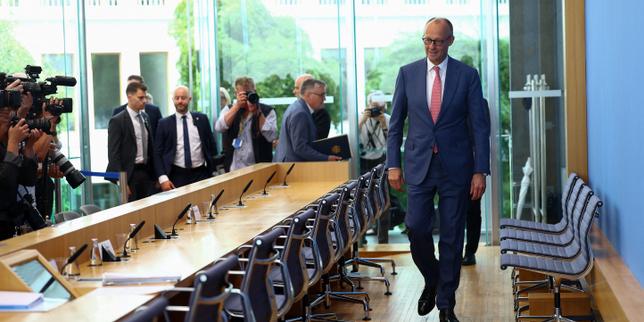
Merz has been forced into a defensive posture. He recently held a combative press conference in Berlin, vowing to maintain a strict "firewall" against the far-right and ruling out any coalition or cooperation with the AfD at any level. He dismissed suggestions that the AfD might moderate if given a taste of local governance, pointing directly to Germany’s dark historical legacy as a reason why comparisons to other European nations are completely invalid.
This firewall is under immense structural stress. If the AfD captures pluralities in eastern state parliaments, the CDU will face an impossible choice. They must either form highly unstable multi-party coalitions with left-wing factions like the Left party or the Greens, or risk collapsing the state governments entirely. Local CDU chapters in the east are far more conservative than the federal leadership in Berlin. Many local officials quietly whisper that a total refusal to engage with a party representing a third of their voters is democratically unsustainable.
Foreign Complications
While managing domestic fractures, Merz must also contend with an increasingly hostile international environment. His recent high-profile meeting in Paris with French President Emmanuel Macron, British Prime Minister Sir Keir Starmer, and Ukrainian President Volodymyr Zelenskyy was designed to project European solidarity. The group pledged 70 billion euros in military assistance for Ukraine this year.
However, the shadow of Washington hangs over these agreements. Reports that the Trump administration is establishing funding channels to support anti-immigration and nationalist groups in Europe have sparked outrage in Berlin. Merz openly warned the United States against interfering in German domestic elections, stating clearly that foreign funding of political parties is strictly illegal under German law.
This geopolitical friction complicates Merz's economic agenda. Germany cannot afford to wage a trade war with a protectionist White House while simultaneously funding massive continental defense initiatives and attempting to rebuild its domestic infrastructure under a self-imposed debt freeze. Every dollar spent on external stability is a dollar that cannot be used to pacify disgruntled voters at home.
The current chancellorship is a study in calculated optimism masking structural vulnerability. Merz speaks of renewal and a bright future because acknowledging the alternative would trigger an immediate crisis of confidence. The 34 reforms currently moving through the legislative pipeline represent the absolute limit of what this grand coalition can achieve before the ideological differences between the CDU and the SPD become irreconcilable. With the eastern regional elections threatening to blow a hole through the party's regional foundations, the chancellor is running out of time to prove that his forced marriage of convenience can actually govern a divided nation. The legislative machinery keeps turning, but the political foundation is turning to dust.