The ice melts quickly in a Damascus summer. Inside the small cafe on Al-Nasr Street, the condensation on a glass of mint tea drips onto a wooden table, smudging the edge of a legal brief. It is mid-afternoon on a Thursday.
Outside, the al-Marjah district hums with its usual, exhausting friction. The Palace of Justice sits just forty meters away, its heavy doors swallowing and spitting out hundreds of people every hour—lawyers in dark suits, frantic clerks, families waiting for news. This week, the building has been particularly suffocating. The high-profile trials of the old regime, including that of the former grand mufti, have drawn massive crowds. The air carries the weight of a country trying to rebuild its identity out of rubble.
A man walks into the cafe. He carries something that does not belong among the scattered sugar wrappers and porcelain cups. He places it carefully beneath a table. Then, he steps back out into the bright, blinding heat.
Seconds later, the routine of a Thursday afternoon ceases to exist.
Boom.
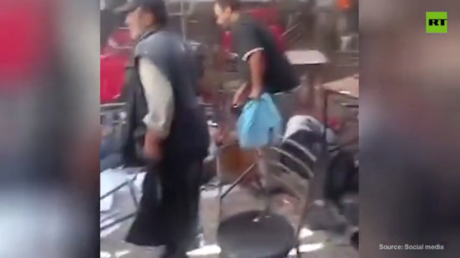
The sound is not just loud; it is a physical weight that shatters the windows, bends the metal frames, and tears through the laughter and low murmurs of the patrons. The Ministry of Health would later count the cost in cold arithmetic: six dead, twenty-two torn apart by shrapnel and glass. But in the immediate aftermath, there are no numbers. There is only the smell of burnt cordite, the choking fog of drywall dust, and the sudden, terrifying silence that precedes the screaming.
Consider the ordinary geometry of that space. The cafe was a sanctuary for the people who make the new judicial system work. Lawyers used it to decompress between grueling hearings. Citizens sat there to steady their nerves before facing a magistrate. It was a place where people assumed they were safe simply because they were surrounded by the architecture of the law.
When the dust began to settle, the floor was slick with crimson.
Local residents did not wait for the sirens. They ran toward the smoke, using napkins and tablecloths to stem the bleeding of strangers until the ambulances could weave through the gridlocked Damascus traffic. When the internal security forces arrived, their first action was to push the crowd back, cordoning off the block. The fear of a secondary device—a classic, cruel tactic designed to kill the rescuers—hung over Al-Nasr Street like a second heatwave.
This is the reality of a transitional state. The old government fell, but the ghosts did not leave with it.
The governor of Damascus stood on the steps of the courthouse shortly after the blast, looking out over a street that had been scrubbed of life. He spoke of "bad actors," of sleeper cells, of factions that find stability terrifying. His words carried a grim truth that everyone in the capital already understands: a bomb is not just an attack on flesh; it is an argument against peace. It is a message wrapped in shrapnel, designed to convince ordinary people that order is an illusion.
No group claimed the blast immediately. They rarely do when the objective is pure, unadulterated friction. For months, the capital had felt a tentative easing of tension, a fragile return to something resembling a normal life. But a single improvised explosive device under a cafe table can undo months of psychological progress in a fraction of a second. It forces the mother walking her children past the Hamidiyeh Market to look twice at every unattended bag. It makes the lawyer hesitate before sitting by the window.
The investigation will pull footage from private surveillance cameras. The Interior Ministry will sweep the debris for chemical signatures. A suspect was pursued and captured nearby, a small thread for the state to pull in hopes of unraveling a larger web.
But tonight, as the sun sets over the ancient city, the yellow police tape flutters in the warm breeze outside the ruined cafe. The broken glass has been swept into small piles on the sidewalk. The blood on the floor will eventually be washed away, but the stain on the city’s collective psyche remains. Syria is learning, through the most brutal calculus imaginable, that building a new world is not nearly as difficult as defending the quiet moments of an ordinary afternoon.