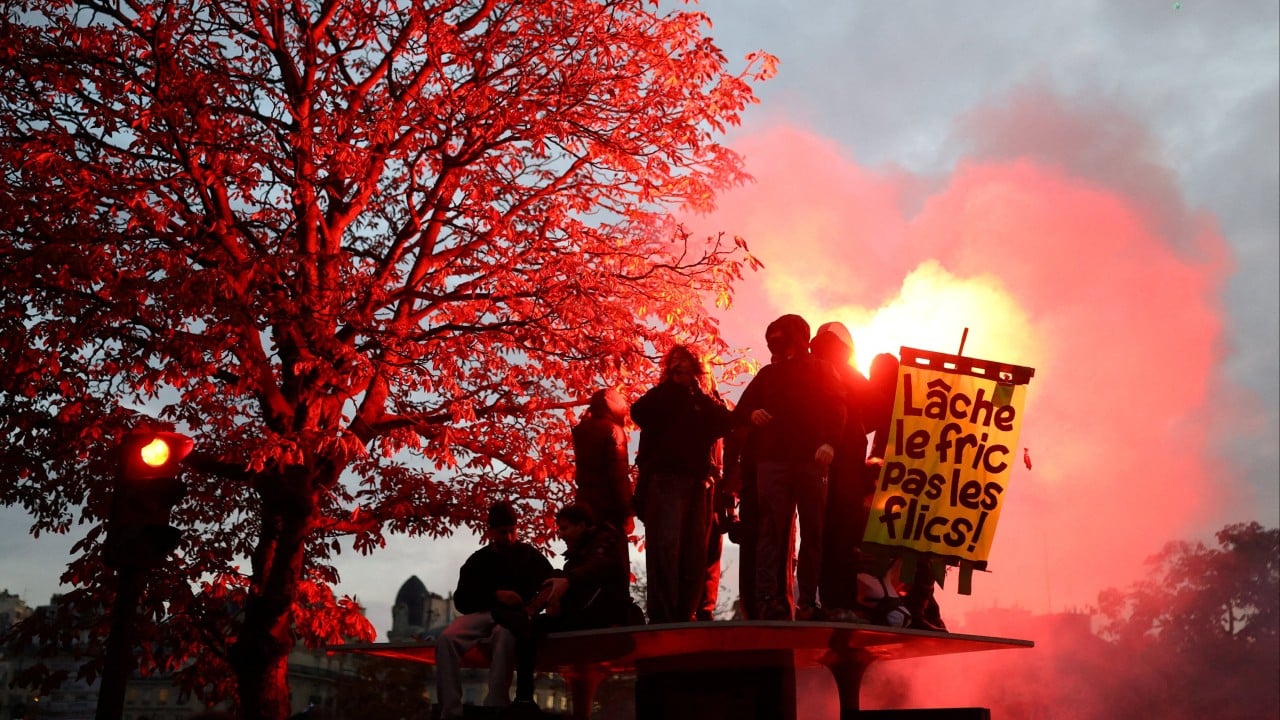
France is back on the streets, and if you only read the surface-level headlines, you’ll think it’s just another routine Tuesday in Paris. It isn't. Across major cities like Lyon, Marseille, and Bordeaux, hundreds of thousands of workers have walked off the job demanding what unions call a "dignified wage."
Trains have stalled. Classrooms sit empty. Public transit looks like a ghost town.
When mass protests sweep France, outsiders often roll their eyes and chalk it up to a stereotypical French love for striking. That's a lazy take. Behind the flares, the chants, and the CGT union banners lies a severe structural squeeze on the European middle and working class that has been building for years. People aren't marching because they enjoy blocking roundabouts; they're marching because the math of everyday survival in France no longer works.
The Real Math Behind the Dignified Wage Demand
To understand why French workers are furious right now, you have to look at the gap between official inflation numbers and actual household bills.
On paper, headline inflation across the Eurozone has cooled compared to the massive spikes of 2022 and 2023. Economists at institutions like INSEE (France's National Institute of Statistics and Economic Studies) point to stabilizing consumer price indices. If you look at a macro spreadsheet, things look calmer.
Walk into a Carrefour supermarket in suburban Lille, though, and the spreadsheet means nothing. Cumulative food inflation over the past few years permanently reset the baseline cost of groceries, energy, and rent. While prices jumped by double digits over a three-year span, base salaries for millions of civil servants, healthcare workers, and private-sector employees barely crept upward.
France does have an automatic indexation mechanism for its minimum wage, known as the SMIC (Salaire Minimum Interprofessionnel de Croissance). Whenever inflation rises by at least 2%, the SMIC automatically ticks up. Sounds great in theory, right?
Here is the catch nobody talks about. Because the SMIC keeps rising automatically while wages just above the minimum remain frozen, France has created a massive "SMIC trap." Millions of skilled workers—nurses, teachers, technicians, logistics coordinators—who used to earn 20% or 30% above the minimum wage have watched the floor rise right up to their ankles. Today, roughly 17% of the French private-sector workforce earns the minimum wage, a historic high. Career progression has basically flatlined. You can work ten years in a French hospital or school and end up making nearly the same base pay as a brand-new hire.
Who Is Actually Marching and Why They’re Fed Up
This isn't a fringe movement led by a single radical union. What makes the current wave of strikes different is the broad coalition pulling the emergency brake at the same time.
- Public sector educators and civil servants whose salary index point (point d'indice) has lagged far behind the cost of living for over a decade.
- Healthcare and hospital staff still exhausted from post-pandemic shortages, facing stagnant pay scales while private agency costs balloon.
- Transport and energy workers from SNCF and RATP, who hold the structural leverage to bring commerce to a halt.
- Private-sector retail and manufacturing employees watching major French CAC 40 corporations post record dividends while claiming there is zero room in the budget for payroll increases.
That last point is pure gasoline on the fire. According to financial data tracked by Janus Henderson and Oxfam France, France's largest publicly traded companies have repeatedly broken records for shareholder payouts in recent years. Workers read those numbers on their phones during their lunch breaks. Then they go back to an afternoon meeting where management tells them a 1.5% raise is "economically irresponsible."
You don't need a degree in macroeconomics to see why that sparks rage.
What Most Foreign Media Get Wrong About French Strikes
If you follow American or British coverage of French labor disputes, you usually get two tropes. Either the protesters are portrayed as spoiled workers clinging to unsustainable 35-hour workweeks, or the protests are framed purely as a personal clash with President Emmanuel Macron.
Both angles miss the point.
First, the idea that French workers are lazy is statistical nonsense. Data from the OECD consistently shows that French workers have high hourly productivity—often outpacing the UK and sitting right alongside Germany. The issue isn't a refusal to work; it's the shrinking share of national wealth going to labor versus capital.
Second, reducing this to a personality contest about Macron ignores the deeper deadlock in French politics. Following the fractured parliamentary landscape after recent legislative elections, the French government lacks a stable majority to push through sweeping economic reforms—or sweeping concessions. Ministers talk endlessly about "budgetary discipline" and avoiding EU excessive deficit procedures, yet they struggle to pass coherent tax or wage policies through a divided National Assembly.
Unions know the government is boxed in. By taking the fight directly to the streets and targeting employers alongside the state, labor leaders like Sophie Binet of the CGT and Marylise Léon of the CFDT are trying to force both corporate boards and the Élysée Palace to the negotiating table.
The Corporate Standoff Over Wage Negotiations
In France, wages above the SMIC aren't set by government decree. They are negotiated through mandatory annual talks known as NAO (Négociations Annuelles Obligatoires) inside companies, alongside sector-wide collective bargaining agreements (branches professionnelles).
And right now, that system is completely jammed.
In dozens of major industry sectors, the lowest pay tiers in collective bargaining agreements have actually fallen below the legal minimum wage because employers refused to update their pay grids fast enough. When a sector's base rate falls below the SMIC, employers simply top up the difference to meet the legal minimum, effectively wiping out seniority bonuses and qualification tiers.
Unions are demanding three concrete fixes during these marches:
- Immediate across-the-board raises tied to real purchasing power, not just one-off tax-free bonuses that don't count toward pensions or unemployment insurance.
- Automatic re-indexing of all wage tiers whenever the SMIC increases, so skilled workers don't get compressed into minimum-wage earners.
- Conditioning corporate tax breaks and public subsidies on actual wage growth and gender pay parity.
Employers' groups like MEDEF push back hard against automatic wage indexation. Their argument isn't entirely baseless, either. France already has some of the highest employer social security contributions in Europe. Small and medium-sized businesses—especially restaurants, independent retailers, and regional manufacturers—genuinely struggle with razor-thin margins. If you force a small bakery or machine shop to index every salary automatically, some of them will simply go under or freeze hiring.
That tension is real. Ignoring the difference between a massive conglomerate like LVMH or TotalEnergies and a twelve-person logistics firm in Normandy is a mistake both sides make when rhetoric heats up.
How This Impacts Travelers, Expats, and Businesses Right Now
If you're planning to travel to France, do business with French suppliers, or manage remote teams based in the country over the coming weeks, don't expect this to blow over by Friday. French labor movements operate on journées d'action—rolling days of coordinated strikes designed to build pressure incrementally without draining workers' strike funds all at once.
Here is how to navigate the disruption practically if you have skin in the game:
- Assume rail and regional transit will be volatile. High-speed TGV lines usually maintain partial service, often around 50% to 60% of trains, while regional TER lines and Paris RER commuter trains take the heaviest hit. Always check the SNCF Connect app after 5:00 PM the evening before travel, as legally mandated strike schedules are published then.
- Build buffer days into supply chains. Port workers in Le Havre and Marseille-Fos frequently join national strike days, delaying container clearance by 48 to 72 hours. If you import French goods, pad your lead times immediately.
- Understand the legal protections for French employees. Under the French Labor Code (Code du travail), the right to strike is constitutional. An employer cannot discipline, penalize, or fire a worker for participating in a national strike, though pay is docked proportionally for the hours missed. Trying to bypass striking staff with temporary agency workers is strictly illegal in France and triggers heavy fines.
The Bigger Picture for Europe
Watch France closely right now because it rarely protests in isolation. Historically, French labor unrest acts as an early warning siren for broader European economic friction.
Across Germany, Italy, and Spain, workers are dealing with the exact same math: higher interest rates, sluggish industrial growth, and a permanent step-change in the cost of housing and food. France just happens to have the union infrastructure, legal protections, and street-level culture to turn quiet household anxiety into national headlines.
Until corporate wage grids catch up with the real cost of living—and until governments figure out how to protect purchasing power without bankrupting small businesses—those flares in Paris aren't going out anytime soon. Keep your eye on the upcoming sector-by-sector wage negotiations over the next month; if employers refuse to unfreeze middle-tier pay scales, expect the rolling strikes to escalate into open-ended walkouts before winter hits.