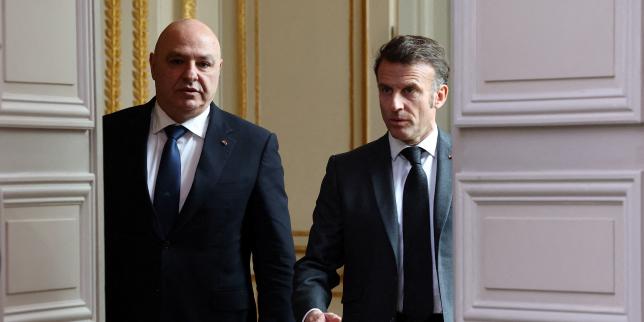
State survival in the modern international system relies on a structural paradox: insolvent regimes require external liquidity to prevent total collapse, yet external actors demand structural reforms that threaten the survival mechanisms of the ruling elite. When French authorities hosted Lebanese President Michel Aoun in Paris, diplomatic communiques framed the engagement through the lens of historical friendship and cultural affinity. Beneath the diplomatic veneer, however, the interaction represents a calculated exercise in influence management, debt triage, and institutional salvage operations within a failed state apparatus. Paris is attempting to arrest the complete erosion of French strategic equity in the Eastern Mediterranean without incurring unmanageable fiscal exposure or committing unconditional bailouts.
Understanding this dynamic requires abandoning diplomatic rhetoric and examining the underlying power structures, financial incentives, and leverage points that govern bilateral relations between Paris and Beirut. French statecraft in the Levant is governed by distinct geopolitical constraints, economic realities, and institutional limitations that dictate a highly risk-averse intervention strategy.
The Tripartite Strategic Imperative
France maintains an active posture in Lebanese governance due to three overlapping structural imperatives: historical continuity, domestic political resonance, and regional geopolitical positioning.
The historical anchor stems from the Mandate era and enduring administrative, educational, and cultural touchpoints. For French political elites, total disengagement from Lebanon represents an abdication of historic responsibility and a symbolic failure of francophone diplomacy. However, sentimentality alone does not drive state resource allocation.
The domestic political dimension in France involves a constituency of Lebanese expatriates, business networks, and public opinion sensitive to humanitarian crises in Beirut. Images of systemic collapse in a country historically tied to French educational and financial infrastructure create acute political pressure in Paris to project competence and protective oversight.
The regional geopolitical driver is the most critical. The Eastern Mediterranean functions as a critical nexus for European security, maritime trade routes, energy exploration, and migration management. A completely failed Lebanese state creates a geopolitical vacuum. Regional competitors and non-state actors stand ready to absorb residual influence, alter sectarian balances, and project power toward the southern borders of Europe. By engaging leadership figures like Aoun, Paris attempts to maintain a diplomatic anchor inside a fracturing institutional framework, ensuring that French channels remain open while other Western actors scale back their diplomatic footprint.
The Mechanics Of Leverage And The Reform Deadlock
Diplomatic engagement without structural leverage is merely symbolic appeasement. France faces a fundamental strategic dilemma: how to compel a deeply entrenched political and financial oligarchy to enact structural reforms that dismantle the very mechanisms of patronage and rent-seeking that sustain their power.
Lebanese state insolvency is not an accidental fiscal shock; it is the structural outcome of a decades-long Ponzi scheme engineered by the central bank in collusion with commercial banks and political elites. Public debt was sustained through high-interest foreign currency inflows, financed by expatriate remittances and regional deposits, until the model exhausted its external liquidity reserves.
When international financial institutions, led by the International Monetary Fund, condition financial assistance on transparent forensic audits, capital control legislation, bank restructuring, and governance overhauls, the Lebanese ruling class faces an existential threat. Implementing these reforms means liquidating insolvent financial institutions, ending preferential foreign exchange access, and dismantling patronage networks.
Paris has attempted to bypass this political impasse through conditional diplomacy, most notably via the French-sponsored roadmap often termed the Macron Initiative. This framework attempted to establish a quid pro quo: structural reforms in exchange for international donor assistance channeled through transparent, non-governmental mechanisms.
The strategy yielded limited results because the target actors possess asymmetric staying power. The ruling elite calculates that the international community fears the complete implosion of Lebanon—with its attendant refugee flows, security spillovers, and proliferation risks—more than the elite fears continued economic stagnation. Consequently, local leadership absorbs diplomatic lectures in Paris while maintaining domestic blockades against meaningful institutional reform.
The Cost Function Of Continued Engagement
Diplomatic hosting and high-level meetings carry opportunity costs and diplomatic risks for France. By maintaining direct channels with figures tied to the discredited political establishment, Paris risks validating the current power structure and alienating emerging civil society actors, reformist movements, and demographic groups demanding root-and-branch political renewal.
The cost-benefit analysis for French statecraft breaks down into distinct operational variables:
- Resource Commitment versus Return: Direct financial bailouts are politically and economically unviable. French taxpayers cannot subsidize Lebanese sovereign debt without European Union consensus and IMF burden-sharing. Therefore, French support is limited to technical assistance, targeted humanitarian aid, and diplomatic mediation.
- Deterioration of Institutional Credibility: Each diplomatic handshake with figures implicated in systemic corruption or state mismanagement dilutes the credibility of French warnings regarding governance standards.
- Risk of Entrapment: By attempting to broker governance solutions and cabinet formations, France risks owning the failures of a dysfunctional state without possessing the executive authority to enforce compliance.
Structural Pathways For External Actors
For external powers attempting to influence governance in collapsed or failing economies, traditional state-to-state diplomacy is insufficient. When central government institutions are captured by rent-seeking elites, diplomatic engagement must shift from supporting personalities to preserving functional technical capacities and empowering decentralized alternatives.
Paris has gradually adapted its approach by bifurcating its engagement strategy. On one track, it maintains minimal formal state engagement to prevent total diplomatic severance. On the secondary track, it channels resources directly to non-governmental organizations, educational institutions, healthcare networks, and local municipalities that operate outside the centralized patronage architecture of the Lebanese state.
This dual-track approach reflects a sober assessment of institutional decay. It acknowledges that the central government cannot be reformed from within by the beneficiaries of its collapse. At the same time, it prevents the complete collapse of human capital and social infrastructure that would render future reconstruction impossible.
Strategic Forecast
The trajectory of Franco-Lebanese relations will be dictated by external regional shocks and the internal pace of asset depletion. As long as remittance flows, informal economic activity, and localized dollarization provide a baseline level of subsistence, the political elite will resist structural adjustment.
France will continue to play the role of an engaged mediator, balancing domestic imperatives to project influence in the Mediterranean with the cold reality of a sovereign state impervious to external economic conditionality. The limitation of French strategy highlights a broader truth of contemporary international relations: external diplomacy cannot substitute for domestic political will. Without internal elite fragmentation or overwhelming popular pressure that alters the calculus of survival, diplomatic visits to Paris remain high-level theater, managing the slow decline of an exhausted institutional order rather than engineering its revival.