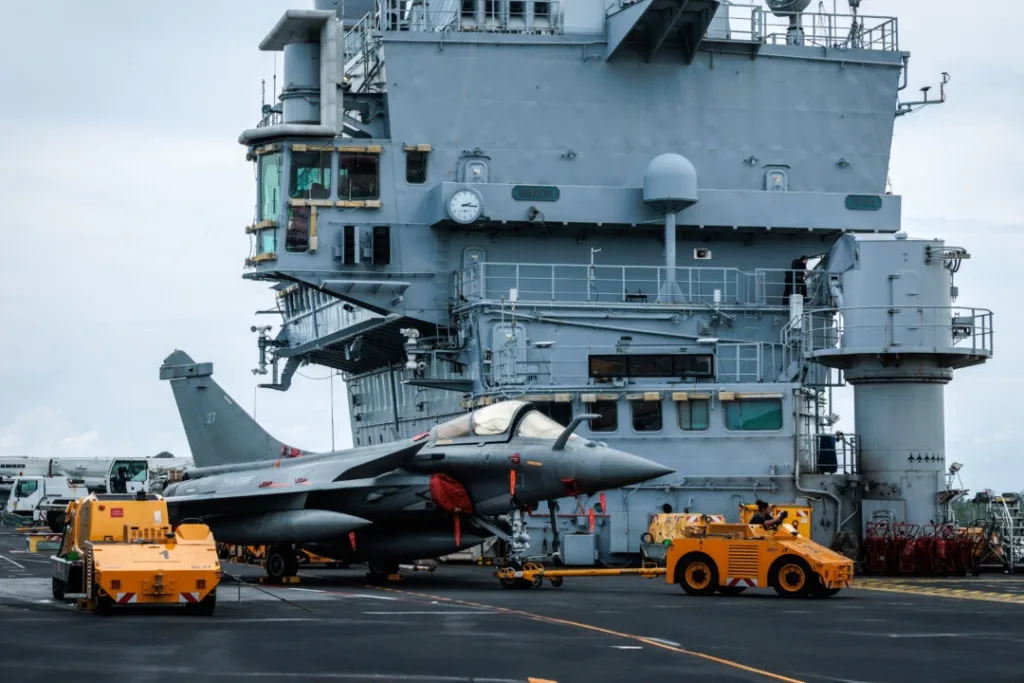
France isn't just talking about European defense anymore. President Emmanuel Macron recently made it clear that the Charles de Gaulle, the pride of the French Navy and the only nuclear-powered aircraft carrier in Europe, is heading to the Mediterranean. This isn't a routine Sunday sail. It's a massive signal to both allies and adversaries that Paris intends to remain a heavyweight in a region that's becoming increasingly volatile.
When you look at the current state of global security, the Mediterranean sits right at the center of several overlapping crises. From the fallout of conflicts in the Middle East to the constant tension in North Africa and the shadow of Russian naval activity, the water is getting crowded. Macron’s decision to deploy his most potent "floating airbase" tells us he's ready to use hard power to back up his diplomatic talk.
Why the Charles de Gaulle remains a unique beast
Most people don't realize how much of a technical marvel this ship actually is. It’s the only vessel outside of the United States Navy that uses a catapult-assisted take-off but arrested recovery (CATOBAR) system. That's a fancy way of saying it uses steam catapults to fling heavy, weapon-loaded jets into the sky. Other European carriers, like the British Queen Elizabeth class, use "ski jumps" which limit how much fuel and ammunition their planes can carry.
The Charles de Gaulle carries the Rafale M, a versatile fighter that can handle everything from dogfights to nuclear strikes. Because the ship is nuclear-powered, it doesn't need to refuel its own engines every few days. It can stay at sea for months, limited only by the food supply for the crew and the aviation fuel for the jets. In a long-term conflict or a sustained monitoring mission, that endurance is everything.
The strategic message behind the move
Sending a carrier strike group isn't just about the ship itself. It’s about the "bubble" of protection and surveillance it creates. When the Charles de Gaulle moves, it’s surrounded by frigates, a nuclear attack submarine, and replenishment ships. It’s a sovereign piece of French territory that can park itself anywhere in international waters.
Macron is likely looking at two specific issues. First, there's the need to reassure NATO's eastern and southern flanks. Second, France has always viewed itself as a Mediterranean power with a "360-degree" view of security. By placing this carrier in the region, France ensures it has a seat at the table for any major decision regarding regional stability. It’s about being "first on the scene" if things go south.
Facing the reality of modern naval threats
It’s not all smooth sailing. Modern naval warfare has changed. We’ve seen in recent Black Sea and Red Sea engagements how cheap drones and anti-ship missiles can threaten even the most expensive warships. The French Navy knows this. That’s why this deployment will involve heavy emphasis on electronic warfare and multi-layered defense.
Experts often point out that a carrier is a "high-value target." If you lose it, you lose a significant portion of your national prestige and combat capability in one go. France is betting that its advanced FREMM frigates and the Aster 15 and 30 missile systems can swat away any incoming threats. It’s a high-stakes game of chess where the board is the entire Mediterranean basin.
What this means for European autonomy
For years, Macron has beaten the drum of "strategic autonomy." He wants Europe to be able to defend itself without always waiting for a green light from Washington. This deployment is the physical manifestation of that philosophy. While the U.S. Navy is increasingly focused on the Indo-Pacific to counter China, France is stepping up to fill the void in its own backyard.
This isn't just about French ego. It’s about collective security. When the Charles de Gaulle operates in the Med, it often integrates ships from other European partners like Greece, Italy, or Spain. It creates a "Europeanized" naval force that proves the continent can project power if it chooses to.
Hard numbers on the strike group
- Aviation Wing: Roughly 30 to 40 aircraft, including Rafale M fighters and E-2C Hawkeye early warning planes.
- Personnel: About 1,200 sailors on the carrier alone, plus the air wing and the crews of the escort ships.
- Speed: It can hit over 27 knots, allowing it to reposition across the Mediterranean in a matter of days.
Tracking the deployment path
If you're watching maritime tracking data, you'll see the strike group moving through specific chokepoints. Their presence near the Suez Canal or the Libyan coast usually coincides with specific diplomatic pushes from the Elysée Palace. It's "gunboat diplomacy" updated for the 21st century.
Keep an eye on the joint exercises. When the French carrier trains with the Egyptian or Israeli navies, it's not just practice. It's a signal to spoilers in the region that France has active, capable partners. The Mediterranean is no longer a quiet lake; it’s a theater where the world's powers are constantly testing each other's resolve.
France is making a clear bet. They believe that in an era of drones and cyber warfare, the massive, nuclear-powered aircraft carrier is still the ultimate symbol of national will. Whether that's true will depend on how the next few months of regional tensions play out.
If you want to stay ahead of these shifts, start by following the official French Navy (Marine Nationale) updates and cross-referencing them with Mediterranean maritime traffic maps. Pay close attention to which nations join the strike group as "escorts" during the mission. That's where the real political alliances are revealed. Get familiar with the capabilities of the Aster missile system, as that’s the primary shield for this entire operation. Watch the horizon, because the Charles de Gaulle certainly is.