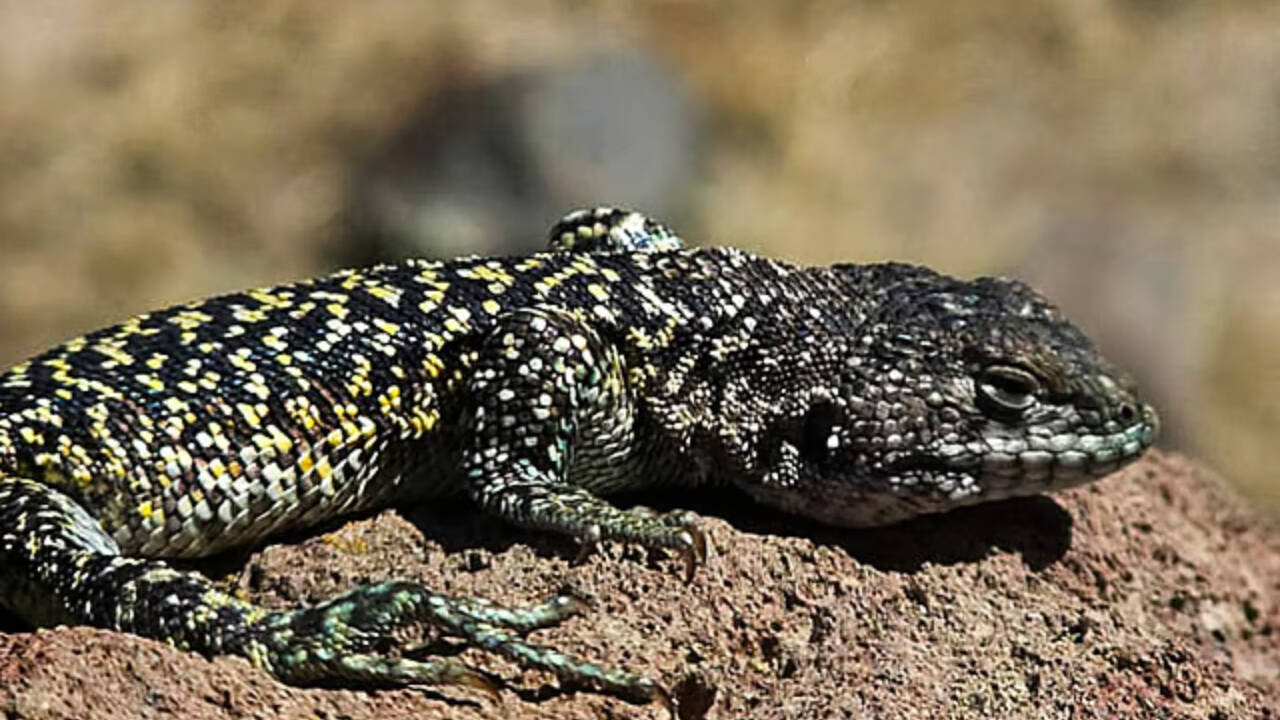
Science loves to draw lines on maps. Biologists spent centuries operating under the firm assumption that ectothermic animals, creatures wholly dependent on external ambient heat to regulate their metabolic rates, face an absolute physiological ceiling in high mountain ranges. At elevations exceeding 15,750 feet, thin air, punishing ultraviolet radiation, and sub-zero night temperatures ought to turn cold-blooded muscle into useless stone.
Yet biology refuses to obey our tidy academic rules.
In the southern Andean puna of Peru's Arequipa region, at altitudes surpassing 4,800 meters, researchers from the Natural History Museum of San Marcos University formally documented a new vertebrate resident. Named Liolaemus archipensis, this tiny reptile measures a mere six to eight centimeters in length, yet it thrives in an alpine zone that strips away almost all familiar comforts of organic existence. To understand why this discovery matters, we have to look past the routine academic announcement and examine the harsh physical pressures that make high-elevation survival a masterclass in evolutionary engineering.
The Physics of Survival at the Roof of the World
High-altitude environments operate under brutal thermodynamic constraints. As elevation climbs, atmospheric pressure drops, air density thins, and solar radiation spikes during daylight hours only to plunge dramatically the moment the sun dips below the jagged ridge lines. For a mammal or a bird, maintaining internal body heat is an expensive metabolic task fueled by high caloric intake and warm-blooded insulation.
For a lizard, the equation is entirely different. Ectotherms lack internal furnaces. They must absorb thermal radiation directly from rocks and soil. At nearly three miles high, the air temperature can hover near freezing even while direct sunlight bakes exposed stone surfaces to blistering levels. Liolaemus archipensis navigates this thermal rollercoaster through precise behavioral micro-habitat selection. By ducking into narrow rock fissures, compressing its body against sun-warmed schist, or utilizing specialized scales, the animal manages to extract just enough heat to fire up its cellular machinery.
The physical appearance of the animal tells an immediate story of adaptation. Females sport orderly, square-shaped dorsal patterns, while males exhibit distinct oblique markings paired with specialized white scales. These white scales are not accidental ornamentation. At extreme elevations, high albedo and intense solar glare create a fractured optical field where disruptive coloration provides critical camouflage against avian predators like the Andean condor or local raptors, while simultaneously helping to manage thermal reflectance.
Dietary Plasticity in a Barren Realm
In a classic lowland ecosystem, an insectivorous lizard enjoys a predictable buffet of soft-bodied flies, moths, and caterpillars. Move up into the high Andean puna, and that food web collapses into sparse minimalism. Vegetation is reduced to stubborn cushion plants, tough bunchgrasses, and encrusting lichens. Arthropods are scarce, wind-blown wanderers—mostly hardy beetles, spiders, true bugs, and specialized larvae that manage to shelter beneath stones.
Liolaemus archipensis survives by abandoning dietary specialization. Stomach content analyses published in scientific literature confirm that the species operates as an opportunistic omnivore. It grazes on low-lying plant matter to secure essential moisture and structural carbohydrates, while actively hunting down small arthropods when weather permits. This flexible palate is the hidden engine of high-altitude survival. An animal that insists on a strict insect diet starves the moment an unseasonal alpine frost wipes out local invertebrate populations.
What This Means for Peruvian Biodiversity
The formal description of this species lifts Peru’s official known lizard count to 296. That number is a milestone, but it also serves as an uncomfortable reminder of how much of our planet remains biologically unmapped. The high Andes are frequently viewed by commercial interests as barren expanses of rock and mineral wealth, prime territory for mining concessions and infrastructure development.
Every time researchers lace up heavy boots and push past previous altitudinal ceilings, they find complex, specialized communities tucked into niches we assumed were sterile. These organisms represent millions of years of genetic trial and error. They carry biochemical adaptations—perhaps novel proteins or cellular mechanisms capable of resisting extreme cold and hypoxic stress—that we have barely begun to catalogue.
The discovery of Liolaemus archipensis changes our baseline expectations. It proves that vertebrate evolution can squeeze functional life forms into extreme margins of the globe where theoretical models say they shouldn't exist. The high Andes are not a quiet museum of static rocks; they are an active theater of ongoing speciation, guarded by creatures small enough to sit in the palm of your hand, yet resilient enough to conquer the sky.