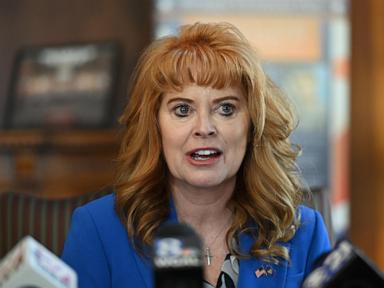
The vault door in Harrisburg doesn’t just hold currency; it holds a specific kind of trust that is harder to mint than any coin. It is a quiet, heavy responsibility. When Pennsylvania Treasurer Stacy Garrity looked at the request sitting on her desk, she wasn't just looking at numbers on a ledger. She was looking at a million-dollar question of where a public official’s life ends and the taxpayer’s obligation begins.
Governor Josh Shapiro wanted a security upgrade. Not for the Capitol, not for a state office, but for his private residence in Montgomery County. The price tag? $1 million.
Money is a cold thing until you realize what it represents. To a family in Erie, a million dollars is a lifetime of missed opportunities or a thousand small victories. To a state treasurer, it is a line in the sand. Garrity looked at that line and decided it had been crossed.
The Cost of a Private Fortress
Most people think of government spending as a giant, faceless machine. We imagine gears turning and money spraying out like water from a broken main. But in reality, it often comes down to a few people in a room arguing over the definition of "necessary."
The request for the Governor’s home wasn't for a simple alarm system or a sturdier lock. It was for a comprehensive overhaul intended to turn a private dwelling into a high-security installation. The argument from the Governor's camp was familiar: the world is a dangerous place, and the leader of a major swing state needs protection that follows him wherever he sleeps.
But there is a catch. Pennsylvania already provides a Governor’s Mansion.
The mansion in Harrisburg is a stately, historic home. It is already fortified. It is already paid for. It is the designated space where the public’s money ensures the public leader’s safety. When a Governor chooses to stay in their own private home instead, the financial math changes. It shifts from a matter of state security to a matter of personal preference.
Garrity’s "no" wasn't just a refusal to sign a check. It was a philosophical stand. She argued that if the Governor wants to live in his own house, the cost of making that house a fortress shouldn't land on the shoulders of people who are struggling to pay their own property taxes.
A Tale of Two Ledgers
Consider a hypothetical citizen named Elena. Elena lives in a modest brick row house in Allentown. She works forty-five hours a week, watches the price of eggs like a hawk, and pays her state income tax without fail. To Elena, $1 million is an abstract concept, a number so large it feels like fiction.
When Elena hears that the state wants to spend that much money on a driveway gate or a high-tech surveillance suite for a private home, she doesn't see "security." She sees a disconnect. She sees a political class that has forgotten the weight of a dollar.
This is the invisible stake in the Treasurer’s decision. It isn’t just about the $1 million—though in a state with crumbling bridges and underfunded classrooms, that million is plenty. It is about the precedent. If the state pays to upgrade this private home, what happens when the next Governor wants a bunker? What happens when a cabinet member decides their suburban cul-de-sac needs a guard shack?
Garrity pointed out a glaring inconsistency in the plan. The state’s Department of General Services was essentially asking for a blank check for a property the state doesn't own. If the Governor sells his house next year, the "security upgrades" paid for by the public stay with the house. The value of his private asset increases, fueled by the taxes of people like Elena.
It’s a windfall masquerading as a necessity.
The Friction of Accountability
Power usually flows toward the path of least resistance. In politics, it is almost always easier to say "yes" to a powerful peer than to say "no." Saying yes keeps the peace. It ensures invitations to the right dinners. It keeps the political machinery greased.
Saying no is loud. It creates friction.
The Governor’s office, predictably, didn't take the rejection quietly. They pointed to the rising tide of political threats, the volatility of the current climate, and the non-negotiable need to keep the Chief Executive safe. These are valid concerns. We live in an era where the temperature of public discourse has reached a boiling point. No one wants to see a public official harmed.
But safety is not a magic word that disappears the need for fiscal logic.
The Treasurer’s counter-argument was grounded in a simple, stubborn reality: the state already provides a safe house. The Governor’s Mansion isn't a prison; it’s a perk of the job. Choosing not to use it is a personal choice, and personal choices usually come with personal costs.
By blocking the $1 million, Garrity acted as a circuit breaker. She forced a conversation about where the government's reach should stop. It is a conversation that happens far too rarely in the halls of power, where "budgeted" often becomes a synonym for "spent."
The Shadow of the Past
Pennsylvania has a long, complicated history with how its leaders spend money. From the "bonusgate" scandals to the lavish renovations of legislative offices, the ghost of excess always haunts the Capitol. Every time a leader asks for a little more, the public remembers the times they were taken for a ride.
Trust is a fragile thing. It is built in increments and destroyed in landslides. For many Pennsylvanians, the request for $1 million in home improvements felt like the first tremor of a landslide. It felt like a return to the "let them eat cake" mentality that separates the rulers from the ruled.
Garrity, a veteran and a fiscal hawk, understands the optics of the ledger. She knows that when people lose faith in how their money is managed, they lose faith in the system itself. Her refusal was a signal to the voters that someone is actually looking at the receipts.
The tension between the Treasurer and the Governor isn't just a partisan squabble. It is a fundamental check and balance in action. It is the system working exactly how it was designed to work—with one hand reaching for the purse and the other hand slapping it away.
The Million Dollar Wall
We often talk about the "walls" of government, but the most significant walls are the ones we build between the reality of the taxpayer and the luxury of the official. A million dollars can buy a lot of stone and steel. It can buy cameras that see in the dark and gates that can stop a truck.
But it cannot buy back the confidence of a public that feels ignored.
The Governor’s private home remains a private home. The Governor’s Mansion remains empty or underutilized. And the $1 million remains in the treasury, at least for now. It is a victory for the idea that public service should involve a degree of public accountability, especially when it comes to the sanctity of the private hearth.
The decision has ripple effects. It forces every other department to look at their "necessities" through a slightly sharper lens. It reminds the bureaucracy that there is a gatekeeper who isn't afraid to say the most difficult word in the English language.
No.
As the sun sets over the Susquehanna River, the lights flicker on in thousands of homes across the Commonwealth. In those homes, people are balancing checkbooks, deciding which bills can wait and which must be paid today. They are making hard choices in the quiet of their kitchens. They expect the people they sent to Harrisburg to do the exact same thing.
A million dollars is a lot of money. But the principle of who pays for a politician's privacy is worth far more.
The vault stays closed. The line in the sand holds.