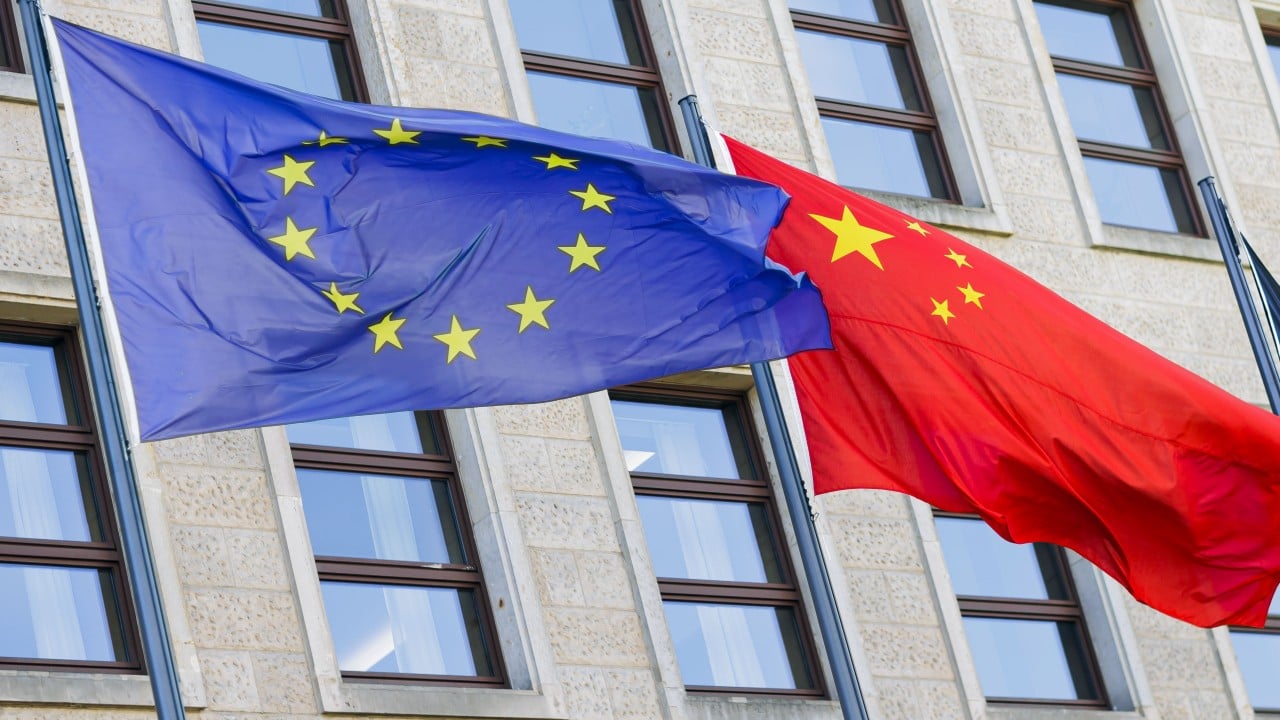
The systemic trade tension between the European Union and the People's Republic of China is not a transient political dispute; it is an structural mismatch between two fundamentally distinct economic engines. While conventional commentary describes the current friction as a looming "trade war" triggered by retaliatory tariffs, an analytical breakdown reveals a deeper systemic friction. The European Union operates a market-driven, regulatory-state model optimized for consumer welfare and open competition. China executes a state-directed, investment-heavy industrial policy designed to secure global supply chain dominance through concentrated capital deployment. This structural misalignment has reached an unsustainable threshold, manifesting as a daily €1 billion trade deficit for the EU and generating a defensive pivot in Brussels.
Understanding the trajectory of this geo-economic confrontation requires moving past political rhetoric to evaluate the underlying mechanics: the Chinese domestic cost function, the structural limitations of the EU’s regulatory framework, and the strategic escalation vectors available to both sovereigns.
The Dual Engines of Chinese Export Expansion
The surge of Chinese industrial exports into Western markets—frequently termed "China Shock 2.0"—is driven by two distinct macroeconomic phenomena: a domestic demand deficit and targeted capital subsidization.
The Macroeconomic Saving-Consumption Imbalance
The primary macroeconomic driver is a severe internal imbalance within the Chinese domestic economy. China’s economic model maintains an extraordinarily high national savings rate, which structurally suppresses domestic consumption. When domestic consumption fails to absorb industrial output, the economic system must export its excess production to maintain employment and service corporate debt. The resulting industrial output is not pushed abroad merely to capture market share, but functions as a critical venting mechanism for internal macroeconomic pressure.
The Fixed-Cost Subsidization Function
The microeconomic advantage of Chinese manufacturing, particularly in green technology sectors like electric vehicles (EVs) and solar supply chains, relies on extensive state-directed credit allocation. Rather than relying on direct cash transfers, this framework operates through localized input distortion. This distortion can be modeled as a significant reduction in an enterprise's fixed-cost function ($FC$):
$$FC_{\text{subsidized}} = FC_{\text{market}} - (C_{\text{capital}} + C_{\text{land}} + C_{\text{energy}})$$
Where:
- $C_{\text{capital}}$ represents the discount achieved through state-backed, below-market interest rates from state-owned commercial banks.
- $C_{\text{land}}$ represents local government provisions of industrial land at near-zero cost.
- $C_{\text{energy}}$ represents direct energy subsidies that lower industrial utility costs.
By lowering the initial capital expenditure and fixed overhead required to scale manufacturing plants, Chinese producers can lower their long-run average cost curves. This allows them to achieve global economies of scale far ahead of competitors operating under standard commercial financing constraints. Consequently, Chinese industrial output enters European markets at a structural discount, with prices frequently arriving up to 40% below European-engineered equivalents.
The European Regulatory Trilemma
The European Commission faces a complex policy trilemma. It must balance three competing structural goals that cannot be achieved simultaneously:
- Accelerated Decarbonization: Meeting stringent climate mandates requires access to the cheapest available green technologies, including solar components and battery cells.
- Industrial Preservation: Protecting the domestic manufacturing core, which supports approximately 29 million industrial jobs across the bloc.
- Adherence to Multilateral Rules: Operating within World Trade Organization (WTO) guidelines and maintaining an open, rules-based trading framework.
The previous European consensus favored the first and third objectives, allowing highly subsidized green imports to accelerate the bloc's energy transition. However, the sheer volume of Chinese manufacturing capacity has forced a policy realignment toward industrial preservation.
                  [ Decarbonization ]
                         /\
                        /  \
                       /    \
                      /      \
                     /________\
 [ Industrial Preservation ]  [ Open Multilateralism ]
The operational challenge for the EU lies in its institutional structure. Unlike the United States, which can deploy sweeping, preventative section-based tariffs under national security justifications, the EU's trade actions must be strictly evidence-based and regulatory in nature.
This constraint explains why the European Commission’s anti-subsidy duties on Chinese EVs are calibrated on a company-by-company basis, ranging from roughly 17% for cooperative firms like BYD to over 35% for non-cooperative state-owned entities like SAIC. The EU is attempting to remain technically compliant with WTO rules by matching the tariff rate directly to the quantified level of domestic distortion discovered during its nine-month field investigations.
Internal Cleavages: The European Sub-State Alignment
The efficacy of any unified European trade policy is limited by internal economic divergence among member states. The bloc is split into two distinct factions determined by their integration into the Chinese market.
The Export-Dependent Manufacturing Faction
Led by Germany, Sweden, and Hungary, this group opposes aggressive trade enforcement. German automotive manufacturers depend on China not only as a primary destination for premium internal combustion engine exports but also as a critical profit center through joint ventures located within the Chinese domestic market. For these states, the risk of asymmetric Chinese retaliation against high-margin sectors—such as luxury German vehicles, machinery, or agricultural exports—outweighs the perceived benefits of protective tariffs. Furthermore, member states like Hungary have secured major capital inflows by positioning themselves as localized manufacturing hubs for Chinese battery and EV firms seeking to bypass external tariff barriers from within the EU.
The Domestic-Market Protective Faction
Led by France, Italy, and Spain, this group advocates for decisive trade defense mechanisms. These economies possess automotive and industrial sectors that compete directly with incoming Chinese imports but lack significant market share inside China. For this faction, defensive trade tools are vital to prevent the erosion of domestic manufacturing bases and to incentivize Chinese firms to transition from direct exporting to greenfield foreign direct investment within Western Europe.
The Retaliatory Matrix: Escalation Vectors and Countermeasures
A mathematical analysis of a bilateral trade dispute demonstrates that escalatory responses rarely match the initial point of friction. China’s retaliatory strategy avoids mirroring the EU's automotive tariffs directly, targeting instead politically sensitive and structurally exposed European sectors to maximize internal political friction within the bloc.
| Targeted European Sector | Primary Impacted Member States | Strategic Objective |
|---|---|---|
| Agricultural Inputs (Pork & Dairy) | Spain, Denmark, France | Exploits agrarian political lobbies to pressure national governments to alter their stance within the European Council. |
| High-End Viticulture & Spirits (Brandy) | France | Hits premium consumer segments to apply pressure on the primary architect of the EU's anti-subsidy investigations. |
| Industrial Chemicals & Materials | Germany, Netherlands | Increases input costs for upstream European manufacturing, squeezing margins during inflationary periods. |
Beyond sector-specific anti-dumping investigations, Beijing maintains structural options designed to disrupt European supply chains:
- Upstream Mineral Restrictions: Implementing export controls on critical inputs—such as gallium, germanium, and graphite—where China controls the vast majority of global refining capacity. This targets the foundational components of European defense, electronics, and renewable energy supply lines.
- The Foreign Trade Law Anti-Discrimination Instrument: Utilizing domestic legal provisions to penalize European corporations operating within China if their home governments implement restrictions deemed discriminatory by Beijing.
Tactical Playbook for European Industrial Strategy
The reliance on standard anti-subsidy tariffs is an incomplete strategy; it addresses the symptoms of industrial asymmetry without altering the underlying cost structure. To preserve industrial capacity without causing a consumer price shock or halting decarbonization, European policymakers must transition from purely defensive duties to structured supply chain insulation.
Implement Safeguards and Tariff-Rate Quotas
Rather than relying solely on anti-subsidy duties that require months of judicial preparation, the EU must utilize rapid safeguard measures and Tariff-Rate Quotas (TRQs). TRQs allow a predetermined volume of imports to enter under low tariff rates, ensuring consumer access to affordable green tech, while applying a higher tariff on volumes exceeding the quota. This preserves price discovery while capping total market penetration.
Operationalize the Industrial Accelerator Act
The European Union must accelerate the implementation of its "Made in EU" procurement frameworks. Public tenders for municipal infrastructure, transit systems, and energy grids must shift away from lowest-cost procurement models toward multi-variable point systems. By legally requiring that 40% of strategic technology supply chains be sourced domestically, the EU can build a stable market for higher-cost European producers.
Leverage the Anti-Coercion Instrument
To counter asymmetric retaliation against vulnerable member states, the European Council must clarify its operational triggers for the Anti-Coercion Instrument. If China imposes targeted restrictions on Spanish agriculture or French spirits in response to a collective Brussels trade decision, the EU must be prepared to respond via collective counter-measures. These could include revoking market access for Chinese digital services or restricting shipping lines within European ports, shifting the dispute from a series of isolated bilateral fights to a unified bloc-wide response.
This analytical framework demonstrates that trade negotiations between the EU and China are not a prelude to a traditional trade war, but rather an ongoing structural recalibration. The outcome will not be decided by a comprehensive diplomatic grand bargain, but by which economy can better manage its domestic political and economic trade-offs during a prolonged period of industrial decoupling.