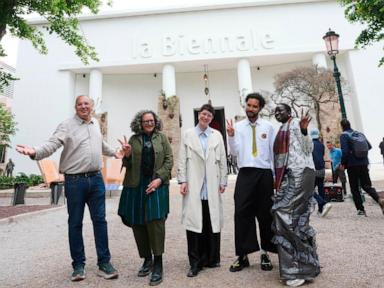
The 60th Venice Biennale functions less as a curated art sanctuary and more as a high-stakes stress test for the viability of international soft power in a fragmented global order. The historic exhibition, traditionally designed to provide a neutral forum for cultural exchange, has seen its structural integrity compromised by the direct intrusion of kinetic warfare and ideological polarization. When geopolitical reality outpaces artistic metaphor, the Biennale’s utility as a diplomatic tool collapses, transforming the Giardini and Arsenale into sites of institutional risk rather than prestige.
The current "chaos" reported by observers is not a series of isolated protests or logistical mishaps. It is the logical outcome of a friction-driven model where the "National Pavilion" system—a 19th-century relic—clashes with 21st-century borderless conflicts. The efficiency of the Biennale depends on the illusion of a controlled environment. Once that environment is breached by the actualities of the Gaza conflict, the Russia-Ukraine war, and rising populist pressures, the exhibition ceases to be a market for ideas and becomes a high-visibility target for strategic disruption.
The Tripartite Crisis of the National Pavilion System
The Biennale’s foundational architecture relies on three pillars that are currently in a state of advanced decay:
- Sovereign Immunity of Art: The assumption that cultural spaces are exempt from the standard pressures of international sanctions or grassroots boycotts.
- Geographic Fixedness: The reliance on permanent, physically static pavilions that tie a nation’s cultural presence to a specific piece of land, regardless of shifts in that nation’s moral or political standing.
- Institutional Neutrality: The capacity of the Biennale board to act as a disinterested arbiter of global creative output.
These pillars are failing because the cost of neutrality has risen exponentially. For instance, the decision of the Israeli pavilion’s artists and curators to remain closed until a "ceasefire and hostage release agreement" is reached represents a total breakdown of the sovereign immunity pillar. It is an admission that the platform can no longer function independently of the conflict it seeks to represent or ignore. This creates a precedent where the physical absence of a state’s contribution becomes a more potent signal than the art itself, effectively devaluing the Biennale as a venue for creative visibility.
The Logistics of Disruption and the Cost of Security
The shift from "preview" to "protest site" necessitates a re-evaluation of the Biennale’s operational overhead. The "chaos" experienced by visitors is the result of a sudden spike in the cost of physical and reputational security. This can be quantified through three distinct vectors of friction:
The Security-Accessibility Paradox
As political volatility increases, the Biennale must implement more rigorous screening processes. This slows the "throughput" of VIPs, collectors, and journalists. In a system where the primary value is social capital and rapid-fire networking, every minute spent in a security line is a loss of potential transactional efficiency. The Arsenale, once a streamlined venue for global curation, now functions with the bottleneck dynamics of an international border crossing.
Narrative Contagion
In a digitally saturated environment, the Biennale no longer controls the narrative of its own opening. The "chaos" is amplified by decentralized actors who use the Biennale’s prestige as a megaphone. When activist groups occupy the Giardini, the global media output shifts from art criticism to crisis reporting. This creates a negative feedback loop for sponsors and philanthropists who provide the capital that sustains the exhibition. The risk of being associated with a "toxic" or "unstable" event leads to capital flight, threatening the long-term solvency of national participations.
The Opportunity Cost of Absence
Russia’s continued absence and the voluntary shuttering of the Israeli pavilion create "dark zones" in the exhibition layout. These vacancies disrupt the psychological flow of the event. Instead of a comprehensive map of global creativity, the Biennale becomes a Swiss-cheese model of geopolitical exclusion. This fragments the visitor experience and forces the viewer to engage with the political vacuum, rather than the curated content.
The Mechanism of Artistic Displacement
The Biennale’s theme, "Foreigners Everywhere," was intended to explore migration and decolonization. However, the event has been overtaken by a literalization of its own theme. The "foreigner" is no longer a conceptual subject of a painting; the foreigner is the protester, the refugee, or the soldier whose actions dictate the opening hours of a pavilion.
This displacement occurs via a three-stage process:
- Overtasking the Medium: Artistic works are being asked to solve or address geopolitical grievances that they lack the agency to influence. This leads to a sense of impotence among participants.
- Institutional Paralysis: The Biennale’s leadership, constrained by its ties to the Italian government and international diplomatic norms, cannot take a definitive stance without alienating a significant portion of its funding or its participating nations.
- The Rise of the "Off-Site" Priority: As the main venues become bogged down by security and protest, the most meaningful interactions migrate to collateral events and private dinners. This hollows out the core exhibition, making it a mere backdrop for the "real" business occurring in less regulated spaces.
Structural Vulnerabilities in Global Art Governance
The current state of the Biennale exposes a significant flaw in how the West manages cultural soft power. The reliance on legacy institutions to process contemporary trauma is proving ineffective. This is not merely a matter of "bad optics"; it is a systemic failure of the governance model.
The Biennale’s board operates on a consensus-based logic that is ill-equipped for a world of "zero-sum" cultural warfare. When a pavilion becomes a point of contention, the board’s inability to act decisively creates a power vacuum. This vacuum is inevitably filled by the loudest or most disruptive voices, leading to the "chaos" cited by critics. The second-order effect is a decline in the "quality" of engagement. When visitors are preoccupied with their physical safety or the ethics of their presence, their capacity for deep aesthetic or intellectual engagement—the very thing the Biennale sells—evaporates.
Data-Driven Hypotheses on the Decline of the Mega-Exhibition
While exact attendance and transaction data for the 2024 preview are still being processed, we can hypothesize the following outcomes based on the observed friction:
- Decreased Institutional Acquisition Rates: Curators from major museums, faced with the logistical nightmare of the opening days, may prioritize acquisitions from more stable environments like Art Basel or individual gallery shows, where the focus remains strictly on the work.
- A Shift in Philanthropic Allocation: Donors who previously sought the "prestige" of a national pavilion may pivot toward private foundations or decentralized projects that offer more control over their public image and less exposure to political volatility.
- The Balkanization of Art Media: Coverage of the Biennale is splitting into two distinct streams: high-level political analysis and traditional art criticism. These two streams are increasingly incompatible, making it difficult for the Biennale to maintain a coherent brand identity.
Strategic Pivot: The End of the Neutral Venue
The "chaos" in Venice is a signal that the era of the "neutral" global exhibition is over. For an organization to survive this shift, it must abandon the pretense of being a sanctuary and instead embrace its role as a contested space. This requires a fundamental redesign of the Biennale’s operational strategy.
Future iterations must account for "political risk" in their initial planning stages. This involves:
- Dynamic Pavilion Allocation: Moving away from permanent buildings toward modular or digital presences that can be scaled or relocated based on the global climate.
- Crisis Management as Curation: Integrating the reality of protest and conflict into the exhibition’s formal structure, rather than treating it as an external disruption to be managed by police.
- Decentralized Funding Models: Reducing reliance on state-sponsored budgets, which are the primary source of political vulnerability, in favor of diversified, multi-lateral financial support.
The Venice Biennale is currently a victim of its own success as a symbol of global unity. By positioning itself as the "world's oldest exhibition," it has made itself a hostage to history. The chaos currently witnessed is the friction of an old-world machine trying to process new-world volatility. To regain its status as a masterclass of global analysis, the Biennale must stop trying to exclude the war from the garden and instead develop a more sophisticated, data-driven method for navigating the inevitable intersection of the two.
The primary strategic move for stakeholders—be they national governments, artists, or investors—is to move from a "prestige-at-all-costs" model to a "resilience-first" approach. This means valuing a pavilion’s ability to remain relevant under pressure over its ability to simply exist in a state of high-cost, high-risk aestheticism. The Biennale is no longer an exhibition of art; it is an exhibition of the world's current inability to coexist. To ignore this is to participate in a failing market.