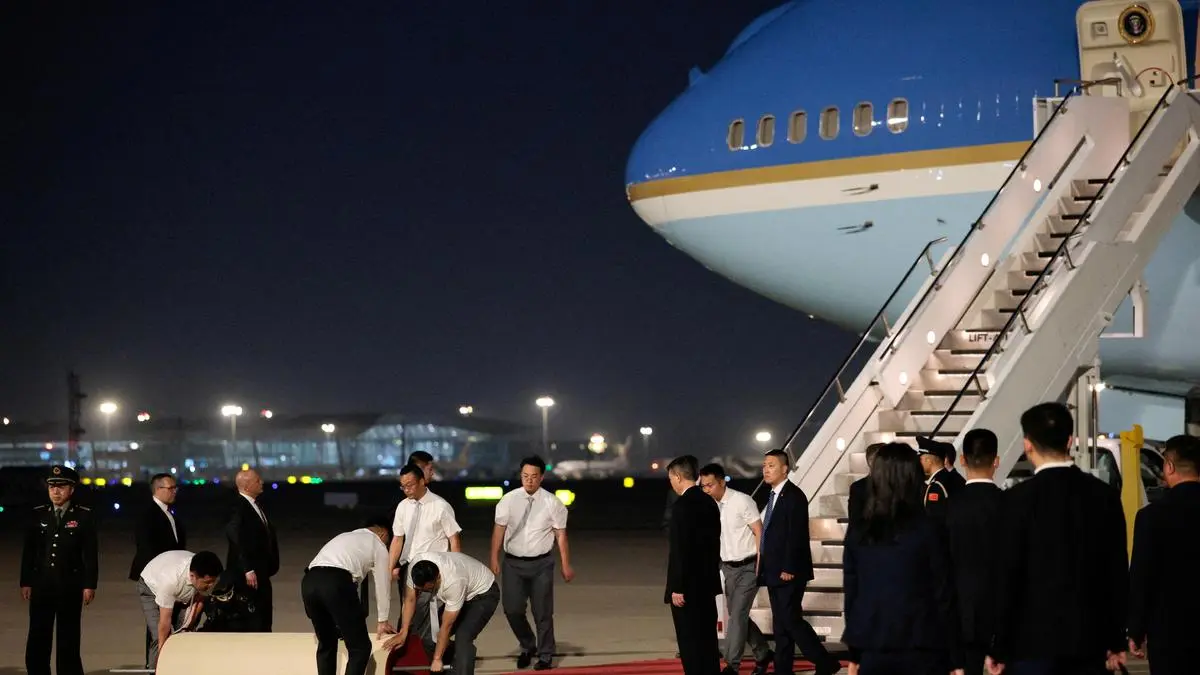
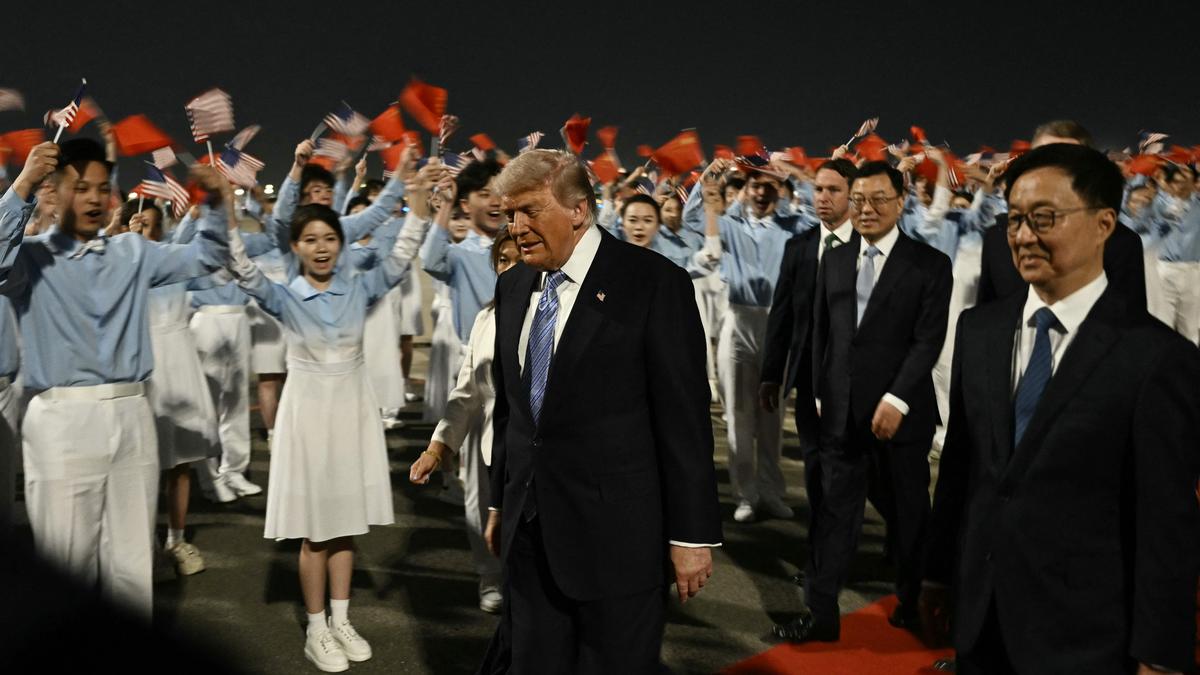
The arrival of a U.S. President in Beijing represents more than a diplomatic event; it is a stress test of the structural dependencies between the world’s two largest economies. While media narratives focus on the optics of the "State Visit-Plus," a rigorous analysis identifies the primary driver of this summit as the management of a deepening friction between integrated supply chains and divergent national security imperatives. The objective of this engagement is not the resolution of systemic differences, which are baked into the respective political architectures of both nations, but the calibration of a "competitive stability" framework. This framework seeks to prevent trade imbalances and territorial disputes from cascading into a hard decoupling that would trigger a global contraction.
The Triad of Friction Trade Security and Sovereignty
To understand the stakes of the Xi-Trump summit, one must categorize the points of contention into three distinct operational pillars. Each pillar contains a specific cost function that determines the floor and ceiling of potential cooperation.
1. The Trade Imbalance and Structural Reciprocity
The U.S. deficit with China is often discussed as a monolithic grievance, yet it is a function of two distinct economic mechanisms. First is the "Global Value Chain" reality, where China acts as the final assembly point for components designed and manufactured in third-party nations. Second is the "Market Access Gap," where state-led industrial policies provide Chinese domestic firms with subsidies and protections that American firms lack.
The strategy for the U.S. delegation centers on shifting from a "rules-based" complaint to a "results-oriented" enforcement. This involves demanding specific purchase agreements—particularly in energy and agriculture—to provide immediate political liquidity while simultaneously pressuring for structural changes in intellectual property (IP) protection. For China, the calculation is simple: offer enough concessions to avoid the escalation of Section 301 tariffs without compromising the "Made in China 2025" industrial roadmap.
2. The Maritime Security Bottleneck
The South China Sea and the Taiwan Strait represent the physical constraints of the relationship. From a strategic perspective, China views these waters as a "blue soil" extension of national sovereignty, essential for a secure maritime buffer. The U.S. views them as international commons vital to the $5 trillion in trade that passes through annually.
The risk here is a miscalculation during freedom of navigation operations (FONOPs). The summit's goal is to reinforce the Military Maritime Consultative Agreement (MMCA) to ensure that tactical-level encounters do not escalate into strategic-level crises. This is a containment strategy designed to manage a geographic overlap that has no immediate diplomatic solution.
3. The North Korean Denuclearization Lever
The most immediate geopolitical variable is the nuclear capability of the DPRK. Washington views Beijing as the sole actor with the economic leverage—specifically via the supply of crude oil and financial clearing—to force a behavioral change in Pyongyang. Beijing, however, operates under the "Three Nos" principle: no war, no instability, and no nukes.
The friction point exists because the U.S. prioritizes "no nukes," while China prioritizes "no instability" (the avoidance of a collapsed state on its border). The summit serves as a venue to negotiate the threshold of "maximum pressure." If the U.S. can offer assurances regarding the long-term presence of its troops on the peninsula, China may increase its enforcement of UN sanctions. Without those assurances, China will likely maintain a baseline of economic support for the DPRK to prevent a chaotic reunification.
The Cost of Decoupling and the Interdependence Paradox
A critical oversight in standard political reporting is the failure to quantify the "Decoupling Tax." Both administrations are operating under the pressure of internal economic mandates. For the Trump administration, the mandate is the revitalization of the domestic manufacturing base. For the Xi administration, it is the transition from an export-led economy to one driven by high-tech innovation and domestic consumption.
These goals are inherently contradictory. If the U.S. aggressively restricts the export of high-end semiconductors or restricts Chinese investment in Silicon Valley, it triggers a "technological balkanization." This creates a dual-standard global economy where hardware and software systems are no longer interoperable. The cost of this shift is not just measured in lost corporate revenue, but in the degradation of global R&D efficiency.
The Feedback Loop of Currency Manipulation
The labeling of China as a currency manipulator remains a potent rhetorical tool, but the underlying data suggests a more complex reality. The People’s Bank of China (PBOC) has historically intervened to prevent the Yuan (RMB) from depreciating too rapidly, which would trigger massive capital flight.
A sharp devaluation of the RMB would make Chinese exports cheaper, further bloating the U.S. trade deficit, but it would also erode the purchasing power of the Chinese middle class—a demographic the Xi administration must satisfy to maintain domestic stability. The summit provides a platform for "shadow coordination" on exchange rates, ensuring that neither side triggers a competitive devaluation that would destabilize the global bond market.
Internal Constraints and Executive Agency
It is a mistake to view either leader as an unconstrained actor. Each is tethered to internal institutional pressures that dictate the limits of their negotiating flexibility.
- The American Constraint: President Trump must navigate a Congress that is increasingly hawkish on China. Any deal perceived as "soft" on IP theft or trade will face legislative pushback, particularly regarding the renewal of the Committee on Foreign Investment in the United States (CFIUS) authorities.
- The Chinese Constraint: President Xi, having recently consolidated power at the 19th Party Congress, cannot afford a public "climb down." In the Chinese political hierarchy, "Face" is a proxy for domestic authority. Any concession must be framed as a mutual benefit between two "Great Powers" rather than a submission to external pressure.
Operational Logistics of the Summit Agreements
Beyond the high-level rhetoric, the summit’s success is measured in "MOU Density"—the volume and value of Memoranda of Understanding signed by the accompanying business delegations. We expect to see significant deals in the following sectors:
- Liquefied Natural Gas (LNG): U.S. energy firms are seeking long-term supply contracts to capitalize on the shale revolution. China is seeking to pivot away from coal to meet environmental targets. This is a rare area of perfect alignment.
- Aerospace: Boeing remains a primary export vehicle for the U.S. Large-scale aircraft orders are the "quick wins" used to temporarily reduce the deficit figures.
- Financial Services: China has signaled a gradual opening of its insurance and banking sectors. Allowing U.S. firms majority stakes in domestic ventures serves as a pressure valve for trade tensions.
The limitation of these MOUs is that they are non-binding. They represent "intent" rather than "execution." The true test of the summit occurs six to twelve months later, when the data reveals whether these intents have translated into actual shipments and settled invoices.
Structural Divergence in the Cyber Domain
The most significant cause-and-effect relationship missed by generalist analysts is the link between cyber espionage and industrial competitiveness. The 2015 agreement between Obama and Xi to curb state-sponsored cyber theft of IP saw a temporary dip in activity, but reports suggest a resurgence under new, more sophisticated guises.
The Trump administration views this as a "systemic theft" that invalidates traditional trade logic. If a competitor can bypass R&D costs by exfiltrating blueprints, the competitive advantage of the innovator is neutralized. The summit will likely see the U.S. demanding a "Verification Mechanism" for cyber activities—a demand Beijing is almost certain to reject on sovereignty grounds. This creates a permanent bottleneck in the relationship that no single summit can clear.
The Regional Alignment Strategy
The summit is not occurring in a vacuum; it is a signal to the rest of the Indo-Pacific. For allies like Japan, South Korea, and Australia, the meeting is a barometer for U.S. commitment to the region.
- The ASEAN Variable: Nations in Southeast Asia are increasingly wary of being forced to choose sides. A successful, stable summit reduces the pressure on these nations to align exclusively with one bloc.
- The Belt and Road Initiative (BRI): China’s massive infrastructure project is the counterweight to U.S. maritime dominance. The U.S. strategy is to critique the "debt-trap diplomacy" of the BRI, while China uses it to cement its role as the regional economic hegemon.
The summit provides a venue for the U.S. to offer an "alternative value proposition," though it lacks the centralized funding of the BRI. This remains a significant gap in the American strategy.
Analytical Projection of the Outcome
Based on the current economic and political data, the summit will likely produce a "Strategic Pause" rather than a "Comprehensive Settlement." The two nations are locked in a Thucydides Trap—a situation where a rising power creates fear in an established power.
The immediate result will be a series of high-dollar purchase agreements designed to satisfy the U.S. political cycle and a joint statement on North Korea that maintains the status quo of "denuclearization through dialogue." However, the underlying structural issues—IP theft, state subsidies, and maritime claims—will remain unresolved.
The strategic play for multinational corporations and investors is to prepare for a "Bifurcated Market." The era of seamless global integration is being replaced by a period of "Gated Globalization." Companies must diversify their supply chains outside of China (the "China Plus One" strategy) to mitigate the risk of sudden tariff escalations or regulatory crackdowns.
The summit serves as a reminder that the U.S.-China relationship is no longer a partnership to be optimized, but a rivalry to be managed. The objective for both sides is to maintain the rivalry within a range that avoids kinetic conflict while continuing the struggle for technological and economic primacy. Logic dictates that the volatility seen in the first year of the Trump administration will not subside, but rather become the new baseline for international relations.