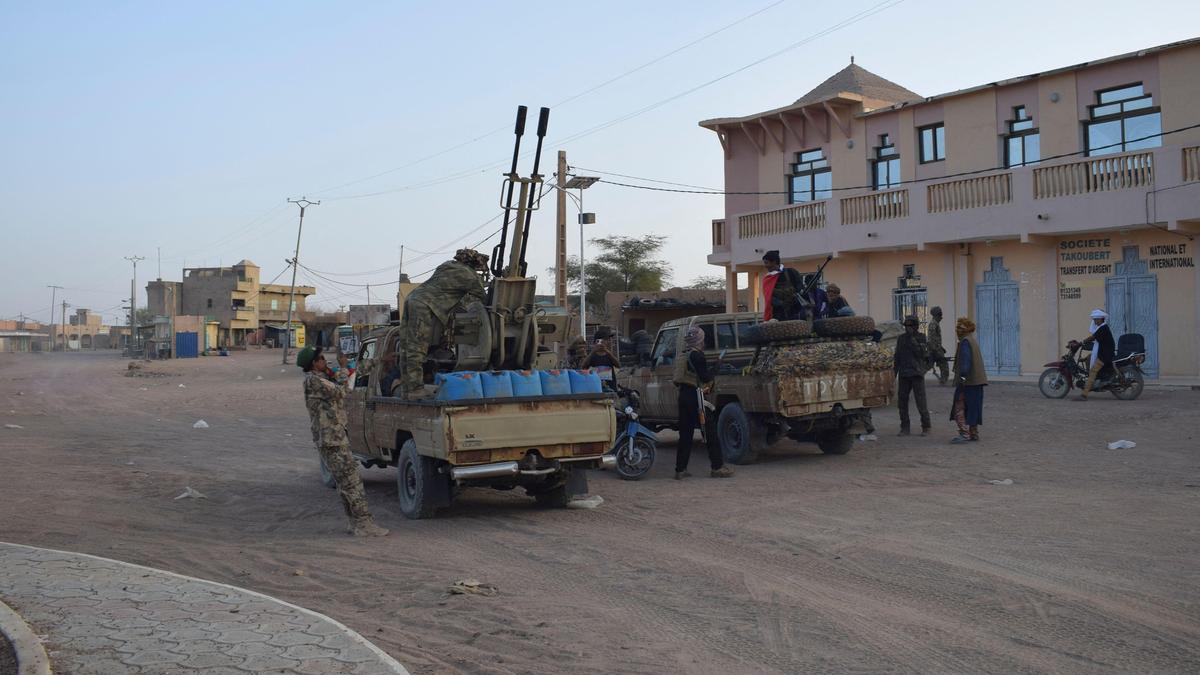
Russia’s dismissal of Tuareg rebel demands for a military withdrawal from Mali underscores a shift from traditional peacekeeping to a permanent security-for-resources architecture. The rejection is not a diplomatic posture but a calculated preservation of a logistical hub that connects Moscow’s influence across the Sahel. This refusal signals that the Kremlin views the risk of localized military attrition as secondary to the strategic necessity of maintaining a contiguous corridor of influence from Libya to the Gulf of Guinea.
The Tri-Pillar Framework of Russian Persistence
To understand why a withdrawal is functionally impossible under current Russian doctrine, one must analyze the intervention through three distinct operational pillars.
1. The Resource-Security Swap Mechanism
The presence of Russian paramilitary forces—formerly Wagner, now integrated into the Africa Corps—functions on a self-funding economic model. In exchange for suppressing insurgencies, the Malian transition government provides access to gold mining concessions and other mineral extraction rights. Withdrawing would collapse this revenue stream, forcing the Kremlin to fund these foreign excursions directly from a state budget already strained by the conflict in Ukraine.
2. Geopolitical Denial and Strategic Depth
Mali serves as the fulcrum of the Sahel. By maintaining a permanent footprint, Russia achieves "strategic denial," ensuring that Western powers, specifically France and the United States, cannot easily re-establish the counter-terrorism infrastructure they dismantled between 2021 and 2023. The rejection of rebel demands confirms that Russia’s primary adversary in the region is not the rebel coalition itself, but the vacuum that a Western return might fill.
3. The Sovereign Shield Doctrine
Russia offers a "no-strings-attached" security package that explicitly ignores the human rights benchmarks required by Western military aid. This creates a high level of "switching costs" for the Malian junta. If the Malian leadership were to pivot away from Russian support, they would lose their primary defense against internal coups and be forced to face international scrutiny regarding democratic transitions. Russia leverages this dependency to ensure its stay is permanent.
Asymmetric Risk and the Tinzaouaten Feedback Loop
The recent combat losses sustained by Russian forces near the Algerian border at Tinzaouaten represent a shift in the tactical landscape. The Permanent Strategic Framework for Peace, Security, and Development (CSP-PSD)—the rebel coalition—demonstrated a newfound capability to utilize terrain and weather to nullify the technological advantages of Russian air support.
This creates a specific "Attrition Paradox." Russia cannot afford to retreat because doing so signals weakness to other regional clients (Burkina Faso and Niger), yet staying requires a higher concentration of troops and hardware that are currently needed on the Eastern Front in Europe. The Russian response has been to increase reliance on high-altitude strikes and drone surveillance, attempting to minimize personnel exposure while maintaining a kinetic presence.
The Drone Proliferation Variable
Intelligence indicates an increasing sophistication in rebel tactics, specifically the potential acquisition of small-unit drone technology. If the rebel coalition successfully integrates FPV (First Person View) drones into their hit-and-run maneuvers, the cost-function for Russian protection will spike. Moscow must now calculate the "Value per Mercenary" versus the "Rate of Mineral Extraction." When the cost of replacing specialized personnel and downed aircraft exceeds the monthly gold yield, the current model becomes a liability.
Structural Constraints of the Malian State
The Malian military’s reliance on Russian assets has led to a degradation of its own independent command structure. The integration has reached a point of "institutional capture" where the Malian Armed Forces (FAMa) are effectively an auxiliary to Russian command in high-stakes sectors.
- Logistical Dependency: FAMa relies on Russian-maintained Mi-24 and Mi-8 helicopters for rapid troop movement.
- Intelligence Bottlenecks: Signal intelligence and satellite data are funneled through Russian channels, leaving the Malian high command with an incomplete operational picture.
- Political Legitimacy: The junta has staked its entire reputation on the "restoration of sovereignty." Admitting that Russian forces are insufficient or asking them to leave would be a de facto admission of state failure.
This dependency creates a feedback loop. The more the rebels attack, the more the junta needs Russia; the more Russia stays, the more the rebels view the conflict as an anti-colonial struggle, broadening their recruitment base.
The Northern Border Friction Point
The refusal to withdraw also carries significant regional diplomatic friction, particularly with Algeria. Algiers views the presence of non-state paramilitary actors on its southern border as a threat to its "Strategic Depth" policy. Russia’s persistence in the north risks alienating a key energy partner and arms client.
Russia is betting that Algeria’s desire for regional stability will outweigh its distaste for the Africa Corps. However, the logic of the "Security Vacuum" suggests that as long as the Tuareg groups feel backed into a corner, they will continue to seek external sponsors. The recent reports of Ukrainian intelligence involvement with the rebels add a layer of "Globalized Insurgency" to the Sahel. If Mali becomes a secondary theater for the Ukraine war, the technical sophistication of the rebels will likely increase, further raising the price of Russian persistence.
The Strategic Path Forward
Moscow’s refusal to withdraw is a commitment to a high-stakes attrition game. The strategy relies on three specific tactical pivots to maintain the status quo:
- Vertical Escalation: Increasing the use of heavy thermobaric weaponry and scorched-earth tactics in rebel-held territories to displace the civilian base that supports the CSP-PSD.
- Information Domain Dominance: Flooding the local digital ecosystem with narratives that frame all rebel activity as "Western-sponsored terrorism," thereby neutralizing local dissent against the Russian presence.
- Financial Diversification: Seeking to expand extraction into the lithium and phosphate sectors to create a buffer against the fluctuating price of gold and the rising costs of private military contractors.
The critical vulnerability in this strategy is the "Single Point of Failure" inherent in the Malian junta. Should a counter-coup occur within the FAMa—driven by mid-level officers dissatisfied with Russian casualties—the entire Russian architecture in the Sahel would lose its legal veneer overnight. Until then, Moscow will treat the rebel demands as noise, prioritizing the extraction of physical wealth over the stabilization of the Malian borderlands. The operation has ceased to be about counter-insurgency; it is now a pure-play exercise in resource protection and geopolitical leverage.