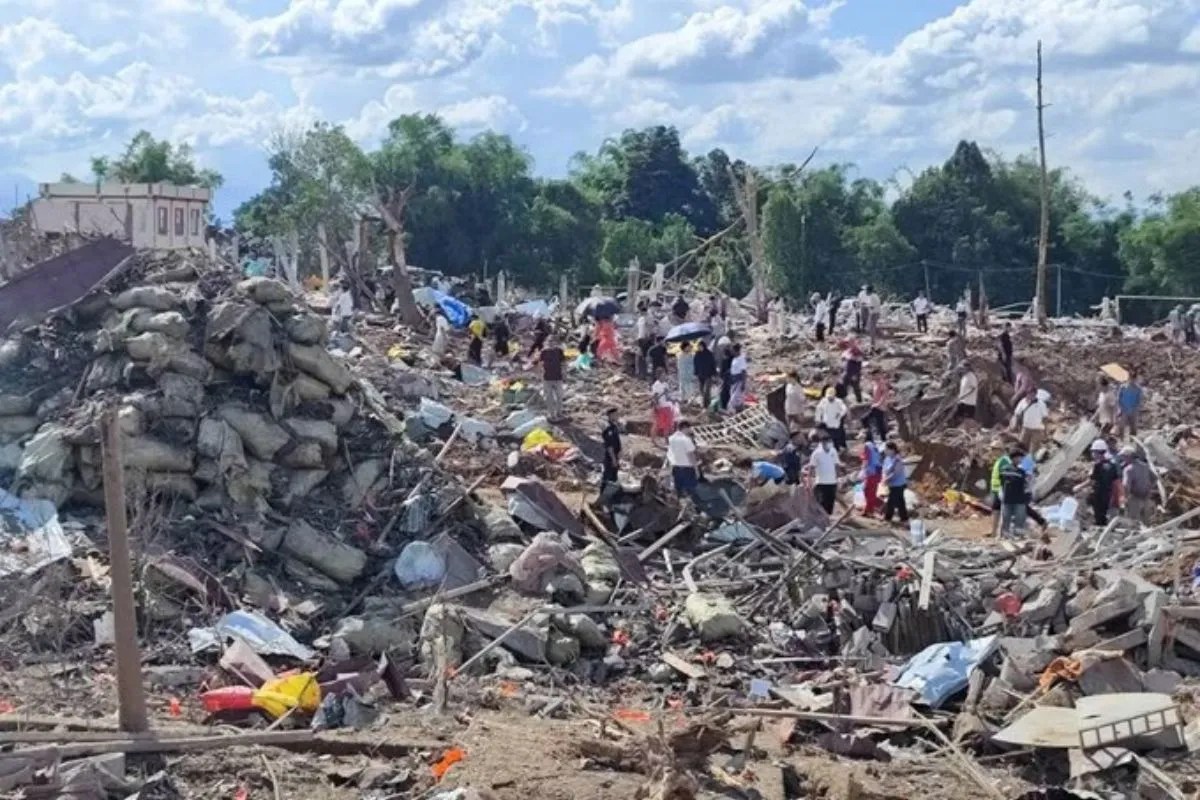
A devastating blast near the Myanmar-China border has leveled an entire village, destroying over 100 homes and leaving at least 55 people dead. The explosion, which occurred in a region fiercely contested by ethnic armed organizations and the Myanmar military junta, highlights a dangerous escalation in a civil war that Beijing is desperately trying to contain. While state media outlets scramble to report basic casualty figures, the deeper reality points to a catastrophic intelligence failure and a black-market arms pipeline that has turned the borderlands into a powder keg.
This is not a localized tragedy. It is the predictable flashpoint of a fragmented war.
For decades, the border region has operated under a fragile equilibrium. Ethnic armed groups control vast swaths of territory, managing everything from taxation to local governance, while China watches from across a heavily fortified fence. But the current conflict, ignited by the 2021 military coup in Myanmar, has shattered that stability. The latest explosion underscores how the proximity of the fighting to Chinese sovereign territory is forcing Beijing's hand, dragging a reluctant superpower into a chaotic civil conflict on its doorstep.
The Anatomy of a Borderland Catastrophe
Initial reports from the region attribute the destruction to a massive munitions depot blast, though local resistance forces and the military junta are already trading blame. The scale of the devastation—100 homes reduced to splinters instantly—suggests industrial-grade explosives rather than conventional mortar fire.
The mechanics of such a blast require context. In these border enclaves, makeshift weapons factories and ammunition stockpiles are routinely embedded within civilian infrastructure.
Tactical necessity drives this dangerous integration. Independent militias lack the luxury of isolated military bases; they operate out of villages, using dense civilian cover to shield their supply chains from junta airstrikes. When a strike hits or an accident occurs, the civilian toll is absolute. The 55 casualties recorded in this latest incident represent not just combatants, but entire families caught in the literal crossfire of a war that has overspilled its traditional boundaries.
The Failed Buffer Strategy
Beijing has long pursued a dual-track policy in Myanmar, maintaining formal diplomatic ties with the military junta in Naypyidaw while simultaneously throwing economic lifelines to ethnic Chinese militias along the border, such as the United Wa State Army (UWSA) and the Myanmar National Democratic Alliance Army (MNDA).
The strategy was simple. Create a compliant buffer zone to protect Chinese infrastructure investments, including strategic oil and gas pipelines that cut across Myanmar to the Indian Ocean.
That strategy is now dead. The chaos is simply too volatile to manage from afar.
+--------------------------------------------------------------+
|             THE FRAGILE BORDER BALANCE                       |
+--------------------------------------------------------------+
|  [China]                                                     |
|     |---> Seeks stability, resource corridors, border security|
|     v                                                        |
|  [Border Buffer Zone]                                        |
|     |---> Controlled by ethnic militias                      |
|     |---> Flooded with black-market munitions                |
|     v                                                        |
|  [Myanmar Interior]                                          |
|        ---> Locked in systemic civil war (Junta vs. Rebels)  |
+--------------------------------------------------------------+
By allowing these border enclaves to become highly militarized zones, the external actors inadvertently created an uncontrolled arms market. Man-portable air-defense systems, heavy artillery, and commercial drones modified for precision bombing run rampant through these hills. This latest explosion proves that the buffer zone is no longer protecting the border; it is actively threatening it, sending shockwaves across the frontier and forcing Chinese border cities into high-alert lockdowns.
The Problem with Black Market Logistics
Tracing the origin of the explosives involved in the blast reveals a complex web of regional trafficking. Most heavy weaponry utilized by ethnic armed organizations originates from state-run factories, but a staggering amount of auxiliary ordnance—ammonium nitrate, detonators, and specialized drone components—flows through unregulated overland routes.
- Porous Trade Routes: Mountain passes bypass official customs checkpoints with ease.
- Dual-Use Chemicals: Agricultural fertilizers are systematically diverted into makeshift bomb factories.
- Corruption: Low-ranking officials on both sides of the frontier frequently look the other way for the right price.
When these materials aggregate in dense civilian areas without safety protocols, disasters are inevitable. The sheer volume of material required to level 100 homes in a single event points to a massive logistical hub operating right under the nose of international observers.
Spillover Dynamics and the Refugee Dilemma
Every time a village falls along the border, a human wave breaks against the frontier fence. The destruction of this village has already sent hundreds of survivors fleeing toward Yunnan province, presenting a direct security challenge.
Security forces face a grim calculus. Open the gates and risk importing the instability of a civil war, or keep them closed and watch a humanitarian disaster unfold on live television.
       [Military Operations / Airstrikes]
                       │
                       ▼
         [Civilian Displacement Village]
                       │
                       ▼
        ┌─────────────────────────────┐
        │    Border Wall Bottleneck   │
        └──────────────┬──────────────┘
                       │
           ┌───────────┴───────────┐
           ▼                       ▼
   [Refugee Pressure]      [Border Lockdowns]
This spillover extends beyond refugees to stray ordnance. Over the past year, artillery shells have repeatedly crossed the border, damaging property and injuring citizens on foreign soil. Each incident ratchets up diplomatic tensions, making it harder to maintain the pretense of non-interference. The latest explosion, given its proximity and magnitude, forces an immediate reassessment of defensive postures along the entire northern perimeter.
A Failure of Mediation
International diplomatic efforts to broker a ceasefire in northern Myanmar have consistently fallen flat because they misjudge the motivations of the combatants. The junta is fighting for its institutional survival, while the ethnic coalitions view this as a historic opportunity to permanently carve out autonomous states.
A piece of paper signed in a distant capital holds zero currency on the ground.
The armed groups have realized that the junta’s forces are stretched thin across multiple fronts, making them vulnerable. Consequently, the incentive to de-escalate is virtually non-existent. Every ceasefire brokered over the last twelve months has served merely as a tactical pause, allowing both sides to resupply, refuel, and prepare for the next round of urban warfare.
The Economic Toll on Regional Trade
Beyond the immediate loss of life, the obliteration of border infrastructure chokes off vital economic arteries. The Muse and Chinshwehaw border crossings account for billions of dollars in annual bilateral trade, serving as the main entry points for agricultural goods flowing north and manufactured items moving south.
| Border Zone | Primary Trade Impact | Security Status |
|---|---|---|
| Northern Corridor | Disrupted agricultural exports, halted machinery imports | Critical / Active Combat Zone |
| Eastern Buffer | Supply chain bottlenecks, restricted personnel movement | High Alert / Militarized |
| Western Outposts | Diverted trade routes, increased logistics costs | Unstable / Unpredictable |
When fighting encroaches on these zones, transit halts entirely. Hundreds of cargo trucks sit idling along the highways, their drivers stranded in combat areas while goods rot in the sun. This economic paralysis hits local populations first, driving up the cost of basic food supplies and fuel, which in turn fuels further desperation and drives more young people into the ranks of local militias.
The Illusion of Control
The core mistake made by regional analysts is assuming that any single external power can dictate terms to the actors on the ground. The militias operating along the border may accept funding or trade access, but they do not take orders. They are deeply entrenched, highly motivated, and now possess weapons capabilities that rival standing armies.
The explosion that leveled 100 homes is a stark reminder that the conflict has evolved past the point of proxy management. The weapon stockpiles are too large, the factions are too numerous, and the hatreds run too deep for an external hand to quietly stabilize the region. As the fires burn near the border fence, the illusion of a controlled, manageable war on the periphery has evaporated entirely, leaving behind the stark reality of an unpredictable conflict that recognizes no international borders.