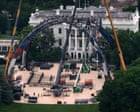
The convergence of executive brand management, elite sports entertainment, and federal property utilization reaches a critical juncture when a temporary sports arena is planned for the South Lawn of the White House. This specific operational undertaking—manifested in the construction of an Ultimate Fighting Championship (UFC) octagon and seating pavilion to mark Donald Trump’s 80th birthday—presents unprecedented engineering, security, and jurisdictional challenges. Examining this event requires moving past superficial political commentary to analyze the precise logistical variables, structural limitations, and constitutional mechanisms governing private entertainment infrastructure within a high-security executive compound.
The Tri-Party Jurisdictional Framework
The execution of a private sporting build on federal parkland necessitates a complex intersection of three distinct authorities. The White House complex is not a standard municipal zone; it operates under layered jurisdictions that control physical access, historic preservation, and airspace. In related developments, read about: Why Mauricio Pochettino Cares More About Talent Than Minutes in His USMNT World Cup Roster.
                  [ National Park Service (NPS) ]
                     /                         \
                    /                           \
                   v                             v
[ U.S. Secret Service (USSS) ] <---> [ White House Executive Residence Staff ]
- The National Park Service (NPS): The South Lawn is part of President's Park, a unit of the National Park System. The NPS manages the physical turf, subterranean utility networks, and historical preservation mandates. Any modification, even temporary, requires a Special Resource Use permit assessing environmental and ground-pressure impacts.
- The United States Secret Service (USSS): The Secret Service holds absolute veto power over any structural implementation based on the Comprehensive Security Plan. The physical layout must preserve clear lines of sight, clear designated emergency egress routes, and maintain the integrity of the technological counter-measures surrounding the Executive Mansion.
- The White House Executive Residence Staff: Managed by the Chief Usher, this entity coordinates the operational interface between private contractors (such as UFC logistics teams) and the institutional scheduling of the presidency.
The primary operational friction occurs between the fast-tracked timelines of a commercial sports production and the bureaucratic verification loops required by the USSS for background-screening every individual equipment technician entering the perimeter.
Structural Engineering and Turf Kinetics on the South Lawn
Building a multi-ton sports pavilion on an unpaved, historically sensitive landscape introduces severe mechanical risks. Standard arenas rely on reinforced concrete sub-bases designed to distribute dynamic loads. The South Lawn features a complex topsoil layer sitting above historical utility conduits, drainage networks, and subterranean secure infrastructure. Sky Sports has also covered this fascinating issue in extensive detail.
The structural engineering solution requires a strict load-distribution model to prevent catastrophic soil compaction or shear failure.
The Mass Distribution Function
To prevent damage to underground assets, the total mass of the octagon, lighting rigs, audio arrays, and grandstand seating must be transformed from concentrated point loads into uniform distributed loads. The maximum allowable ground pressure ($P_{max}$) on the South Lawn is strictly limited by the shear strength of the underlying soil matrix.
The structural engineering team must satisfy the following safety condition:
$$P_{actual} = \frac{F_{dead} + F_{live}}{A_{effective}} \le P_{max}$$
Where:
- $F_{dead}$ represents the static weight of the structural steel, aluminum trusses, and the octagon platform.
- $F_{live}$ represents the dynamic, shifting weight of the athletes, officials, production crew, and spectators.
- $A_{effective}`$ is the total surface area of the interlocking heavy-duty load-distribution mats (such as Dura-Base systems) laid over the turf.
If $A_{effective}$ is insufficient, the localized force will crush subsurface irrigation networks and compromise the root systems of historic trees planted by previous administrations.
The Low-Profile Canopy Constraint
A standard UFC pay-per-view event utilizes a massive overhead truss system suspending tons of lighting, cameras, and audio equipment directly over the cage. On the White House lawn, this design encounters a strict vertical constraint.
High-profile vertical trusses disrupt the visual monitoring fields of USSS counter-snout and optical surveillance teams stationed on the roof of the Executive Mansion. Therefore, the engineering architecture must pivot to a low-profile, cantilevered ground-support system. This system trades vertical clearance for lateral stability, increasing the overall footprint of the stage assembly and requiring more precise counter-weight calculations to resist wind-shear forces without anchoring deep stakes into the protected soil.
The Production Supply Chain and Security Bottleneck
The logistical timeline of standard stadium builds is compressed into a high-security bottleneck when staging an event at 1600 Pennsylvania Avenue. The standard commercial supply chain relies on Just-In-Time (JIT) delivery, where flatbed trucks arrive sequentially to unload steel staging. At the White House, this model breaks down due to the mandatory Off-Site Security Screening Facility (OSSF) protocol.
Every piece of equipment—from the canvas of the canvas mat down to individual XLR audio cables—must route through a remote screening site hours before arrival at the South Lawn gate.
[ Production Warehouse ]
         │
         ▼
[ Off-Site Security Screening Facility (OSSF) ] -> (X-Ray, K-9, Explosive Detection)
         │
         ▼
[ Escorted Secret Service Convoy ]
         │
         ▼
[ White House Tactical Access Point ]
         │
         ▼
[ Just-In-Time Assembly on South Lawn ]
This structural bottleneck introduces a variable delay coefficient into the construction schedule. A single unmanifested piece of equipment found in a delivery truck can halt the entire logistical pipeline, creating a compounding delay that threatens the hard deadline of a live broadcast or scheduled event.
Commercial Integration vs. Federal Gift Compliance
Hosting a major sporting brand like the UFC within the executive perimeter introduces significant legal and ethical boundaries. The anti-deficiency act and strict federal gift compliance frameworks restrict how private corporations can interact with the executive branch.
- Valuation of Corporate Infrastructure: The provision of an arena, production equipment, and world-class athletes constitutes a tangible service with high market value. Under Office of Government Ethics (OGE) guidelines, if the event is categorized as an official state function, the corporate entity must act strictly as a vendor or follow precise donation protocols that strip the corporation of any commercial branding rights within the venue.
- The Zero-Commercialization Zone: A standard UFC event features a canvas covered in corporate sponsor logos. Federal regulations prohibit the appearance of commercial endorsement by the Executive Office of the President. Consequently, the visual design of the octagon must undergo complete sanitization. The canvas must be devoid of standard corporate sponsors, forcing a unique design aesthetic that balances the raw brand identity of the UFC with the austere decorum demanded by the venue.
Operational Execution Strategy
To successfully execute an athletic event of this magnitude without compromising the functionality or security of the executive branch, the project management team must deploy a three-phase operational blueprint.
Phase 1: Subsurface Mapping and Load Modeling
Execute a complete Ground Penetrating Radar (GPR) scan of the South Lawn build site to map all historical voids, utility lines, and structural vulnerabilities. Calculate the exact footprint of the interlocking composite matting system based on the total calculated weight of the specific low-profile octagon configuration chosen for the event.
Phase 2: Staged Security Manifesting
Establish a digital manifest system linking the UFC production crew directly with the USSS technical security division. Every tool, camera lens, and structural bolt must be cataloged with an associated serial number. Personnel schedules must be locked 72 hours prior to the initial build phase, with zero substitutions permitted to avoid security screening delays at the OSSF.
Phase 3: High-Density Assembly and Rapid Deconstruction
Utilize an accelerated modular building technique. Pre-assemble major structural components off-site, allowing cranes positioned on reinforced perimeter roadways to hoist pre-built segments directly onto the load-distribution mats. This minimizes the footprint of active laborers on the lawn and compresses the total physical disruption of the White House grounds to under 48 hours.
The success of this operation relies entirely on treating the White House not as an ordinary event venue, but as a live, highly restricted military and administrative installation where entertainment objectives must completely defer to structural and security realities.