State-driven aviation procurement operates fundamentally as a mechanism of macroeconomic statecraft rather than a simple commercial transaction. When a sovereign entity commits to purchasing 200 commercial aircraft from a foreign aerospace manufacturer, the transaction cannot be evaluated through the standard lens of fleet optimization or airline capacity demands. Instead, this scale of capital deployment functions as a dual-purpose instrument: a tactical concession to balance bilateral trade asymmetric pressures and a strategic lever within domestic industrial policy.
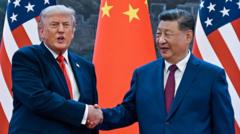
The announcement of China’s commitment to acquire 200 Boeing aircraft following the summit between Donald Trump and Xi Jinping represents a textbook case of managed trade. To understand the economic reality of this commitment, one must dissect the structural drivers behind Chinese aerospace procurement, the operational constraints of the global aviation supply chain, and the strategic calculus that governs how these commitments are actualized or delayed.
The Dual-Track Framework of Chinese Aerospace Procurement
Aviation procurement in centralized economies follows a dual-track framework that splits the commercial utility of an aircraft from its political utility. In a decoupled or purely market-driven economy, an airline evaluates its network architecture, calculates the net present value (NPV) of an asset over a 20-year lifecycle, and places an order based on projected passenger demand. In contrast, the Chinese aviation ecosystem routes all major foreign procurement through a centralized state agency, the China Aviation Supplies Holding Company (CASC).
This centralized architecture creates a two-tiered ordering process:
- The Political Commitment (The Framework Agreement): This is the high-profile announcement typically timed to coincide with diplomatic summits. It serves as a statement of intent, signaling a willingness to alter trade balances. It binds the sovereign state rhetorically but lacks the granular technical specifications, delivery slots, or binding financial penalties of a definitive contract.
- The Operational Allocation (The Firm Contract): This is the subsequent, often unpublicized phase where CASC distributes the blanket order among state-owned carriers—such as China Eastern, China Southern, and Air China—based on actual capacity requirements, pilot type-ratings, and route allocations.
By utilizing this dual-track system, the state retains structural options. The 200-aircraft commitment acts as an economic buffer. If bilateral relations stabilize, the framework agreements transition into firm contracts with specific delivery timetables. If geopolitical frictions intensify, the state can stall the conversion process, deferring deliveries without triggering the explicit default clauses embedded in standard commercial purchase agreements.
The Trade Balance Equation and Capital Flight Mitigation
From a macroeconomic perspective, the procurement of widebody and narrowbody aircraft serves as an efficient mechanism for adjusting trade imbalances. Commercial aircraft represent one of the highest-value single-item manufactured exports available. For an administration focused heavily on bilateral trade deficits, a multi-billion-dollar aircraft order provides an immediate, quantifiable reduction in the deficit metrics.
However, the financial mechanics behind these transactions reveal a deeper strategic calculus regarding capital outflows. When China commits to purchasing US-manufactured aerospace assets, the capital deployment accomplishes three distinct objectives:
- Asset Diversification: It converts liquid foreign exchange reserves (largely held in low-yield US Treasury bonds) into hard, productive industrial assets that generate domestic economic yield through air transport infrastructure.
- Technology Transfer Leverage: Large-scale procurement agreements historically carry offsets—contractual obligations requiring the foreign manufacturer to invest in local sub-assembly facilities, training centers, or maintenance, repair, and overhaul (MRO) hubs. This builds domestic aerospace capabilities over a multi-decade horizon.
- Supply Chain Interdependence: By embedding its domestic transport infrastructure within a specific manufacturer’s ecosystem, the purchasing nation creates a counter-lobby within the exporting nation. The aerospace manufacturer becomes an advocate for stable bilateral relations, as its long-term financial health depends on the execution of those delivery slots.
The Production Bottleneck and Delivery Timeline Realities
A critical error made by superficial market observers is treating an announcement of 200 aircraft as an immediate injection of liquidity into the manufacturer or an instant expansion of operational fleet capacity. The physics of aerospace manufacturing prevent rapid scaling.
The global commercial aerospace sector is governed by a rigid capacity constraint function. Boeing’s production system for narrowbody (737 MAX) and widebody (777, 787) aircraft operates on multi-year lead times determined by tier-one structural suppliers, engine manufacturers (such as CFM International or General Electric), and regulatory oversight constraints.
$$Production\ Rate = f(Supply\ Chain\ Throughput,\ Regulatory\ Clearances,\ Capital\ Expenditure)$$
Because production slots are typically booked out three to seven years in advance, an order for 200 aircraft cannot be fulfilled through a sudden surge in manufacturing output. Instead, the delivery of these units must be integrated into existing production master schedules. This creates a structural delay between the political announcement and the actual transfer of ownership.
The execution phase typically spans a five-to-ten-year horizon. During this period, the purchasing entity retains significant leverage over the manufacturer via Pre-Delivery Payments (PDPs). These payments are structured milestones paid prior to final assembly. By adjusting the timing of PDPs or delaying the final acceptance inspections of completed aircraft on the tarmac, the purchasing state can exert financial pressure on the manufacturer’s cash flow without formally canceling the order.
Duopoly Dynamics and the Strategic Pivot to Airbus
The 200-aircraft commitment must also be analyzed within the context of the global aerospace duopoly. China’s long-term strategic interest lies in preventing either Boeing or Airbus from establishing a monopoly, as competition between the two Western manufacturers maximizes China's purchasing leverage.
Historically, CASC has maintained a calculated equilibrium in its fleet mix, splitting major procurement cycles between the American and European consortiums. A massive commitment to one manufacturer is almost invariably followed by an equivalent or larger commitment to the other. This balancing act serves a clear operational purpose: it mitigates systemic risk. If a design flaw or regulatory issue grounds one aircraft family, the domestic aviation network remains functional via the alternative fleet type.
The introduction of the Comac C919—China’s domestically produced narrowbody aircraft—alters this duopoly dynamic, shifting it toward a nascent triopoly within the domestic market.
While the C919 relies heavily on Western components for its propulsion and avionics systems, its entry into commercial service changes the strategic utility of foreign orders. Foreign procurement is no longer the sole mechanism for meeting capacity growth; it is now a bridge used to fill capacity deficits while domestic manufacturing capability scales to high-rate production.
Consequently, the 200-aircraft commitment to Boeing functions as a tactical bridge. It secures necessary lift capability for the immediate decade while domestic production curves mature, ensuring that domestic airlines are not choked of capacity if local manufacturing scales slower than projected.
Operational Constraints and Infrastructure Absorption Capacity
For an order of 200 aircraft to deliver economic value, the domestic aviation ecosystem must possess the structural capacity to absorb them. The absorption capacity of an aviation market is limited by three critical bottlenecks:
- Airspace Congestion: Airspace in China is heavily restricted, with a significant percentage controlled by the military. Commercial corridors are narrow, and expanding a fleet by hundreds of airframes requires a commensurate liberalization of airspace management or a radical increase in air traffic control efficiency to prevent systemic delays.
- Human Capital Shortages: Operating 200 additional aircraft requires thousands of qualified pilots, flight attendants, and certified line maintenance engineers. Training pipelines must be scaled years in advance to match delivery schedules. A failure to synchronize human capital development with airframe delivery results in underutilized, depreciating assets sitting idle on runways.
- Airport Infrastructure: While terminal construction and runway expansions have proceeded at a rapid pace across first- and second-tier Chinese cities, slot availability at primary hubs remains highly constrained. Adding airframes requires optimizing scheduling or routing those aircraft to secondary and tertiary markets, which alters the yield metrics and profitability of the state-owned airlines tasked with operating them.
The Strategic Playbook For Aerospace Executives and Policy Analysts
Navigating state-driven aerospace procurement requires abandoning standard market-demand models in favor of a political-economy framework. The announcement of a 200-aircraft commitment is the beginning of a multi-stage negotiation, not its conclusion.
The strategic imperative for industrial operators is to decouple headline order numbers from baseline revenue projections. Corporate planners must build discounted execution models that assume an extended delivery timeline, factoring in potential geopolitical friction points that could freeze the conversion of framework agreements into firm contracts.
To hedge against this volatility, capital deployment must be diversified across regional markets where procurement decisions are driven strictly by airline balance sheets rather than sovereign trade negotiations. Ultimately, the entities that thrive in this environment are those that treat sovereign commitments as variable options rather than fixed assets, optimizing their supply chains to absorb sudden shifts in political winds without destabilizing their core production architecture.