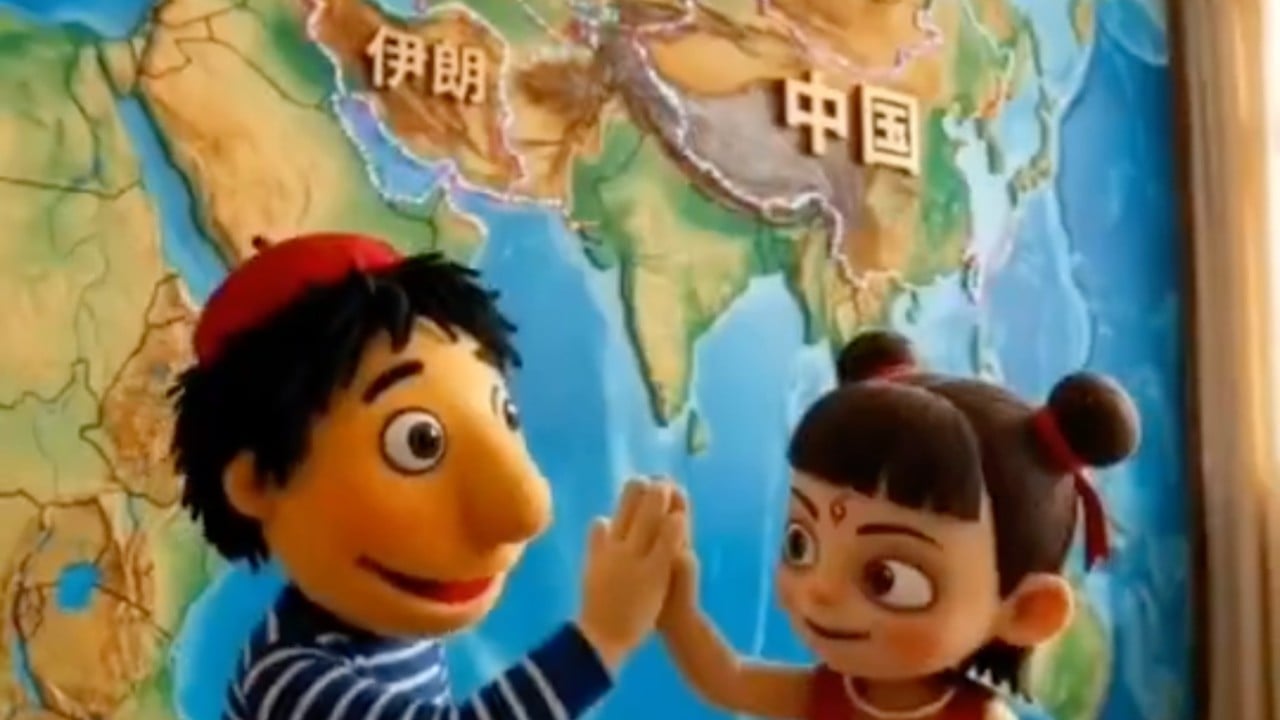
The convergence of Iranian state-produced media and Chinese digital consumption patterns represents a calculated bypass of traditional diplomatic discourse, utilizing the "Transgressive Viral Loop" to bridge disparate political cultures. When Iranian social media accounts deploy pop-culture imagery—specifically Western cinematic icons like Jack Sparrow or Chucky—to satirize American political figures, they are not merely engaging in humor. They are executing a high-leverage information operation that exploits the specific algorithmic vulnerabilities and nationalist sentiments of the Chinese internet. This strategy functions through three distinct operational pillars: cultural decoupling, the irony-shielded attack, and the alignment of adversarial interests.
The Architecture of Pop-Culture Weaponization
The efficacy of these videos rests on the deliberate use of Western intellectual property as a vehicle for anti-Western sentiment. By casting Donald Trump or other U.S. officials in roles derived from Hollywood, Iran creates a cognitive dissonance that serves two strategic functions. Meanwhile, you can explore other developments here: The Anatomy of Agrarian Vulnerability: Quantifying the EU Fertiliser Strategic Reserve Framework.
- Lowering the Barrier to Entry: Standard Iranian state propaganda often relies on religious or regional motifs that lack resonance in East Asia. Using globally recognized characters provides a universal visual shorthand that requires zero cultural translation for a Chinese viewer.
- The Subversion of Authority: Representing a superpower leader as a fictional villain or a buffoonish pirate strips the subject of "state-level" dignity. This shifts the conflict from a geopolitical dispute between nations to a memetic conflict where the rules of formal diplomacy do not apply.
These videos operate on a cost-function where the "Price of Production" is negligible compared to the "Reach of Distribution." Because the content is shared via platforms like Weibo and Douyin, it avoids the friction of official state-to-state communication. The Chinese audience views this content not as foreign policy, but as entertainment, which significantly increases the "Retention Rate" of the underlying political message.
The Mechanism of Selective Virality in China
The success of Iranian content in China is not accidental; it is facilitated by the structural alignment of the "Great Firewall" and the internal demand for nationalist content. The Chinese digital ecosystem operates under a "Sentiment Filter" that prioritizes content aligning with the state's narrative while filtering for high engagement. To see the full picture, check out the recent article by Al Jazeera.
Iranian digital actors exploit this by tailoring their output to fit the specific tropes favored by Chinese "Little Pinks" (nationalist youth). The logic follows a clear causal chain:
- Step A: Identify a shared geopolitical friction point (e.g., U.S. sanctions).
- Step B: Wrap the grievance in a high-engagement visual format (cinematic parody).
- Step C: Inject the content into the Chinese ecosystem during peak hours of nationalist discourse.
This creates an "Adversarial Synergy." Iran seeks to delegitimize the U.S. to a global audience, while Chinese social media platforms benefit from high-traffic content that reinforces domestic political alignments without requiring direct state attribution.
Quantitative Disparity and the Illusion of Organic Growth
While the competitor narrative focuses on these videos being an "online hit," a rigorous analysis must distinguish between organic popularity and "engineered visibility." The metrics of engagement—likes, shares, and comments—on platforms like Weibo are often influenced by "Traffic Boosting" (liuliang).
The visibility of Iranian jibes is a result of a "Sympathetic Environment." In a strictly moderated space, content that attacks a common rival is given a "Positive Friction" coefficient. It is allowed to spread with fewer restrictions than domestic political satire, leading to an inflated perception of its reach. This creates a feedback loop: as the content appears to go viral, more users engage with it to signal their own political alignment, further signaling to the algorithm that the content is high-value.
The Three Pillars of Transgressive Persuasion
To understand why a video of Donald Trump as a horror movie character succeeds where a diplomatic press release fails, we must look at the psychological mechanics of the "Transgressive Loop."
1. The Mask of Humor
Humor acts as a delivery system for radicalizing content. By framing an attack as a "joke" or a "jibe," the creator bypasses the reader's logical defenses. If the recipient laughs, they have already made a subconscious investment in the creator's perspective. This is the "Trojan Horse of Irony."
2. De-contextualized Aggression
Iranian state media strips the historical baggage of the Iran-U.S. relationship and replaces it with a simplified "Hero vs. Villain" narrative familiar to moviegoers. This makes the conflict accessible to a Chinese teenager who may not understand the intricacies of the JCPOA (Joint Comprehensive Plan of Action) but understands that a "Pirate" or a "Monster" is someone to be mocked or feared.
3. Algorithmic Opportunism
Platforms like Douyin (TikTok's domestic counterpart) are designed for rapid, high-impact visual consumption. The "Attention Economy" of these platforms penalizes nuance and rewards extremity. Iran's shift from long-form theological discourse to short-form cinematic parody is a direct adaptation to the technical constraints of modern social media.
Limitations and Strategic Risks
This strategy is not without its bottlenecks. Relying on Western pop culture creates a "Dependency Paradox." To mock the West, Iran must utilize the very cultural products (Hollywood films) that represent American soft power. This reinforces the global dominance of American imagery even as it seeks to subvert it.
Furthermore, there is a "Satire Ceiling." While these videos generate high engagement, they rarely translate into deep diplomatic influence. They are effective at "In-Group Signaling"—reminding allies of shared animosities—but they are ineffective at "Out-Group Conversion." A viewer might enjoy the mockery of a U.S. president without necessarily supporting Iranian foreign policy objectives.
The Friction Between State Narrative and Digital Chaos
The second limitation is the risk of "Uncontrolled Interpretation." Once a meme is released into the Chinese digital wild, the state loses control over its meaning. Users may repurpose the same satirical tools to mock other figures, including those Iran or China might wish to protect. This creates a "Double-Edged Sword" where the normalization of digital mockery lowers the overall threshold for political decorum, potentially destabilizing the very authorities that initiated the campaign.
The Strategic Path Forward: Institutionalizing the Meme
For state actors looking to replicate or counter this model, the move is to transition from "Spontaneous Viral Events" to "Systemic Narrative Design." This involves:
- Content Modularization: Breaking down political grievances into 15-second visual "modules" that can be easily repurposed by local influencers.
- Cultural Arbitrage: Identifying specific cultural niches within the target audience (e.g., Chinese gaming culture or anime fandom) and injecting political subtext into those specific aesthetic languages.
- Verification of Impact: Moving beyond "Vanity Metrics" (likes/shares) to measure "Sentiment Shift." True success is measured by the degree to which the satirical framing of a leader becomes the default public perception.
The current Iranian-Chinese digital nexus is a prototype for future asymmetric information warfare. It demonstrates that in a fragmented media environment, the ability to manipulate existing cultural symbols is more valuable than the ability to create new ones. The objective is no longer to win an argument, but to dominate the visual vocabulary of the opposition.
The final strategic move for analysts is to stop treating "viral videos" as mere cultural curiosities and start treating them as "Digital Kinetic Assets." In a conflict defined by perception, the one who controls the meme controls the "Baseline of Reality" for the next generation of digital natives. The transition from Jack Sparrow to Bride of Chucky is not a joke; it is a recalibration of the weapon of the weak for the age of the algorithm.