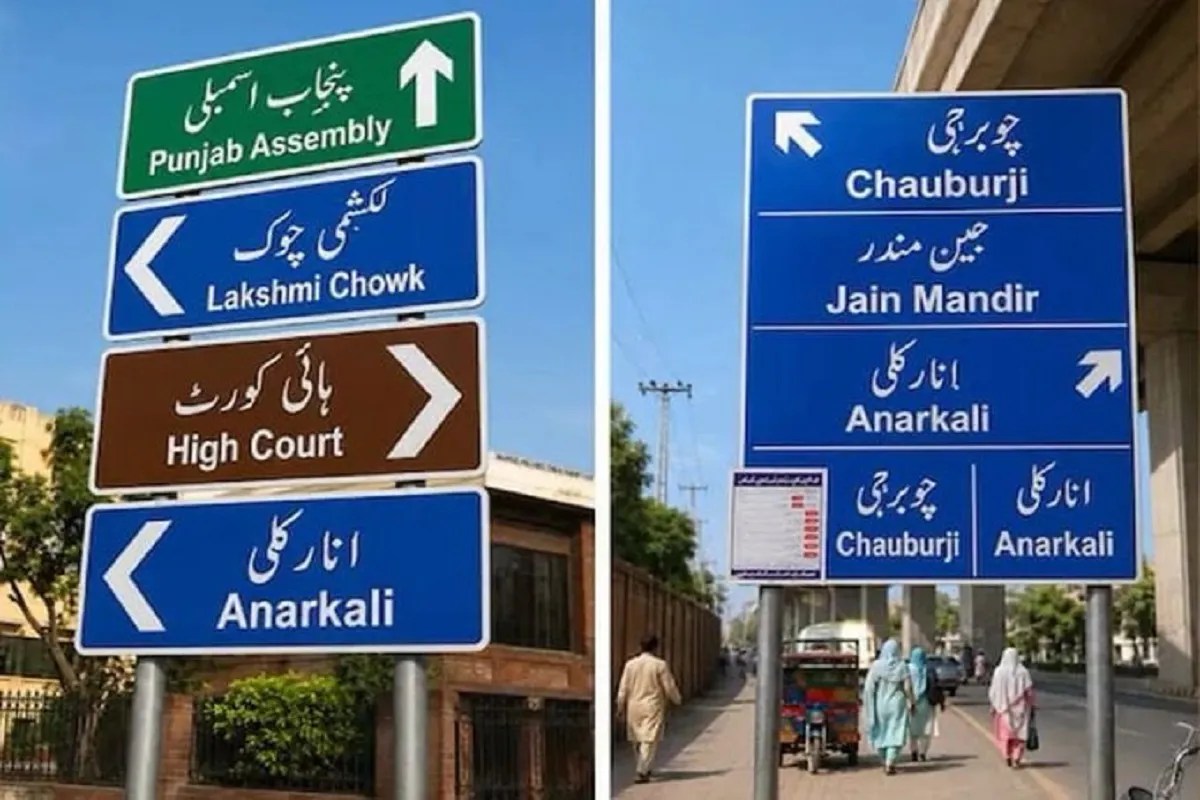
The physical geography of a city serves as a permanent ledger of its political hegemony. When the District Administration of Lahore initiated the reversion of colonial and post-Partition street names—restoring "Krishan Nagar" to Islampura and "Jain Mandir Chowk" to Babri Masjid Chowk—it executed a calculated recalibration of civic identity rather than a mere administrative correction. Urban toponymy, the taxonomy of place names, operates as a non-recurrent capital asset for state legitimacy. By altering these linguistic markers eight decades after the 1947 Partition, municipal authorities are participating in a broader structural shift: the transition from ideological homogenization to the preservation of historical real estate as a tool for international diplomacy and internal stability.
To evaluate the systemic impact of this renaming initiative, the process must be parsed through three distinct analytical lenses: the preservation of civic memory, the economics of religious tourism, and the mitigation of diplomatic friction.
The Mechanics of Toponymic Erasure and Restoration
Urban spaces are governed by a path-dependent evolution. When a state alters a place name, it attempts to break this path dependency to align physical infrastructure with contemporary political narratives. The post-1947 landscape of Lahore underwent systematic de-pluralization. Streets, squares, and neighborhoods bearing Hindu, Sikh, or British nomenclature were systematically overwritten to forge a mono-cultural identity.
This historic process operates on a binary mechanism:
- Systemic Obfuscation: The deliberate removal of minority identifiers from municipal maps, utilities, and legal registries to establish a singular national baseline.
- Narrative Substitution: The replacement of original designations with names tied to state-sanctioned historical figures, religious milestones, or ideological allies.
The reversion of Islampura back to Krishan Nagar reverses this lifecycle. The primary bottleneck in executing such a strategy is the friction between administrative mandates and organic civic habits. Generational memory acts as a counterweight to state-enforced toponymy; despite decades of official designation as Islampura, local populations frequently retained the usage of Krishan Nagar in colloquial commerce and navigation. The current administrative policy acknowledges this friction, formalizing vernacular reality into legal infrastructure.
The Economic Motive: Cultural Patrimony as an Asset Class
The restoration of pre-Partition nomenclature cannot be separated from the macroeconomic objectives of the state. Municipal rebranding acts as a precursor to infrastructure development aimed at unlocking value from religious tourism networks. The Kartarpur Corridor established a functional precedent: regional stability and hard currency inflows can be generated by granting access to heritage corridors.
[Toponymic Restoration] ──> [Enhanced Global Visibility] ──> [Inbound Heritage Tourism] ──> [Localized Capital Injection]
By officially reinstating Jain Mandir Chowk, the municipality establishes a geographic anchor point that signals historical pluralism to external observers. The value chain of this strategy depends on two operational variables:
- The Restoration of Physical Anchors: Rebranding a intersection requires corresponding capital expenditure to preserve or reconstruct the architectural artifacts associated with the name. Without the physical asset, the toponymic change loses its symbolic utility.
- Regulatory Credibility: International heritage frameworks require consistent institutional behavior. Reverting names is a low-cost, high-visibility signal of compliance with global cultural preservation standards.
This creates an infrastructure loop. The formalization of the name protects the site from commercial encroachment, stabilizing the surrounding real estate value and creating structured zones for targeted municipal development.
Diplomatic Leverage and Regional Reciprocity
On an international scale, urban nomenclature serves as a low-intensity diplomatic instrument. The renaming of Babri Masjid Chowk back to Jain Mandir Chowk occurs within a specific regional context, directly countering the aggressive toponymic revisions occurring elsewhere in South Asia.
This creates a strategic asymmetry. While neighboring states systematically remove Islamic and Mughal designations from their urban centers, the institutional restoration of non-Islamic names within Pakistan allows the state to claim the moral high ground in international forums such as the United Nations and UNESCO. The geopolitical utility of this move is maximized by its timing, presenting a calculated contrast to regional majoritarian trends.
The risk matrix of this strategy involves internal blowback. Reverting an Islamic designation to a Hindu or Jain alternative can trigger domestic ideological friction. The state mitigates this risk by framing the restoration not as a theological concession, but as an act of historic preservation and municipal regularisation. The administrative apparatus relies on the lapse of time—eight decades—to dull the immediate emotional volatility of the transition, leveraging the change as a sign of institutional maturity.
Institutional Limitations of Rebranding Frameworks
The execution of municipal renaming campaigns reveals distinct structural limitations that prevent them from being absolute solutions for civic integration.
First, administrative updates face a major bottleneck in bureaucratic synchronization. Changing a name on a central municipal ledger does not instantly update land revenue records, postal databases, digital mapping services, or commercial registries. This lag creates transactional friction within the local economy, increasing the time and cost required to verify property titles and navigate civil logistics.
Second, tokenistic nomenclature shifts can mask underlying systemic deficits. If the restoration of a minority place name is not accompanied by civil protections, resource allocation for heritage maintenance, and equitable urban planning, the policy yields diminishing returns. The symbolic capital gained internationally is quickly eroded if the physical site remains neglected or inaccessible.
The Strategic Path for Urban Heritage Optimization
To convert these toponymic adjustments into long-term civic and economic dividends, municipal authorities must move past symbolic announcements and implement a highly structured operational framework.
The immediate requirement is the digitalization of historical mapping layers. The Lahore Development Authority must integrate a chronological registry within its geographic information systems (GIS). This architecture must allow users to track the legal, cartographic, and administrative genealogy of any plot or thoroughfare across pre-colonial, colonial, post-Partition, and contemporary eras. This transparency reduces title disputes and provides a stable foundation for academic and commercial research.
Simultaneously, the physical intersections must undergo zoned infrastructure upgrades. Rebranding Jain Mandir Chowk necessitates a dedicated architectural conservation zone around the remnants of the historical temple. This zone must be optimized for pedestrian transit, security integration, and structured commercial zoning that prevents unregulated sprawl while accommodating high-density heritage tourism.
Finally, the policy must be insulated from shifting political cycles through legislative codification. If place names remain subject to the whims of alternating regimes, the resulting instability destroys institutional credibility and discourages long-term private investment in heritage corridors. The designation of these historic zones must be tied to independent statutory bodies governed by urban planners, historians, and legal experts rather than local political syndicates. Only through this institutional insulation can the streets of Lahore leverage their past to capitalize on future economic and diplomatic opportunities.