Pour a glass of water from the tap. Hold it up to the light. It looks pristine. Clear, cold, and entirely innocent. You drink it, trusting an ancient contract between civilization and safety. But that glass holds more than hydration. It holds the invisible dust of our modern lives.
Microplastics.
They are everywhere. They float in the air we breathe, ride the salt spray of the deepest oceans, and rest quietly in the tissue of human lungs and placentas. We built an empire out of indestructible polymers, and now those polymers are slowly, steadily digesting the planet back. We tried to filter them out before. Traditional municipal treatment plants catch a lot, but they miss the microscopic ghosts—the tiny fragments shed from synthetic clothes, degrading car tires, and fracturing packaging. These particles slip right through conventional municipal barriers, sliding into rivers, lakes, and eventually back into our kitchens.
Until now, the standard fix was expensive and exhausting. Advanced membrane systems clogged constantly. Chemical treatments introduced new pollutants to solve old ones. We were chasing our own tails, throwing energy at a problem that multiplied faster than we could shovel it away.
Then came the sludge.
Picture an ordinary water-treatment plant at the end of a long, grueling work week. Piles of residual sludge sit waiting for disposal—a grey, noxious byproduct of cleaning municipal water. To anyone else, it is garbage. A liability. A headache for plant managers who must pay to haul it off to landfills.
Researchers looked at that exact pile of useless muck and saw a skeleton key.
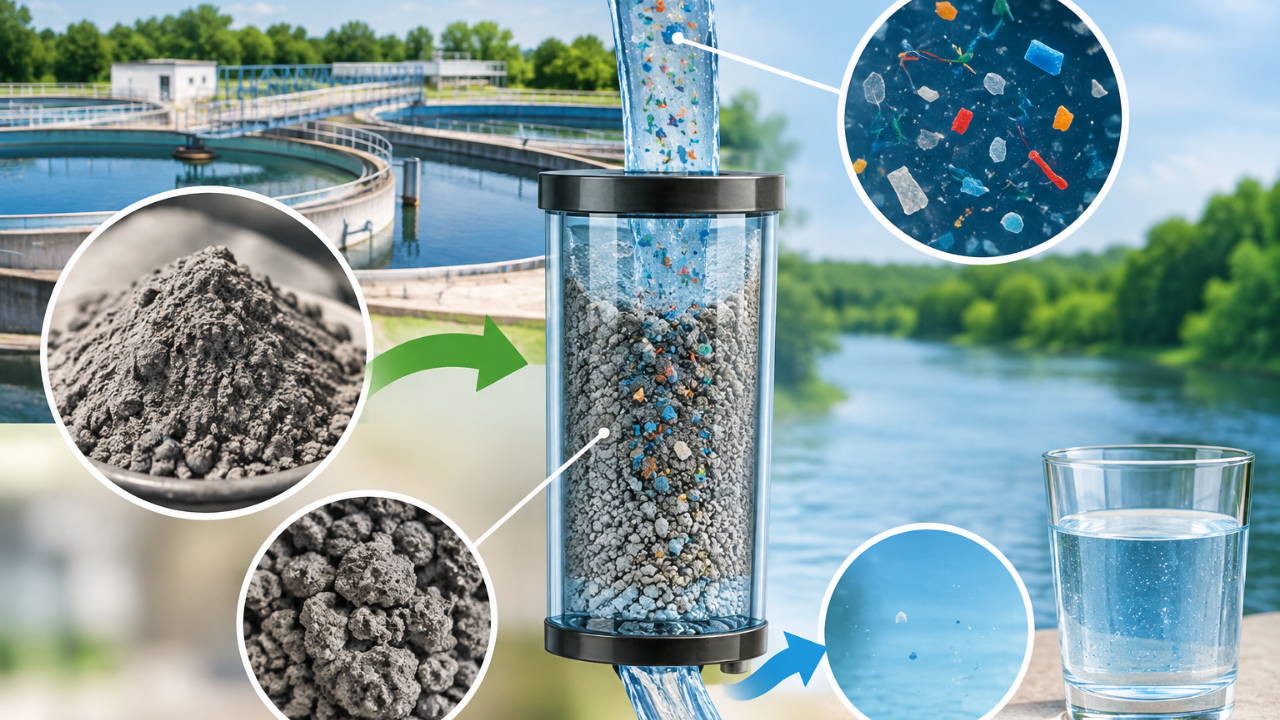
Through a precise, controlled process of carbonization, scientists discovered they could transform this unwanted water-treatment waste into a high-performance porous carbon filter. Think of it like baking bread, except the dough is heavy with trapped mineral ash and organic remnants from the cleaning process, and the oven reaches blistering, oxygen-starved temperatures. The resulting material looks like ordinary charcoal, but under an electron microscope, it resembles an impossibly dense, microscopic labyrinth.
It is a sponge designed at the molecular scale.
When water spiked with microplastics flows through this recycled carbon matrix, something remarkable happens. The labyrinth traps up to 97.1 percent of the stray particles. Fragments measuring mere micrometers—too small for sand filters, too stubborn for basic sediment screens—are snagged in the maze of pores.
Consider the poetry of this solution for a moment. We are taking the very waste produced by the act of cleaning water, upgrading it through thermal alchemy, and using it to catch the most insidious pollutant of our industrial age. It is a closed loop. A circular economy in the truest, most visceral sense.
We often talk about environmental repair as if it requires an entirely new planetary machinery—some gleaming, hyper-expensive space-age apparatus that costs billions and takes decades to build. We look for miracles in clean rooms. But sometimes the answer is sitting in a dumpster behind the municipal plant, waiting for someone to look past its ugliness.
The technology is not yet spinning in every city across the globe. Scaling lab-bench chemistry to handle millions of gallons of daily municipal flow requires engineering grit, capital, and time. Skeptics will point out that production costs must be ironed out, and pilot tests must prove durability under continuous, heavy loads. They are right to ask. Progress crawls at the speed of logistics.
Yet the proof of concept stands tall. It tells us that our waste streams are not dead ends. They are resource libraries.
Every time we turn on a faucet, we participate in a massive collective experiment. For generations, the byproduct of that convenience was a slow accumulation of synthetic poison in the wild. We traded durability for permanence, and permanence for pollution.
A handful of recycled sludge changes the arithmetic. It proves that we can outwit our own mess using the very refuse we generate. The ghost in our glass is finally starting to fade.