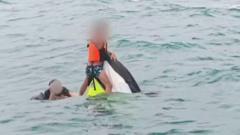
The air smells of salt, freezing mist, and ancient stone.
Standing at the edge of the floating dock in Churchill, Manitoba, the sub-arctic wind cuts straight through a heavy goose-down parka. It bites your cheeks. It freezes the moisture in your eyelashes. Your fingers lose feeling inside your gloves within minutes. You are cold. Profoundly, achingly cold.
Then the water beneath the surface breaks.
It does not splash with a violent crash. It exhales. A long, sharp rush of air cutting through the silence of the bay, followed by a sound that defies every expectation you hold about the ocean. It is a chirp. A high-pitched, resonant trill that echoes through the hull of the boat and rattles directly against your ribcage.
You look down.
A face is watching you.
It is chalk-white, stark against the dark, glacier-fed currents of the Churchill River. Two dark, expressive eyes study you with an eerie, intelligent curiosity. But it is the forehead that stops you cold. The bulbous, malleable melon shifts and ripples as the creature tilts its head. It smiles. Or at least, the anatomy of its curved jaw creates an uncanny, permanent grin that bridges the gap between two entirely different worlds.
This is the beluga whale. And if you have ever wondered what it means to truly bond with a wild marine mammal, you have to throw away every textbook definition of wildlife tourism.
Most people arrive here expecting a spectacle. They buy a ticket, step onto a Zodiac boat, and wait to be entertained. They want a National Geographic moment served on a silver platter. They want to check a box.
They are entirely unprepared for the intimacy.
Consider what happens next. The boat engine cuts. Silence descends, save for the slop of the tide against the fiberglass. The water around you begins to churn. Not with one whale, but dozens. Then hundreds. The western shore of Hudson Bay transforms into a shifting mosaic of white shapes during the brief summer thaw. Nearly sixty thousand belugas migrate into these shallow, warmer estuaries every year, escaping the heavy pack ice of the open Arctic and bringing their newborn calves into the safety of the river mouths.
They are known as the canaries of the sea.
Science tells us this because of their vocal range. They click, whistle, trill, and squeak in frequencies that carry for miles through the dense medium of water. When you dangle a hydrophone over the side of the boat, the audio monitor crackles to life like a CB radio tuned to an alien frequency. Static gives way to metallic chirps, rhythmic pulses, and high-pitched shrieks. It sounds like a crowded playground at recess, filtered through a deep-sea acoustic lens.
Listen closely.
That is not just noise. That is conversation. Belugas possess complex social structures that mirror our own in unsettling ways. They live in pods, form lifelong alliances, care for orphaned calves, and pass down cultural knowledge from generation to generation. A grandmother whale teaches her lineage where to feed, where to calve, and how to navigate the intricate labyrinth of the sub-arctic coastline.
When you make eye contact with one, you realize you are not the only observer in the equation. You are being audited.
I remember leaning over the gunwale on a breathless July morning, the water so glassy that the reflection of the sky blurred into the depths. A young beluga—scarcely older than a toddler, its skin a dark, slate-gray before fading into the characteristic adult white—detached from a pod of three. It glided directly beneath the boat, turned completely onto its back, and floated there.
It wanted belly rubs.
Now, every conservation instinct screams at you: do not touch wild animals. Keep your distance. Respect the boundary. And you should. The laws and guidelines governing marine mammal interaction are strict for a reason. Harassment is real. Stress is real. But this whale had other ideas. It rolled, blew a gentle cascade of bubbles against the hull, and drifted upward until its rubbery, surprisingly warm melon brushed lightly against the wooden keel.
It was an invitation. A tentative, cross-species handshake offered in the middle of nowhere.
How do we process that? How do we reconcile our modern, hyper-digital existence with an animal that has lived in the perpetual twilight of the Arctic for millions of years, yet chooses to swim alongside strangers with nothing more than pure, unadulterated curiosity?
The answer lies in our shared vulnerability.
We are fragile creatures, encased in Gore-Tex and fiberglass, shivering on the surface of a planet that is changing faster than the ice can melt. They are creatures of adaptation, navigating warming seas, industrial encroachment, and the slow, grinding shift of their ancient home. When a beluga looks up at you through three feet of sub-arctic water, it is looking at an ambassador of a world it doesn't quite understand. And we are looking at an anchor to a wilderness we are desperately trying not to lose.
People ask if these encounters change you.
They do. But not in the cinematic, life-altering way movies promise. It is quieter than that. It settles into your bones like the cold.
You return home to the hum of traffic, the glow of screens, and the frantic pace of daily obligations. But a part of your mind remains anchored to that freezing bay in northern Manitoba. You remember the sound of the blowhole venting into the crisp morning air. You remember the sudden, shocking flash of white beneath the dark waves.
And you realize that the world is much larger, much stranger, and infinitely more alive than our daily routines would ever suggest. Somewhere out there, beneath the northern lights and the shifting pack ice, the canaries are still singing.
And they are waiting for an answer.