Silence.
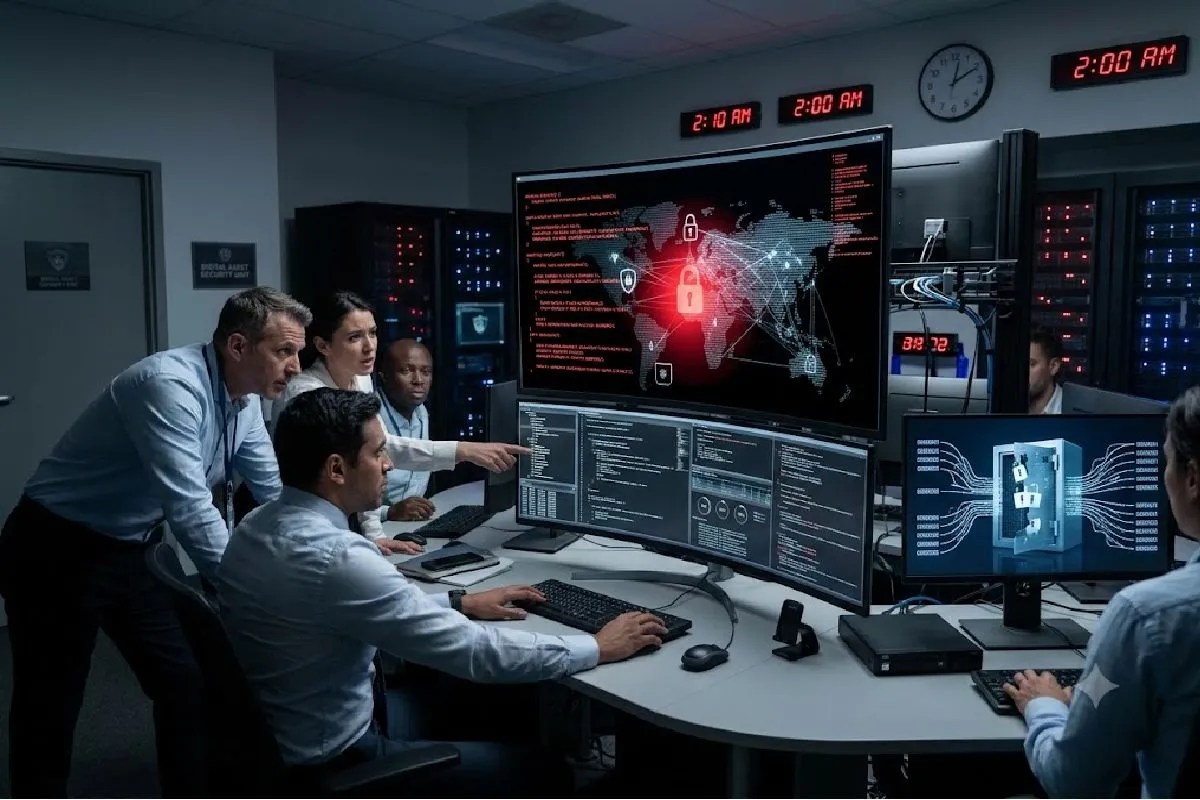
That is the first thing you notice when a digital fortune vanishes. There is no shattering glass, no wailing siren, no masked man sprinting toward a getaway car with canvas sacks slung over his shoulder. There is only the soft, indifferent hum of a cooling fan inside a laptop, the faint blue glow of a monitor reflecting off tired eyes, and a string of alphanumeric characters on a screen that suddenly reads zero. For a closer look into similar topics, we recommend: this related article.
I remember the first time I watched a live blockchain explorer during a major exploit. My coffee went cold in my hand. On the screen, numbers that represented the life savings of thousands of ordinary people—teachers, software engineers, retirees who had finally decided to trust the promise of decentralized finance—were moving like water down a drain. Every few seconds, another block confirmed. Another million dollars crossed an invisible border where no badge, no subpoena, and no swat team could ever follow.
You feel helpless watching it. You feel small. To get more background on this topic, in-depth coverage can also be found at Engadget.
When the Federal Bureau of Investigation officially pointed the finger at North Korea for the historic theft of billions of dollars tied to Binance and its ecosystem, the headlines treated it like another line item in the endless ledger of cybercrime. A record-breaking number. A familiar geopolitical villain. A brief spike in market anxiety before the tickers resumed their frantic blinking.
We have grown numb to the scale of digital theft. When someone says "billions," the human brain simply refuses to process the weight of it. To understand what actually happened when state-sponsored hackers breached the largest cryptocurrency exchange architecture in the world, we have to strip away the jargon of cryptographic hashes and liquidity pools. We have to look at the human architecture behind the code, and the terrifying reality that the world's most isolated regime has turned the open internet into its personal ATM.
The Architecture of an Invisible Bank Robbery
Imagine, for a moment, a hypothetical man named David. Let us place him in a cramped, sunlit apartment in Chicago. David is thirty-four, works in logistics, and spent four years carefully moving a portion of every paycheck into digital assets. He wasn't chasing meme coins or gambling on overnight riches. He trusted the platforms that looked like banks, acted like banks, and carried the sheen of institutional permanence.
Now, picture another room, seven thousand miles away, in a nondescript building in Pyongyang—or perhaps a quiet hotel room in Shenyang, China, where North Korean IT operatives frequently operate under false identities. There are no posters of cyber-warriors on the walls. There are young men who were plucked from their middle schools at age eleven because they showed an uncanny aptitude for mathematics. They were trained not to march with rifles, but to hunt for microscopic cracks in human psychology and software logic.
When the FBI attributes a heist of this magnitude to the Democratic People's Republic of Korea—specifically the notorious Lazarus Group and its sub-units like TraderTraitor—they are describing a collision between David’s quiet trust and a state-run machine engineered entirely around extraction.
To grasp how someone steals billions without picking a physical lock, consider how a cross-chain bridge or a high-volume exchange hot wallet functions. Think of it as an armored truck ferrying gold bars between two sovereign nations. Because the two nations use different currencies, the truck stops at a border station. You lock your gold in a vault on one side, and a trusted clerk hands you a paper receipt that lets you claim an identical amount of gold on the other side.
The hackers didn't blow up the armored truck. They didn't tunnel under the vault. Instead, they spent months studying the clerk. They learned when he got tired, how he verified signatures, and where the blind spots in his ledger lived. Then, through a mixture of social engineering—often disguised as lucrative job offers sent via LinkedIn or encrypted messaging apps to exhausted engineers—and patient code exploitation, they forged the clerk's stamp.
They walked up to the window and printed receipts out of thin air.
By the time the alarms tripped, the gold wasn't just gone. It had been melted down, recast into thousands of unrecognizable coins, and scattered across a labyrinth of decentralized exchanges and mixing protocols.
Why a Rogue Nation Needs Digital Gold
People often ask why a country that struggles to keep its own power grid lit at night possesses one of the most sophisticated cyber-offensive units on earth. The answer is brutally simple: desperation breeds precision.
Cut off from the global banking system by decades of crushing international sanctions, North Korea cannot easily sell coal, textiles, or seafood to fund its government or its ballistic missile program. Traditional money laundering requires shell companies, corrupt bankers, and physical borders—all of which leave paper trails that intelligence agencies in Washington, Seoul, and Tokyo have spent years mapping.
Cryptocurrency solved Pyongyang's greatest logistical headache.
A blockchain does not ask for a passport. It does not care if an IP address traces back to a sanctioned regime. When North Korean operatives siphon hundreds of millions—or, across cumulative breaches targeting Binance-linked infrastructure and connected bridges, billions—they are bypassing the entire global financial blockade in a single afternoon.
United Nations panels and federal investigators have tracked this pipeline with grim clarity. The stolen tokens are first split into thousands of microscopic transactions, bouncing between automated decentralized protocols like a pinball in a machine built of mirrors. From there, over-the-counter brokers in East Asia quietly convert the washed digital assets into hard currency—US dollars, yuan, euros—which then flow back into state coffers.
Every exploited smart contract, every compromised private key, every manipulated validator node translates directly into rocket fuel, guidance systems, and centrifuges. The distance between a retail investor's phone screen in Ohio and a launchpad on the Korean peninsula is measured in milliseconds.
The Human Weakness Inside the Machine
We love to believe that technology will save us from human fallibility. That is the founding myth of crypto: "Code is law." Remove the greedy middleman, replace fallible bankers with immutable math, and your money becomes untouchable.
Except math does not write itself. Tired, overworked, deeply human engineers write it.
Consider what happens when a brilliant developer—let's call her Sarah, a hypothetical senior security architect working remotely—receives an encrypted message from a recruiter claiming to represent a rival firm. The compensation package is life-changing. The technical interview involves downloading a seemingly benign coding challenge or reviewing a PDF outlining the role's architecture.
Sarah is smart. She runs antivirus checks. She looks for obvious red flags. Yet the file contains a zero-day exploit tailored specifically to her operating system, crafted by state-funded researchers who treat espionage like an Olympic sport. The moment she opens that document, a silent listener takes root in her machine. It doesn't crash her computer. It doesn't steal her personal photos. It simply waits, watching her keystrokes, learning the rhythm of her work, waiting for the exact moment she accesses a multi-signature wallet or pushes an update to a staging server.
This is how modern cyberwarfare actually looks. It is rarely a brute-force assault against impenetrable walls. It is a patient, psychological siege against the people holding the keys.
When Binance CEOs and security teams scrambled in the wake of massive breaches—most notably the $570 million exploit of the BNB Chain bridge in late 2022, alongside earlier and subsequent campaigns that federal investigators linked to Pyongyang's sprawling theft apparatus—they weren't fighting faceless machines. They were locked in a real-time chess match against human adversaries who knew every rule of the board and had zero intention of playing by them.
During the BNB bridge attack, the hackers successfully forged cryptographic proofs to mint two million BNB tokens out of nothing. The sheer speed of the response from validators, who temporarily halted the entire blockchain to freeze roughly $430 million before it could escape the network, prevented an even deeper catastrophe. Still, more than $100 million slipped through the cracks into the ether.
That pause—freezing a supposedly decentralized network to stop a state-sponsored thief—exposed the raw nerve at the center of modern finance. To save the money, the guardians had to prove they still controlled the switch.
The Illusion of Safety in an Open Network
If you hold assets on a major exchange or interact with decentralized protocols, the aftermath of an FBI attribution notice leaves a lingering, metallic taste in your mouth. What are you actually supposed to do with the knowledge that a nuclear-armed state has targeted your bank?
The honest answer is uncomfortable. There is no absolute immunity.
Security experts will tell you to move your holdings into cold storage—hardware devices disconnected from the internet, where private keys never touch a live browser. That advice is sound, yet it shifts the burden of survival entirely onto the individual. One misplaced seed phrase, one compromised firmware update, one moment of distraction while signing a malicious smart contract permission, and the fortress crumbles from the inside.
Meanwhile, the platforms themselves remain locked in an asymmetric war. A defender must patch ten thousand doors; an attacker only needs to find one window left unlatched on a humid Tuesday afternoon.
Federal law enforcement has grown remarkably adept at tracing these stolen funds. Agencies like the FBI and the Treasury Department's Office of Foreign Assets Control now routinely blacklist wallet addresses within hours of a breach, effectively branding stolen tokens with a digital scarlet letter. When a wallet is sanctioned, legitimate exchanges refuse to touch it, turning billions in stolen crypto into radioactive waste that hackers struggle to spend.
Yet the Lazarus Group adapts. Whenever investigators close one laundering avenue—whether by sanctioning mixing services like Tornado Cash or dismantling underground broker networks—North Korean operators pivot to cross-chain swaps, decentralized derivatives, and obscure liquidity pools. They treat law enforcement pressure not as a deterrent, but as an engineering constraint to be solved.
The Weight of Invisible Stakes
It is easy to treat these stories as distant spectacles—digital gladiators clashing in the cloud while we go about our lives. We read the FBI press release, marvel at the sheer audacity of a billion-dollar theft, and scroll on to sports scores or weather forecasts.
Pause for a second and feel the tremor beneath the surface.
Our entire modern existence—our power grids, our hospital records, our retirement accounts, our water treatment plants—runs on the exact same interconnected logic as those cryptocurrency bridges. The techniques perfected by North Korean hackers to drain digital vaults do not stay neatly quarantined inside the crypto sector. Every phishing lure refined, every zero-day vulnerability uncovered, every automated laundering pipeline built becomes a blueprint for the next target.
Today, it is an exchange's cross-chain bridge. Tomorrow, it is a regional clearinghouse, a defense contractor's logistics portal, or a municipal utility network.
Back in that quiet apartment in Chicago, our hypothetical investor David still checks his portfolio every morning before his coffee brews. The numbers are there, glowing faintly in the early light. He feels a flicker of relief each time the balance matches what he remembers from the night before. He has learned to keep his recovery phrases etched on steel plates hidden in a fireproof safe, far away from any Wi-Fi signal. He has learned to treat every unexpected email, every unfamiliar link, every too-good-to-be-true opportunity as a loaded weapon aimed at his front door.
He is safer now, though he has lost something that no software patch can ever restore: the quiet, effortless trust that the world's vaults are actually locked.
Somewhere across the Pacific, inside a room with no windows and rows of glowing monitors, someone is already typing the next line of code, waiting patiently for the rest of us to blink.