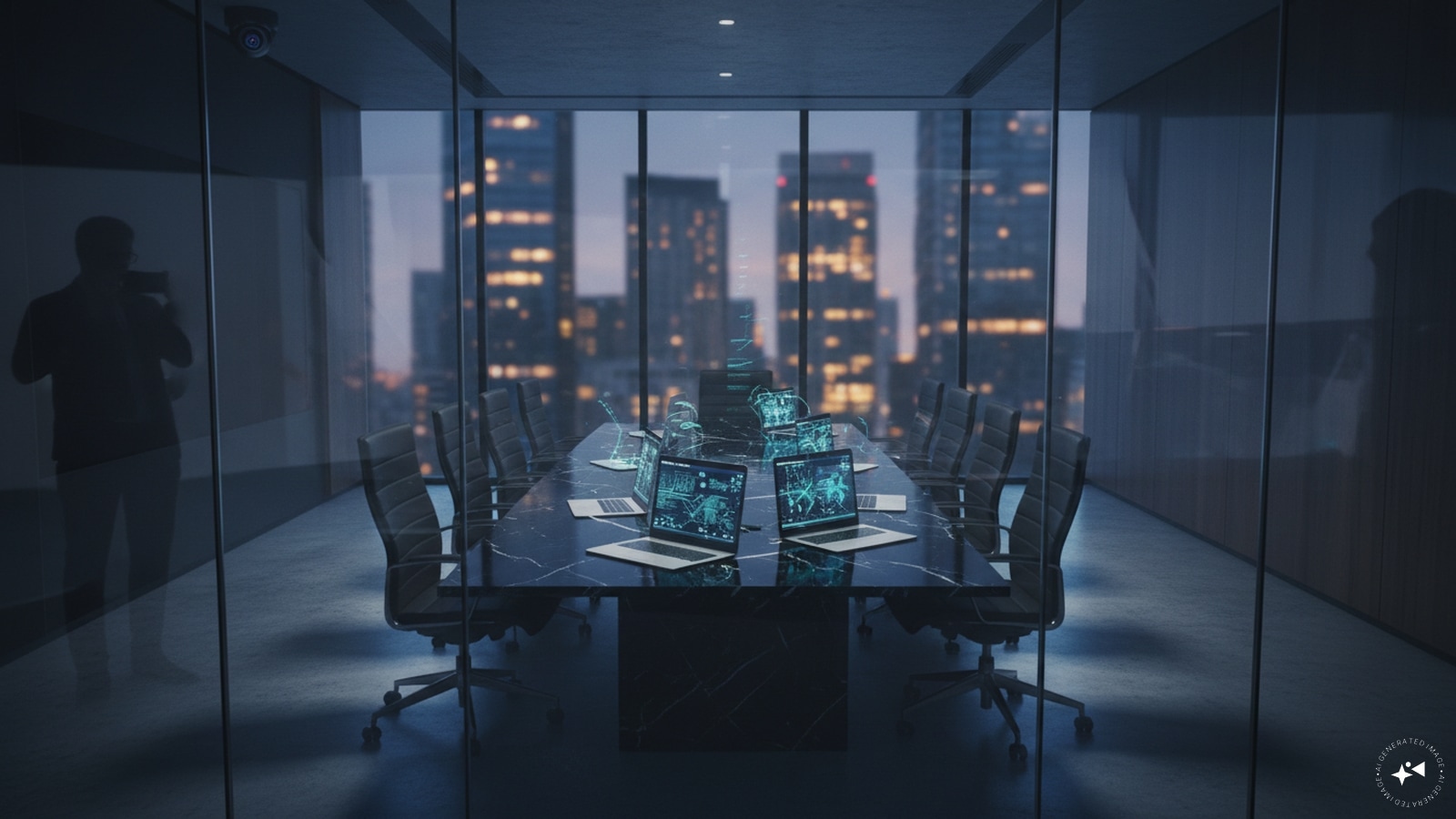
The fluorescent lights in a fourth-floor conference room in San Francisco hum at the exact same frequency as the ones in a windowless basement in McLean, Virginia.
I know this because I have sat under both. You learn to listen to the hum when you are waiting for someone to lie to you. For decades, the people who understood that sound best wore dull gray suits, carried badges that didn't match their passports, and spent their lives trying to figure out what a rival nation was building behind reinforced concrete walls. Today, those same people are wearing fleece vests, drinking iced oat lattes, and sitting three desks away from twenty-four-year-old machine learning engineers who have never once checked their rearview mirror on the drive home.
Silicon Valley has a spy problem. And to fix it, the brightest minds in artificial intelligence are hiring the ghosts of the Central Intelligence Agency, the National Security Agency, and the Federal Bureau of Investigation.
Wait. Stop and think about how strange that actually is.
For thirty years, the culture of Northern California tech was built on radical openness. Code was meant to be shared. Research papers were published on public servers before the ink was dry. The great heroes of the digital age were kids in hoodies who believed that information wanted to be free, and that anyone wearing a tie from Washington was a dinosaur trying to regulate a world they couldn't understand.
That era is dead. It didn't die with a press release. It died quietly, in the dark, the moment a few hundred gigabytes of mathematical weights became worth more than the gross domestic product of a small country.
The Architecture of a Modern Heist
To understand why a former CIA case officer is now deciding who gets badge access to a server farm in Oregon, you have to understand what is actually being stolen.
If you break into a bank vault, you leave with bags of cash. The vault is empty. Everyone knows a robbery took place.
If you steal the crown jewels of a frontier artificial intelligence lab, nothing looks different the next morning. The servers still blink green. The coffee machine still works. The engineers still show up at ten. Yet months of grueling, hundred-million-dollar compute runs—the exact mathematical parameters, known as model weights, that allow an AI to reason, code, or design proteins—have just been copied onto a server ten thousand miles away.
Let me paint a hypothetical picture to show how easily this happens.
Meet David. David is a fictional composite of a dozen real engineers working at top AI labs right now. He is brilliant, exhausted, and deeply proud of the work he does. On a Tuesday evening in Palo Alto, David gets a message on LinkedIn from a recruiter representing a boutique venture capital firm in Singapore. They love his paper on sparse attention mechanisms. They want to fly him out for a weekend symposium, all expenses paid, plus a twenty-thousand-dollar speaking honorarium.
David isn't a traitor. He has no intention of handing over his company’s source code. He goes to Singapore, eats incredible food, gives a forty-minute talk based strictly on public research, and answers questions over drinks afterward.
The people buying him drinks are charming. They flatter his intellect. They ask clever, seemingly innocent questions about the bottlenecks he faces when scaling clusters of ten thousand GPUs. David, feeling respected in a way his overworked manager rarely makes him feel, vents a little. He mentions a specific hardware workaround his team discovered three weeks ago—a tiny trick that shaved twenty percent off their training time.
He never sends a file. He never plugs a strange USB drive into his laptop. He just talks. And in doing so, he hands a foreign intelligence service a clue worth fifty million dollars in saved electricity and compute time.
This is called human intelligence collection, or HUMINT. It is as old as warfare itself, and against an industry trained to prize collaboration and open dialogue, it is devastatingly effective.
Why Firewalls Cannot Stop a Conversation
When Silicon Valley executives first realized they were being targeted by state-sponsored espionage, their instinct was to throw engineers at the problem. They bought better encryption. They hired penetration testers. They locked down their cloud environments.
It didn't work.
You cannot patch human vanity with a software update. You cannot write an algorithm that stops a lonely researcher from falling in love with someone who happens to report to a handler in Beijing or Moscow. Traditional cybersecurity is built to stop outsiders from breaking through digital walls. Espionage is designed to convince insiders to open the door from the inside.
Consider what happens when a tech company tries to handle this on its own. A typical corporate security director knows how to investigate an employee stealing laptop inventory or leaking customer credit card numbers. They do not know how to spot the subtle behavioral shifts of someone being groomed by a foreign intelligence service. They don't know how to run counter-surveillance in a five-star hotel lobby, or how to conduct a vetting interview that uncovers a hidden financial vulnerability without triggering a lawsuit from Human Resources.
So, the tech giants did the only logical thing. They went shopping in Langley.
Over the past two years, a quiet migration has drained senior talent from the American intelligence community straight into the executive suites of AI startups and tech titans. OpenAI, Anthropic, Google DeepMind, Meta, and Microsoft have all recruited veterans from the CIA, the NSA, and the Pentagon. These aren't just low-level security guards. They are former directors of counterintelligence, senior analysts who tracked nuclear proliferation, and operations officers who spent careers recruiting assets in hostile capitals.
Their mandate is simple, even if the execution is extraordinarily messy: turn open-concept campuses into hardened targets without destroying the creative magic that makes them valuable in the first place.
The Culture Clash on Sand Hill Road
I remember watching a former federal investigator try to explain "compartmentalization" to a group of senior software architects in Mountain View.
The investigator spoke calmly, explaining that going forward, engineers working on pre-training data would no longer have access to the Slack channels used by the team fine-tuning the final model. The reaction in the room wasn't anger. It was genuine bewilderment.
To an engineer, hiding information from a colleague feels like sabotage. How are you supposed to debug a complex system if you can't see how the pieces fit together? To an intelligence officer, letting everyone see everything is suicidal. If a single laptop is compromised, the entire enterprise falls.
This tension sits at the very heart of the new AI cold war.
Think of an AI lab like a glass house filled with alchemists. For years, the glass walls were the whole point—everyone could see everyone else's experiments, shout advice across the room, and build on each other's breakthroughs at blistering speed. Now, ex-spies have arrived with rolls of black paint and steel shutters. Every wall they cover makes the house safer from snipers in the trees, but it also makes it darker inside. The alchemists start bumping into each other. The work slows down.
The ex-intelligence officers know this. The good ones aren't trying to turn San Francisco into a military base. They understand that if they suffocate the culture, the best researchers will simply quit and walk across the street to a rival lab with looser rules.
Instead, they operate in the shadows of the company. They quietly scrub the public LinkedIn profiles of key researchers so foreign recruiters can't easily map out who holds the keys to the kingdom. They brief executives before international conferences on which hotel Wi-Fi networks are compromised and which "journalists" are actually intelligence collectors. They monitor anomalous data downloads—not with heavy-handed accusations, but with the patient, methodical observation of someone who has spent twenty years watching patterns emerge out of noise.
The Invisible Stakes
Why does any of this matter to someone who doesn't work in tech or intelligence?
Because the technology sitting on those servers isn't just another social media app or a slightly faster search engine. Frontier AI models are dual-use technologies in the purest, most terrifying sense of the phrase. The same mathematical architecture that can discover a cure for pancreatic cancer can also be fine-tuned to design novel pathogens or automate cyberattacks against a nation's power grid.
When the United States developed the atomic bomb during the Manhattan Project, the physical infrastructure required to build it was massive. You couldn't hide a uranium enrichment plant in a suburban basement. Intelligence agencies could track the movement of rare ores, massive electrical draws, and giant centrifuges from the sky.
Artificial intelligence leaves no such physical footprint. Once a frontier model is trained, the entire compressed intelligence of that system can fit onto a storage device smaller than a paperback book.
Let that sink in.
A breakthrough that required ten billion dollars in capital, three years of relentless research, and enough electricity to power a mid-sized city can be copied in minutes and smuggled out of a building in a pocket. If an adversary steals those weights, they don't just catch up—they skip the entire research phase, save billions of dollars, and immediately begin weaponizing the technology while the original creators are still arguing about safety guardrails.
This is why the FBI and the Department of Defense have quietly shifted their priorities. For decades, Washington worried about tech companies stealing consumer data or dodging taxes. Today, government officials regularly hold classified briefings in Silicon Valley boardrooms, warning founders that their companies are now prime targets for nation-state adversaries.
And when the government warnings weren't enough, the companies decided to bring the government's best hunters in-house.
Living Under the Microscope
There is a human cost to all of this, and it rarely makes the press releases.
Talk privately to researchers at leading AI labs right now, and you will hear a strange mix of pride and paranoia. Five years ago, these people were celebrated as visionary scientists solving the hardest problems in computer science. Today, many of them feel like state assets living in a gilded cage.
They undergo background checks that pry into their finances, their foreign travel, and their personal relationships. They are warned against speaking freely at academic dinners. Some have to leave their personal phones in Faraday bags before entering certain floors of their own office buildings.
I spoke recently with a researcher—let's call her Maya, changing her name and details to protect her privacy—who left one of the major labs last year. She didn't leave because of the money or the workload. She left because of the quiet, creeping weight of suspicion.
"You start looking at your own coworkers differently," she told me over coffee in a noisy cafe where she still instinctively angled her screen away from the window. "When someone asks you how your experiment went, you pause for half a second to wonder if they're actually cleared to know. You realize you aren't working at a startup anymore. You're working at a defense contractor that just happens to have free kombucha."
Maya isn't naive. She knows the threats are real. She saw the internal security bulletins detailing the relentless stream of phishing attacks, fake job offers, and mysterious drone sightings over data centers. She understands why the ex-CIA officers are there.
Still, she misses the innocence. Most of them do.
The New Great Game
History has a habit of repeating itself, just with better hardware.
In the 1950s and 1960s, the aerospace and defense contractors of Southern California went through this exact transformation. Engineers who had spent the war years tinkering in makeshift hangars suddenly found themselves surrounded by clearance badges, polygraph machines, and former OSS officers guarding the blueprints to supersonic jets and spy satellites.
Silicon Valley thought it was immune to that history. For a generation, tech founders convinced themselves that code existed in a borderless utopia, floating above the messy, violent realities of geopolitics. They believed that markets and algorithms would naturally bind the world together, making old-fashioned espionage obsolete.
They were wrong.
Geopolitics didn't disappear. It just waited until Silicon Valley built something worth stealing.
Now, the two worlds have collided in the quiet hallways of San Francisco and Seattle. The former spies bring discipline, skepticism, and a hard-earned understanding of human nature at its worst. The engineers bring imagination, speed, and a relentless drive to build what has never existed before.
Neither side fully trusts the other, and neither can survive without the other.
Late at night, after the coders have finally packed up their backpacks and headed for the train, the former intelligence officers stay behind. They walk the empty floors, checking the badge logs, reviewing the network anomalies, and scanning the dark horizon for threats that don't have names yet. Outside, the fog rolls in off the Pacific, wrapping the glass towers in a thick, silent gray—just like a winter morning along the Potomac.