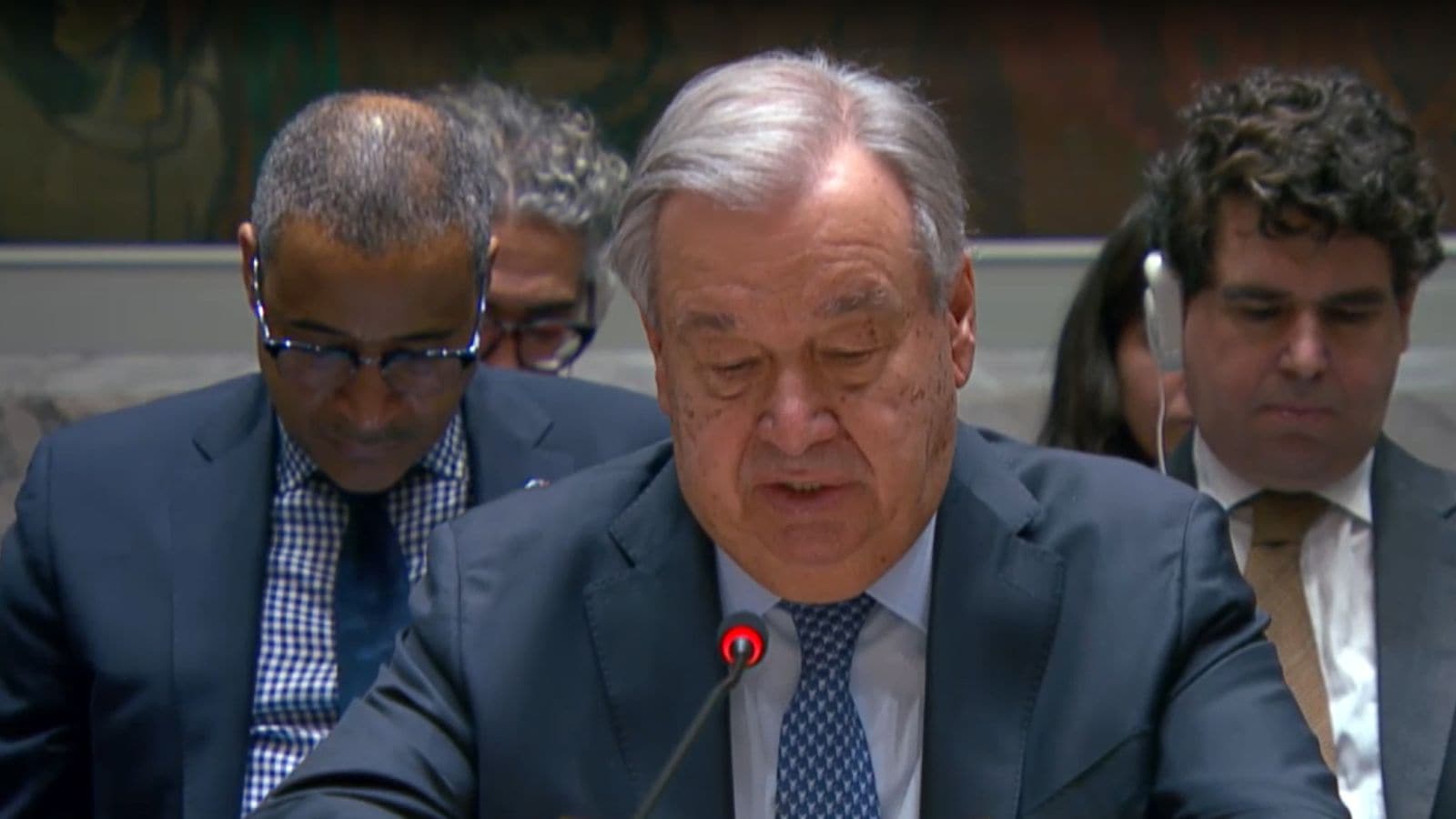
The air inside the United Nations Security Council chamber has a specific weight. It isn’t just the oxygen-starved dryness of a room sealed against the chaos of Manhattan; it is the physical pressure of words that carry the power to move carrier groups or silence artillery. When the heavy wooden doors swing shut, the roar of the city vanishes. Outside, a yellow taxi honks at a bicycle messenger. Inside, a diplomat from a small nation adjusts his glasses, his hands trembling slightly as he looks at the green light on his microphone.
This is where the math of survival happens.
When tensions between the United States and Iran spike—when a drone is downed, a tanker is seized, or a shadow war creeps into the light—the world looks at the UN as if it were a massive, slow-moving machine. We see the televised hand-raising and the translated speeches. But the reality is far more intimate and far more terrifying. It is a room full of people trying to stop a clock that is ticking toward a midnight no one wants to see.
The Anatomy of a Shudder
Consider a hypothetical family in a coastal city. Let’s call them the Amiris. They are not politicians. They are not soldiers. They are people who wake up, brew tea, and wonder if the price of bread will double by Tuesday. To them, "rising tensions" isn't a headline; it's a vibration in the floorboards. It is the sound of a phone ringing at 3:00 AM.
When the US and Iran square off, the UN doesn’t just "react." It breathes. The Secretary-General releases a statement, and to the casual observer, the language seems frustratingly neutral. Words like restraint, de-escalation, and dialogue are tossed around like life jackets in a storm.
But look closer at the mechanics of that neutrality. The UN acts as the world’s only official pressure valve. In the halls of the Secretariat, diplomats from both sides—often men and women who cannot be seen eating lunch together—pass each other in the corridors. They exchange nods. They exchange "non-papers," those unsigned, unofficial documents that allow governments to say things they aren’t yet ready to put on letterhead.
This is the invisible architecture of peace. It is built out of coffee, whispered side-bars, and the desperate hope that a typo doesn't start a fire.
The Geometry of the Table
The Security Council is a circle, and that shape is intentional. There is no head of the table. In times of crisis, the US and Iranian representatives (when the latter is invited to speak) occupy the same visual plane.
When the US presents evidence—satellite imagery of a missile site or debris from a sea mine—the room becomes a courtroom where the jury is the entire planet. The Iranian delegation counters with talk of sovereignty and "maximum pressure" campaigns. To the outside world, this looks like a stalemate. To those inside the room, it is a way to keep the conflict verbal rather than ballistic.
Every minute spent arguing in the Glass House on First Avenue is a minute that a commander in the Persian Gulf isn't giving the order to fire. We often mock the UN for its bureaucracy, for its endless committees and its penchant for "expressing deep concern." Yet, when the choice is between a dry speech and a wet deck on a sinking ship, the speech is a miracle.
The Ghost at the Feast
The most powerful person in the room is often the one who isn't there: the ghost of history.
In the corridors, veterans of the 1979 revolution rub shoulders with those who remember the 1953 coup. The tension isn't just about current events; it’s a ledger of grievances that spans generations. The UN’s job is to act as a collective memory, reminding everyone that we have been to the brink before and that the view from the edge is never worth the climb.
The "reaction" we see in the news—the formal meetings, the emergency sessions—is only the tip of the iceberg. Beneath the surface, the UN’s specialized agencies are scrambling. The International Atomic Energy Agency (IAEA) is the world’s nuclear locksmith. Their inspectors are the ones who actually go into the heart of the facilities, wearing blue vests and carrying Geiger counters.
Think about the courage it takes to be an inspector in a high-tension zone. You are the human buffer. If you find something, you trigger a crisis. If you miss something, you risk a catastrophe. These are the people the UN sends into the gap when the rhetoric gets too loud. They aren't interested in the politics of Washington or Tehran; they are interested in the isotopes.
The Price of a Cold Shoulder
There is a human cost to the diplomatic dance. When the UN fails to find a consensus, the vacuum is filled by sanctions and isolation.
Consider a nurse in a hospital in Isfahan. She knows that because of the geopolitical chess game being played in New York, the specialized medicine her cancer patients need is stuck at a border, caught in a web of financial red tape. She doesn't care about "strategic pivots" or "regional hegemony." She cares about the empty vials.
The UN’s reaction to US-Iran tensions is often a frantic attempt to carve out humanitarian corridors within the wall of sanctions. It is a battle of logistics played out in the dark. The UN’s "reaction" isn't just a vote; it’s a plea to remember the nurse, the student, and the shopkeeper who have no say in the missiles being moved across the map.
The Weight of the Gavel
I remember watching a session during a particularly dark week of escalation. The room was silent. You could hear the hum of the air conditioning. The President of the Council—a role that rotates monthly—struck the gavel. It’s a small, wooden sound. It shouldn't be able to stop a war.
But for that moment, everyone in the room had to acknowledge a shared set of rules. That is the true power of the institution. It is the only place where the most powerful nation on Earth and one of its most defiant adversaries are forced to use the same vocabulary of international law.
Critics say the UN is toothless. They aren't entirely wrong. It has no army of its own. It cannot force a superpower to do anything it doesn't want to do. But what it does have is the power of the spotlight. When the UN "reacts," it drags the shadow war into the light. It forces the world to look.
The Long Night in the Secretariat
As night falls over the East River, the lights in the upper floors of the UN building stay on.
Down in the lounges, the diplomats are tired. They have been debating the phrasing of a resolution for ten hours. They are arguing over whether to use the word condemns or deplores. It seems like a ridiculous distinction—a linguistic game while lives hang in the balance.
But that word choice is the difference between a country losing its trade status or just getting a formal reprimand. It is the difference between an escalation and a pause. These people are the world’s professional delayers. They are the ones who buy us time.
And time is the most precious commodity we have.
When we read about the UN’s reaction to the latest flare-up in the Middle East, we shouldn't just look for a winner or a loser. There are no winners in a collision between two powers of this magnitude. There is only the preservation of the status quo, which, in the world of high-stakes diplomacy, is a massive victory.
The UN is a mirror. It reflects the world exactly as it is: fractured, stubborn, and desperately afraid of its own shadow. Its reactions are not the solution to the US-Iran conflict; they are the container in which the conflict is held so that it doesn't spill over and drown the rest of us.
The Amiris, that hypothetical family waiting for the tea to boil, will likely never know the name of the junior diplomat who stayed up all night to ensure a resolution was worded just vaguely enough to be signed. They won't know about the frantic phone calls made from the basement of the Secretariat to a capital halfway around the world.
They will only know that the morning came, the bread was still there, and the sky remained empty of planes.
The gavel falls. The doors open. The diplomats step out into the humid New York night. They check their phones. They hail taxis. And tomorrow, they will come back to the glass house and start the math of survival all over again.